
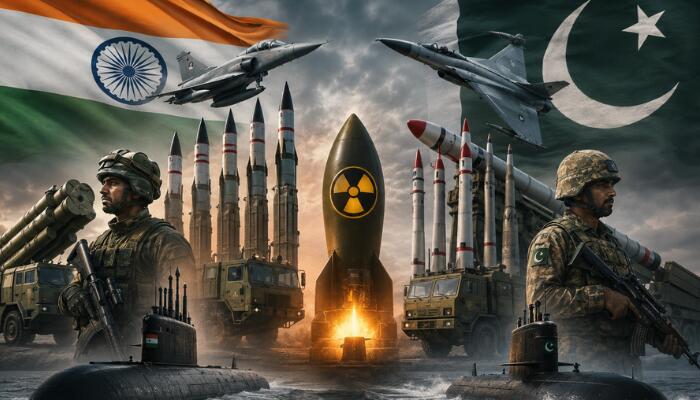
Pakistan-sponsored terrorists killed at least 26 civilians in Jammu and Kashmir’s Pahalgam on 22 April, sharply escalating tensions between India and Pakistan. India responded with several retaliatory measures, including suspending the Indus Waters Treaty. Military activity also intensified across the region. As speculation over possible Indian military action grew, Pakistan repeatedly referred to its nuclear arsenal. This triggered global concern over a possible nuclear confrontation between the two neighbours.
The rising tensions have once again drawn attention to the nuclear strength of both countries and the major differences in their nuclear doctrines.
How Many Nuclear Weapons Exist in the World?
A 2025 report by the Stockholm International Peace Research Institute (SIPRI) stated that nine countries possessed around 12,121 nuclear weapons at the beginning of 2024. These countries include the United States, Russia, the United Kingdom, France, China, India, Pakistan, North Korea and Israel. Around 9,585 weapons were considered potentially operational. Nearly 3,904 warheads were deployed with active military forces.
SIPRI noted that the decline in global nuclear weapons mainly resulted from the United States and Russia dismantling retired warheads. However, both countries continue to modernise their nuclear systems, missiles, aircraft, submarines and production facilities. Together, they account for almost 90 per cent of the world’s nuclear arsenal.
The Federation of American Scientists (FAS) estimated that the world possessed around 12,331 nuclear weapons by early 2025. The organisation also stated that the pace of reduction has slowed considerably compared to previous decades.
India’s Nuclear Capability
India’s nuclear capability is considered stronger and technologically more advanced than Pakistan’s in several areas. SIPRI estimated that India possessed 172 nuclear weapons at the beginning of 2024, up from 164 in 2023. The report stated that Pakistan remains central to India’s deterrence strategy. However, India has increasingly focused on longer-range systems that can also target China.
India can launch nuclear weapons through aircraft, land-based missiles and nuclear-powered ballistic missile submarines. The Indian government rarely discloses details regarding its nuclear arsenal publicly. FAS estimated that India would possess around 180 nuclear bombs in 2025.
Pakistan’s Nuclear Capability
Pakistan has steadily expanded its nuclear programme over several decades, although the growth of its arsenal has slowed in recent years. SIPRI estimated that Pakistan possessed 170 nuclear weapons at the beginning of 2024. The number remained unchanged from 2023.
Pakistan can deploy nuclear weapons through aircraft, ballistic missiles, cruise missiles and sea-based systems. Islamabad has never officially disclosed the size of its nuclear stockpile. According to FAS estimates, Pakistan continues to possess around 170 nuclear bombs in 2025.
India’s Nuclear Doctrine
India conducted its first nuclear test on 18 May 1974 in Pokhran, Rajasthan. The country named the test “Smiling Buddha”. India described it as a peaceful nuclear explosion. However, India formally declared itself a nuclear weapons state only in 1998 after conducting five tests under the Pokhran-II series, also known as “Operation Shakti”.
India adopted a “No First Use” (NFU) policy in 1999. The Cabinet Committee on Security reaffirmed the doctrine in 2003. India’s nuclear policy focuses on maintaining a “credible minimum deterrent”. In simple terms, India seeks enough nuclear capability to discourage adversaries from launching an attack.
Under the doctrine, India pledges that it will not initiate a nuclear strike. It reserves nuclear weapons only for retaliation after a nuclear attack on India or its armed forces. India also states that any retaliation would inflict unacceptable damage on the aggressor. The doctrine further says India will not use nuclear weapons against non-nuclear states. However, India reserves the right to respond with nuclear force if another country launches a major chemical or biological attack.
Pakistan’s Nuclear Doctrine
Pakistan conducted its first nuclear tests on 28 May 1998 in the Ras Koh Hills of Chagai, Balochistan. It named the tests “Chagai-I”. Two days later, Pakistan carried out another series called “Chagai-II”. Scientists Munir Ahmad Khan and Abdul Qadeer Khan played major roles in developing Pakistan’s nuclear programme. Abdul Qadeer Khan significantly contributed to uranium enrichment technology.
Unlike India, Pakistan has never formally declared a detailed nuclear doctrine. However, it reserves the right to use nuclear weapons first during conflict. Pakistan does not follow a No First Use policy. Analysts largely attribute this to Islamabad’s perception that its conventional military strength remains weaker than India’s.
At the same time, Pakistan has supported several United Nations initiatives that assure non-nuclear states it would neither use nor threaten nuclear weapons against them.
How Can India Launch a Nuclear Strike?
India possesses several fighter aircraft capable of carrying nuclear weapons. These include the Mirage 2000H, Jaguar IS and Rafale. SIPRI estimated that India had around 48 nuclear gravity bombs designated for aircraft delivery by January 2024.
India’s Strategic Forces Command also operates several nuclear-capable ballistic missiles. These include the short-range Prithvi-II and Agni-I missiles, the medium-range Agni-II, and the intermediate-range Agni-III and Agni-IV systems. SIPRI estimated that India possessed around 80 operational ballistic missiles by January 2024.
India also maintains a sea-based nuclear deterrent. Experts believe the country possesses between four and six nuclear-powered ballistic missile submarines. These include INS Arihant and INS Arighat. According to SIPRI, satellite imagery suggests that each submarine contains a four-tube vertical launch system capable of carrying up to 12 K-15 submarine-launched ballistic missiles, now designated B-05.
Pakistan’s Nuclear Options
Like India, Pakistan also possesses land, air and sea-based nuclear delivery systems. Its nuclear-capable aircraft reportedly include the Mirage III, Mirage V, F-16 and JF-17 fighter jets. SIPRI stated that the Mirage III and possibly the Mirage V remain the most likely nuclear delivery aircraft. However, the JF-17 may assume that role in the future.
Pakistan is estimated to possess around 125 short- and medium-range missiles. Its arsenal includes the Abdali, Ghaznavi, Shaheen-I/IA and Nasr short-range ballistic missiles. It also operates the Ghauri and Shaheen-II medium-range systems.
Pakistan also possesses the longer-range Shaheen-III missile, which reportedly has a range of approximately 2,750 kilometres. In October 2023, Pakistan tested the Ababeel missile. The missile uses MIRV technology and can carry multiple independently targetable warheads.
Islamabad has also attempted to establish a nuclear triad. As part of this effort, Pakistan tested the Babur-3 submarine-launched cruise missile. The system aims to provide nuclear capability to the Pakistan Navy’s Agosta-90B diesel-electric submarines.
Conclusion
India and Pakistan possess roughly similar numbers of nuclear weapons. However, experts believe India’s arsenal remains more advanced in sophistication, reach and destructive capability.
The two countries also follow sharply different nuclear strategies. India presents itself as a restrained nuclear power through its No First Use doctrine and emphasis on minimum deterrence. Pakistan, meanwhile, keeps the option of first nuclear use open because of its perceived conventional military disadvantage against India.
These differences make South Asia one of the world’s most sensitive nuclear flashpoints, where even limited military escalation could produce catastrophic consequences.