
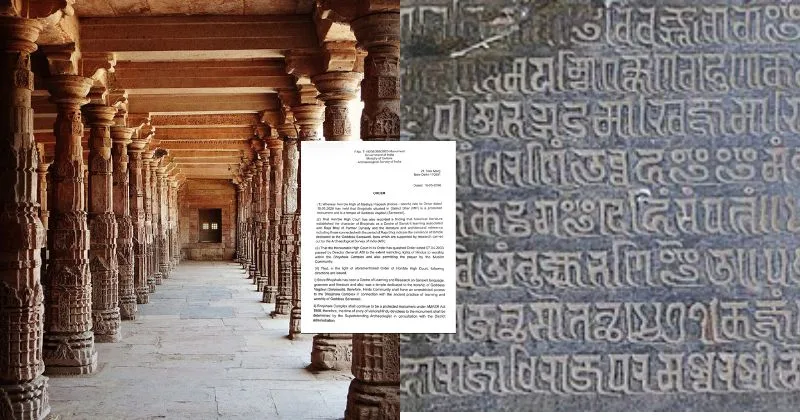
Following a definitive ruling by the Madhya Pradesh High Court, the Archaeological Survey of India (ASI) has officially restored unrestricted daily worship rights to the Hindu community at the disputed Bhojshala complex in Dhar. Moving swiftly to implement the judicial directive, the ASI nullified its previous April 2003 order, which had structurally divided access to the monument between two communities on separate days of the week.
ASI has passed order in compliance of order passed by the Hon’ble High court. Now the Hindu community has unrestricted access to Bhojshala complex. pic.twitter.com/mbddiKVxmA
— Vishnu Shankar Jain (@Vishnu_Jain1) May 16, 2026
In its new directive, the ASI explicitly recognized the site’s deep-rooted historical legacy as a premier center of learning, grammar, and research for the Sanskrit language, fundamentally intertwined with the ancient worship of Goddess Saraswati. Consequently, the restrictive schedules have been permanently replaced with open, daily access for Hindu devotees.
High Court Overturns the 2003 Arrangement
The legal shift traces back to the High Court’s decisive Friday verdict, which conclusively set aside the 2003 arrangement. Under that older framework, Hindus were permitted to perform puja only on Tuesdays and during Basant Panchami, while the Muslim community was granted exclusive rights to offer Friday namaz.
The division bench comprising Justice Vijay Kumar Shukla and Justice Alok Awasthi noted that the 2003 order unduly restricted Hindu religious rights. Relying heavily on a comprehensive, 2,000-page scientific survey conducted by the ASI using carbon dating and advanced architectural analysis, the court determined that the existing structure was built heavily from the repurposed components of a pre-existing 11th-century temple complex erected by King Bhoj of the Parmar dynasty.
Jubilant Devotees Gather for Daily Rituals
Following the official announcement, numbers of Hindu devotees and members of the Bhoj Utsav Samiti gathered at the complex to perform Vedic rituals and recite the Hanuman Chalisa. For the first time in over two decades, entry restrictions and special fees for daily darshan were completely waived.
#WATCH | Hindu devotees are reciting the Hanuman Chalisa at the Bhojshala Complex in Dhar.
Yesterday, the Madhya Pradesh High Court declared the complex a mandir and granted the Hindu side the right to worship at the site. pic.twitter.com/0Lk1IlDz6h
— Organiser Weekly (@eOrganiser) May 16, 2026
However, representatives of the Maulana Kamaluddin Welfare Society, who led the Muslim side during the 36 days of regular hearings, have voiced strong disagreements, labeling the underlying survey report as biased.
Maulana Kamaluddin Welfare Society approached Supreme Court against the HC’s survey order
Supreme Court issued notice but refused to stay the survey. It directed that no physical excavation altering the site’s character should take place and no action should be taken on survey…
— STAR Boy TARUN (@Starboy2079) May 15, 2026
As the Muslim side prepares to challenge the High Court’s decision in the Supreme Court, advocates representing the Hindu petitioners have already filed a caveat in the apex court, demanding a fair hearing before any stay orders are considered.