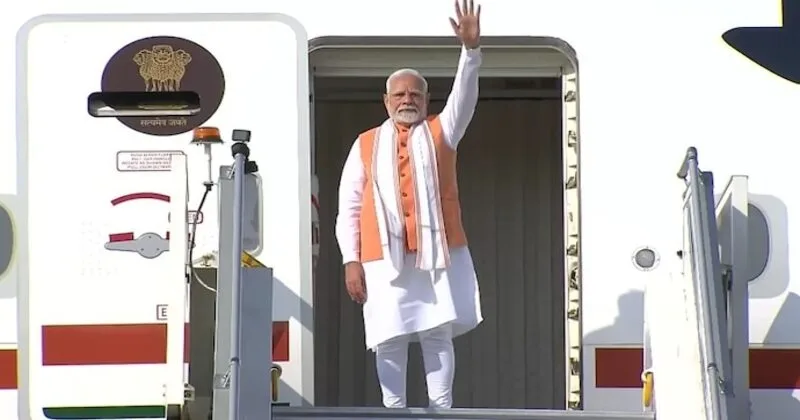
Prime Minister Narendra Modi visited the United Arab Emirates on May 15, 2026 and held talks with UAE President Mohamed bin Zayed Al Nahyan. The visit highlighted the growing momentum of the India–UAE Comprehensive Strategic Partnership, with both sides reaffirming their commitment to deepen cooperation across strategic, economic, technological, energy, and people-centric sectors.
India and the UAE share historically rooted ties shaped by centuries of maritime trade, cultural interaction, and vibrant people-to-people exchanges across the Arabian Sea. Trade in pearls, dates, spices, textiles, and fishery products connected western India with the Gulf region long before the modern era, laying the foundation for enduring civilisational linkages.
Diplomatic relations were formally established in 1972 with the opening of embassies in Abu Dhabi and New Delhi. Bilateral ties acquired renewed strategic depth following Prime Minister Narendra Modi’s landmark 2015 visit to the UAE—the first by an Indian Prime Minister in more than three decades. Since 2014, Prime Minister Modi has visited the UAE seven times, while President Mohamed bin Zayed Al Nahyan has made five visits to India, reflecting the increasing intensity of high-level political engagement. During this period, cooperation has expanded significantly across trade, investment, energy, infrastructure, technology, defence, digital innovation, and connectivity initiatives.
During the visit, Prime Minister Modi interacted with the large Indian diaspora in the Gulf and appreciated its role as a living bridge between the two countries. The Indian community has contributed significantly to strengthening mutual understanding, preserving cultural linkages, and enhancing bilateral goodwill. The close personal rapport between Prime Minister Modi and President Mohamed bin Zayed Al Nahyan reflects the growing warmth and trust in bilateral relations, as well as the increasing acceptance and appreciation of Indian culture in the UAE. Alongside major economic and connectivity initiatives, both leaders also emphasised deeper collaboration in cultural exchange, education, innovation, and knowledge partnerships.
The visit marks another important milestone in the expanding India–UAE partnership. The outcomes span several strategic sectors and reflect the growing convergence of economic, geopolitical, and technological priorities between the two countries. These initiatives are expected to strengthen long-term economic resilience, technological cooperation, energy security, and regional connectivity.
A major outcome of the visit was the Memorandum of Understanding on strategic collaboration between Indian Strategic Petroleum Reserves Limited and Abu Dhabi National Oil Company. The agreement is expected to reinforce India’s energy security by deepening cooperation in the hydrocarbons sector and ensuring stable access to critical energy resources. It will strengthen India’s Strategic Petroleum Reserves framework and enhance resilience against global supply disruptions and volatility in international energy markets. The partnership is also expected to open new avenues for cooperation in Liquefied Natural Gas (LNG) and Liquefied Petroleum Gas (LPG) storage infrastructure, supporting India’s efforts to diversify energy sources and expand storage capacity. In addition, the proposed framework for a Strategic Defence Partnership will strengthen defence industrial cooperation through joint ventures, co-development initiatives, technology collaboration, and greater industry participation between the two countries.
Overall, the outcomes of Prime Minister Modi’s visit underscore the transformation of India–UAE relations into a comprehensive, future-oriented strategic partnership anchored in mutual trust, innovation, and shared prosperity.
Netherlands
The outcomes of the Prime Minister’s visit reflect the deepening of India–Netherlands relations and the growing scope for a resilient, future-oriented partnership across strategic sectors. The expanding strategic partnership is expected to further strengthen bilateral ties and contribute to sustainable economic growth in line with the vision of Viksit Bharat. It will promote greater trade and investment flows, generate employment opportunities in India, and deepen cooperation in sectors critical to India’s long-term security, technological advancement, and developmental priorities. The partnership will also significantly enhance academic, research, and innovation collaboration, leading to higher research output, stronger institutional linkages, and the development of knowledge-driven ecosystems in both countries.
Bilateral cooperation in higher education is expected to enhance the mobility of students, researchers, and faculty members while strengthening collaborative research and academic exchanges. The partnership will improve skills, employability, innovation capacity, and entrepreneurship opportunities, thereby contributing to human resource development and knowledge creation. Cooperation between Nalanda University and the University of Groningen will deepen institutional and academic engagement between India and the Netherlands through joint academic programmes, research initiatives, faculty exchanges, and interdisciplinary collaboration in emerging fields of study. The partnership is also expected to facilitate access to international funding opportunities, strengthen innovation ecosystems, and support talent development and capacity building in higher education.
Similarly, collaboration between Leiden University Libraries and the Archaeological Survey of India will strengthen bilateral cooperation in historical research, archival preservation, and cultural exchange. The initiative will create new opportunities for joint research on the Chola period, improve access to valuable manuscripts and historical records, and promote deeper academic engagement on India’s civilisational heritage. It will also reinforce cultural diplomacy and enhance global awareness of India’s rich archaeological and historical legacy.
Repatriation of Chola Copper Plates: The repatriation of the 11th-century Chola Copper Plates from the Netherlands marked a significant milestone in India’s efforts to reclaim and preserve its cultural heritage. The collection comprises 21 large and 3 small copper plates containing inscriptions primarily in Tamil, one of the world’s oldest and most celebrated classical languages. The plates record the reign of Emperor Rajendra Chola I and formalise an oral commitment made earlier by his father, Emperor Rajaraja Chola I. They reflect the administrative sophistication, maritime power, and cultural richness of the Chola Empire and are regarded as among the most valuable surviving historical records of the period. Widely known in Europe as the “Leiden Plates,” the artefacts symbolise India’s enduring civilisational legacy and the strengthening cultural partnership between India and the Netherlands.
Historians regard the copper plates as one of the finest surviving treasures of Tamil heritage preserved outside India. “Weighing nearly 30 kilograms, the plates are bound together by a bronze ring bearing the royal Chola seal. While one section of the inscriptions is written in Sanskrit, the other is in Tamil, highlighting the linguistic and cultural diversity of the period.” The inscriptions document grants made to a Buddhist monastery in Nagapattinam and provide valuable evidence of the vibrant religious, maritime, and cultural exchanges that flourished during the Chola era. Scholars believe the records offer important insights into South India’s trade and civilisational links with Southeast Asia, as well as the spirit of religious coexistence that characterised the period.
Historical accounts suggest that Emperor Rajaraja Chola I initially issued the grant orally, after which it was documented on palm leaves. His successor, Emperor Rajendra Chola I, later ordered the details to be engraved on copper plates for permanent preservation, with the binding ring carrying the imperial emblem of the Chola dynasty. “The copper plates were taken to the Netherlands in the 18th century by Florentius Camper, who was associated with a Christian mission in India during the period when Nagapattinam was under Dutch control. For decades, the artefacts remained preserved in repositories in the Netherlands and were primarily accessible to historians and researchers.” Over time, they gained prominence among scholars of Tamil epigraphy and entered popular imagination through references in Ponniyin Selvan, the celebrated Tamil historical novel based on the Chola Empire.
The expanding India–Netherlands partnership is poised to emerge as a major pillar of innovation-driven international cooperation spanning education, research, culture, heritage preservation, technology, and strategic collaboration, further reinforcing the strong and multifaceted relationship between the two countries.
Sweden
Prime Minister Narendra Modi was conferred Sweden’s highest honour, the “Royal Order of the Polar Star, Degree Commander Grand Cross,” in recognition of his outstanding contribution to India–Sweden relations and visionary leadership. The award is the highest distinction bestowed upon a Head of Government and marks PM Modi’s 31st international honour. During his visit to Gothenburg on 17 May 2026, PM Modi received a warm welcome featuring traditional Bengali cultural performances and Bharatanatyam presentations by students of Lilla Akademien. The celebrations reflected the strong cultural ties between India and Sweden and highlighted the important role of the Indian diaspora in promoting Indian heritage abroad. PM Modi and Swedish Prime Minister Ulf Kristersson also attended an Indo-Swedish musical orchestra performance led by musician Ron Davis Alvarez and his students.
The visit also renewed global interest in Ayurveda and holistic healthcare cooperation between India and the Nordic region. Ayurveda Sweden Association Chairperson Stina Andersson described the visit as a significant opportunity to expand Ayurveda in Sweden and across Europe. She noted that the growing global interest in traditional Indian medicine could create new avenues for collaboration between Indian Ayurvedic experts and Swedish healthcare and research institutions.
Earlier this year, a Swedish delegation visited the National Institute of Ayurveda to study Ayurvedic treatment systems, patient care practices, and academic programmes, reflecting increasing international interest in India’s traditional healthcare systems. During the visit, PM Modi and PM Kristersson also discussed strengthening cooperation in healthcare, research, innovation, and emerging technologies.
Norway
Prime Minister Narendra Modi’s historic two-day visit to Norway from 18–19 May 2026, the first visit by an Indian Prime Minister in 43 years, marked a major milestone in India–Norway relations. During the visit, Prime Minister Modi held bilateral talks with Jonas Gahr Støre in Oslo and participated in the 3rd India–Nordic Summit. The two countries elevated their ties to a Green Strategic Partnership, giving fresh momentum to bilateral cooperation and strengthening their long-term partnership.
The Green Strategic Partnership reflects the shared commitment of both countries towards sustainable development and green transition. It aims to promote cooperation in renewable energy, green hydrogen, green technology, green shipping, climate action, circular economy, innovation, and sustainable industries. The partnership also seeks to create new green jobs, attract investments, accelerate the clean energy transition, and maintain energy security. This cooperation supports India’s vision of “Viksit Bharat 2047,” which focuses on building a developed and sustainable India by the centenary year of independence.
Both leaders emphasised that democracy, freedom, human rights, pluralism, international peace, and respect for international law and the United Nations Charter form the foundation of the growing bilateral relationship. Prime Minister Modi stated that in a time of global tensions, India and the Nordic countries would continue to work together to strengthen a rules-based global order. On global conflicts, including Ukraine and West Asia, both sides supported efforts for peace and early resolution. Prime Minister Modi also reiterated that there can be no compromise or double standards on terrorism.
Recognising India’s Maritime Amrit Kaal Vision 2047, the leaders agreed to expand cooperation in green shipping and sustainable ports. Norway welcomed India’s decision to participate in Nor-Shipping 2027 by setting up a pavilion. Both countries also agreed to explore partnerships in innovative maritime clusters, green transition strategies, sustainable practices, and regulatory frameworks through the Joint Working Group on Maritime Cooperation.
India and Norway further decided to strengthen collaboration in research, innovation, and higher education. Key areas of cooperation include renewable energy, ocean studies, polar research, climate and environment, health, critical minerals, emerging technologies, information technology, and artificial intelligence. Both countries also discussed promoting joint degree programmes, mutual recognition of qualifications, compatible credit transfer systems, and greater mobility of students and academic staff.
People-to-people and cultural ties between the two countries are also growing steadily. A significant number of Indian students and faculty members are studying and working in Norwegian universities. More than 40 Indian associations are active in Norway, contributing to cultural and community engagement. Events such as Turbandagen (Turban Day) and the Oslo Colour Festival have become popular celebrations of Indian culture in Norway and reflect the strong bonds between the people of the two countries.
Italy
On 19-20th May 2026, Prime Minister Narendra Modi’s visit to Italy took place at a time when India–Italy relations were gaining strong momentum. Both countries are actively implementing the Joint Strategic Action Plan 2025–2029, a broad roadmap aimed at expanding cooperation in many sectors. Bilateral trade between the two countries reached nearly USD 16.77 billion in 2025, reflecting the growing economic partnership.
The two Prime Ministers emphasised culture as an important pillar of bilateral relations. They welcomed the signing of an MoU for Italy’s participation in the development of the National Maritime Heritage Complex at Lothal in Gujarat. They also appreciated the Indian National Pavilion at the Venice Art Biennale 2026. Both leaders agreed to celebrate 2027 as the “Year of Culture and Tourism between Italy and India,” which will include several cultural programs and a major exhibition on the ancient cultural links between the two civilisations. The leaders also encouraged the creation of an Italy–India Cultural Forum that will bring together institutions, scholars, and creative industry representatives from both countries. They appreciated the launch of a twinning programme between UNESCO World Heritage sites in India and Italy to strengthen cooperation in the preservation and management of cultural heritage. India and Italy further agreed to strengthen cooperation in the film and audio-visual sector by building on their bilateral co-production agreement and the creative strengths of their industries.
In the field of education, “the two Prime Ministers reaffirmed their commitment to closer cooperation in higher education and research. They welcomed the Indo-Italian Roadmap on Higher Education and Research, while Prime Minister Modi invited leading Italian universities and institutions to establish campuses in India under the New Education Policy.”
Recognising the growing India–Italy Special Strategic Partnership, both leaders reaffirmed their commitment to expanding cooperation across all sectors and maintaining close consultations on important regional and global issues. Prime Minister Narendra Modi also added a unique cultural touch to diplomacy during his visit to Italy by presenting a Parle “Melody” toffee to Italian Prime Minister Giorgia Meloni. The gesture quickly became popular on social media and symbolised India’s soft diplomacy in a simple yet effective manner. This light-hearted moment highlighted how small cultural gestures can help build goodwill and human connections in international relations.
The episode demonstrated that diplomacy is not only about agreements and negotiations, but also about creating warmth and mutual understanding between leaders and people. PM Modi’s “confectionery diplomacy” showed that even a simple Indian toffee can become a symbol of friendship, cultural connection, and shared human experience between nations.