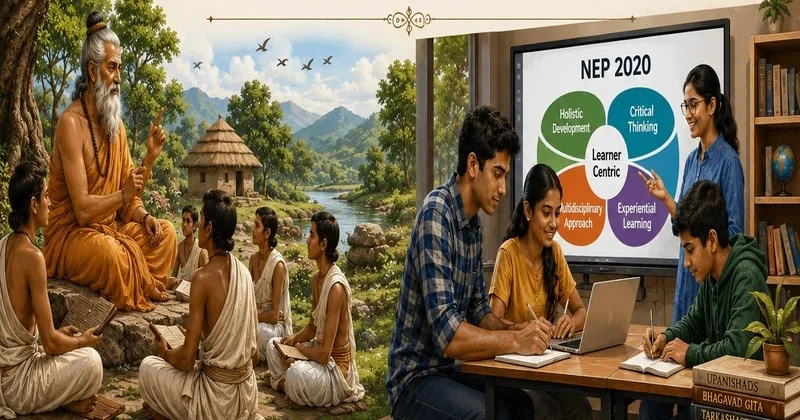
In the traditional interpretive reading, Bharat’s civilisation is embedded within a rich body of culture and philosophy. The name Bharat reflects a society committed to the pursuit of knowledge through the disciplines of light, learning and self-discipline. From Bha, meaning light or knowledge, and Rata, meaning engaged, immersed or devoted, a society that engages with knowledge-creation, sharing, and application embodies the quintessence of Bharat. Regardless of whether the idea represents a literal etymology or an enduring aspirational ideology, it encapsulates the classical Bharatiya view of both the individual and the nation; an ecological framework wherein education serves as the illumination of one’s existence and not simply as a means of attaining livelihood certification.
Perils of Modern Education
However, today we are facing an unprecedented turning point. Mass-industrialised forms of education that have been implemented globally have resulted in reducing learners to nothing more than economic units. Systems such as rote memorisation and immediate employment potential are prioritised over the development of the whole individual. Education is reduced merely to a prerequisite for employment. If we remove the din of the modern system of credentialing and explore the basic ontological function of learning, we will find that true education is based upon freedom, liberation and realisation. An age-old Sanskrit proverb states “तत्कर्म यन्न बन्धाय, सा विद्या या विमुक्तये”—meaning, true knowledge is that which liberates humanity from bondage to nature and all its constraints.
Therefore, while India endeavours to create the vision of a Viksit Bharat 2047, it is incumbent upon us to deconstruct the current overly transactional education system. We must reclaim the cognitive rigour, pedagogic excellence and holistic relational understanding of learning found in Bharat’s ancient educational heritage to enable institutions to graduate youth for employment and genuinely excellent humans as well.
Blueprint of Panchakosha Framework
Most modern educational systems are examination-oriented, which tends to separate the intellectual aspect of children by viewing them as empty vessels for filling with standardised information. However, this reductionist method ignores the fact that human development has numerous aspects. In contrast, ancient Indian philosophical systems were developed using an all-encompassing systems-oriented approach towards understanding the individual. This approach is demonstrated in the Panchakosha model (five sheaths) of humans propounded in the Taittiriya Upanishad. Apart from a comprehensive and holistic view of human development, this model is also multilayered in its perspective.
As opposed to separating the ability to think cognitively, this framework suggests that true education should consciously cultivate the whole of humanity’s potential by developing the full spectrum of the humans in five distinct yet interconnected layers referred to as pancha koshas: Annamaya Kosha (Physical Sheath), Pranamaya Kosha (Energy Sheath), Manomaya Kosha (Mental or Emotional Sheath), Vijnanamaya Kosha (Intellectual or Reasoning Sheath), and Anandamaya Kosha (Spiritual Self-Actualisation Layer or Spiritual Sheath).
This structure provides education with a fundamental basis in developing character and sees students as capable of growth and evolution rather than simply programming entities waiting to be populated with knowledge. It is highly encouraging that the National Education Policy- 2020 shares structural and spiritual characteristics with this ancient methodology and supports an experiential, multidisciplinary, holistic approach to education. This Vedic blueprint is very relevant today as it can also address students’ mental health or burnout problems also. Thus, this model can be a trend setter in transforming educational institutions into holistic learning centres, not just testing centres.
Predecessor to Socratic Dialogue
We have been conditioned to believe that our society’s love affair with critical inquiry began with the Greeks; the Bharatiya were doing this centuries prior. The idea that the “Socratic Method”—the process of having teachers constantly question students and vice versa—was invented by the Western World is a misconception. In fact, over 400 years before Socrates roamed the Agora of Athens, Bharat had already established its Gurukul system of education, which allowed scholars to engage in intense debates and questioning.
Many historians have made the mistake of viewing the ancient Bharatiya education system as a mere transmitter of dogma. However, it was actually a system of vigorous debate and validation of ideas. Students in the Gurukulas were actively encouraged to question their mentors and were empowered to dissect arguments and validate ideas using formal logic (Tarkashastra) long before the Western world would codify similar techniques.
One way to appreciate the full scope of this pedagogical tradition is to read the Prashna Upanishad (“The Upanishad of Questions”). The first lines of this text describe a group of serious students arriving at the Academy of Sage Pippalada seeking knowledge about the nature of reality. What is important is that when they arrive, instead of being told what to think or being lectured on the subject, they are required to spend a year with the sage to prepare themselves to learn and ask questions.
This is a remarkable pedagogical statement. What is suggested here is that true high-level critical thinking cannot occur without a clear mind, moral foundations, and exceptional self-discipline. Moreover, the requirement that the student come up with their own questions first illustrates an extremely interactive pedagogy. In other words, the student must first gather their thoughts, recognise what they don’t know, develop a specific question, and then seek out answers. This approach is drastically different from the passive lecture style used today and demonstrates clearly that the roots of dialogue-based learning originated in the Bharatiya Ethos.
In Vedic Bharat, the pursuit of higher learning would require a significant psychological and ethical transformation. This is embodied in Vidyarambha (initiation into education), clearly demonstrated by Sage Pippalada’s mandate for students to undergo a one-year induction. Modern institutions have incorporated this understanding into their structures and policies, such as the Student Induction Program (Deeksharambh), instituted by the UGC. Such initiatives recognise that prior to introducing students to the pressures of academic discourse, they need to be socialised to the values, emotional ground and educated on how to interact with both their peers and mentors based on mutual goals and objectives.
Gita: Chronicle of Educational Philosophy
The intellectual humility and ability to critically evaluate information find their greatest expression in the Shrimad Bhagavad Gita. Bhagwan Krishna’s conversation with Arjun on the battlefield of Kurukshetra represents possibly the greatest lesson in psychological and intellectual growth ever told. When discussing the relative importance of knowledge versus material wealth, Krishna asserts in verse 4.33 that “all action leads to knowledge” and that the sacrifice of knowledge is greater than material sacrifices. Further, in verse 4.38, Krishna declares that no means of spiritual purification surpasses knowledge.
However, Krishna provides guidance on how one may obtain purifying knowledge. In verse 4.34, Krishna advises Arjun to pursue wisdom by approaching those who possess it with devotion, inquiry (pariprashnena परिप्रश्नेन) and service. These three elements create an optimal environment for learning—one must be willing to learn humbly and serve others while simultaneously possessing sufficient courage to question others and oneself. Krishna never advocates for blind faith or thoughtless submission. In subsequent sections of the discourse, he encourages Arjun to utilise his reason and willpower to overcome his inner doubts and contradictions. In verse 4.42, Krishna commands Arjun to “with the sword of knowledge… cut down this doubt born of ignorance within your heart.”
The educational philosophy of Bhagwan Krishna reaches its culmination in verse 18.63. Krishna concludes, “Now reflect upon it thoroughly and proceed as you see fit.” This is ultimately the epitome of education – offering students both a foundation in ethics and principles, providing them with empirical evidence, and finally allowing them to exercise their independently developed rational faculties with complete autonomy. In today’s world of AI and information overload, returning to the tradition of Shastrarth is not a matter of nostalgia but a pedagogical necessity in order to transform the classroom from an echo chamber to a space for developing creative, independent thinkers.
Synthesising Ancient Quarters with Modern Quadrants
Looking back to the educational mechanisms developed in ancient Bharat, there appears to be a unique structural relationship between the ancient models of education and the current technological advancements in today’s digital-based educational systems. The ancient educators recognised that teachers could not solely impart knowledge to students; learning is both highly distributive and participative.
For instance, a sloka in Khanda 7, Sutra 29 in the commentary by Acharya Haradatta on Apastamba Dharmasūtra states: आचार्यात्पादमादत्ते पादं शिष्यस्स्वमेधया, पादं सब्रह्मचारिभ्यः पादः कालेन पच्यते॥ This is, in fact, a pedagogical maxim stating that learning happens in four quarters. The first quarter is acquired through listening to the Acharya (teacher); next develops from their own intellect and efforts they make for understanding what they have learned; the third is acquired through discussions and debate with their peers; and the fourth quarter, when knowledge is allowed to mature and become refined through practical experiences in life.
It is fascinating that this pedagogical framework, established so long ago in ancient times, mirrors many of the principles behind the use of distributed learning now employed by large-scale Massive Open Online Courses (MOOCs), offered through the SWAYAM platform. Specifically, it can be seen that both share commonalities in their use of a structured four-quadrant methodology. MOOCs also have four quadrants, namely e-Content or Teacher, e-Tutorial or Self-Intellect, Discussion and Assessment or Time and Ripening.
The above parallels demonstrate that despite the changes in medium used to deliver instruction—from Ashrams to the digital cloud—the underlying processes by which humans acquire knowledge and skills were successfully defined thousands of years before today’s digital educational environments by thinkers in ancient Bharat. Further, the concepts illustrated here coincide completely with contemporary adult learning theory frameworks such as Malcolm Knowles’ andragogy theory, which emphasises learner-centeredness, self-directed motivation, readiness to learn, and intrinsic motivation to learn.
This model can serve as a counterpoint to modern educational technology. This means that when trying to reform digital education, one should go further than simply flooding it with videos and other digital content. We should create learning experiences that encourage students to engage in critical thinking and develop experiential skills, as stipulated in NEP 2020.
Shared Purpose Over Zero-Sum Conflict
While the mechanical aspects of learning are important, it is ultimately the ecological and psychological classroom environment that will determine whether an education system will succeed. An authentic and sustainable education system would need to be based upon a common purpose and vision for all members of the learners’ community, as opposed to being based solely upon individual victory. The Rig-Veda (10.191) describes the base model for this intellectual harmony: “संगच्छध्वं संवदध्वं सं वो मनांसि जानताम्”—walk in harmony with one another, speak with one voice, and have your minds agree. This is a plea for cooperative and collaborative relationships among members of the community, as emphasised by NEP.
There is a similar symbiosis present in the traditional peace prayer of the Taittiriya Upanishad, “ॐ सह नाववतु । सह नौ भुनक्तु । सह वीर्यं करवावहै” which is recited at the beginning of study sessions. The Guru and Shishya sit together during study sessions and do not view each other as opponents within a transactional relationship, nor do the students see each other as simply competitors. Rather, they ask as a single unit: — May the divine protect us both together; May he nourish us both together; May we work together with courage and deep concentration. They pray that their shared pursuit of knowledge be illuminated with a brilliant understanding and that through their learning, no animosity or hatred towards each other.
To reform the current educational system, one needs to adopt this ecological approach to break down the toxic, hyper-competitive learning ecosystem. Instead, institutions need to create spaces that foster collaboration among students so that students measure each other’s success based on how well they have all grown together.
A Taxonomy of Transmission: Re-imagining the Educator
To stimulate this modern awakening within our schools and universities, we must recognise the various roles that an educator must assume. Modern conceptions of educators commonly reduce the concept of an educator to a singular term, teacher. However, traditional Bharatiya educational contexts provided a variety of different terms for educators, which suggested varying degrees of commitment to knowledge and responsibilities toward the students.
Instead of Western frameworks like Bloom’s taxonomy, universities and other educational institutes of Bharat should look to these historical roles for considerable inspiration when designing programs that allow faculty to continue to reinvent themselves. These are Adhyapak (provider of basic factual information for access to foundational data); Upadhyaya (imparter of knowledge by contextualising for what is taught); Acharya (developer of the student’s ability to perform a particular skill or set of skills with disciplines); Pandit (imparter of analytical capabilities) and scholarship; Drishta (developer of holistic insights and synthesis of thoughts essential for critical thinking; Guru (help remove ignorance and achieve enlightenment).
We need to embrace these diverse roles as educators to help students learn holistically. Faculty Development Programs need to adopt this taxonomy. After all, Viksit Bharat needs visionary mentors who can inspire students to move away from rote memorisation to having critical mind-sets and problem-solving skills.
Toward a Modern Gurukul Ethos
The real measure of a nation’s education is not simply its gross economic output, nor its rank. What really matters is the quality of youth it mentors. In fact, in the Bharatiya model of education, knowledge is not used as a means to individual gain – it is used for the betterment of all, and of course, personal spiritual growth. A long-standing Subhashita states clearly the differences between the wicked and the virtuous as they relate to how each uses their possessions; the wicked uses knowledge to create disputes, wealth to show off, and power to oppress. On the other hand, the virtuous use knowledge to help others, wealth to give away to those who are less fortunate than themselves, and power to protect both themselves and others (“ज्ञानाय दानाय च रक्षणाय”).
In Sanskrit, a wise saying is “ज्ञानं सर्वत्र पूज्यते”—knowledge is revered everywhere. And when we inspire students to think critically using logical inquiry and connect them with modern ways of accessing information through digital platforms and instil within them intellectual humility, we establish the framework for our nation’s future success. In today’s rapidly changing world, learners will need to be able to continue to learn, unlearn, and relearn. We can make use of the wisdom that has been gained over thousands of years. Rather than merely glorifying our past, we should now tap into this rich civilisational ethos to allow our educational institutions to produce individuals who are not only capable and employable, but also highly developed, intellectually and morally. Through this approach, we will develop not only an Atmanirbhar Bharat but a truly awakened nation.