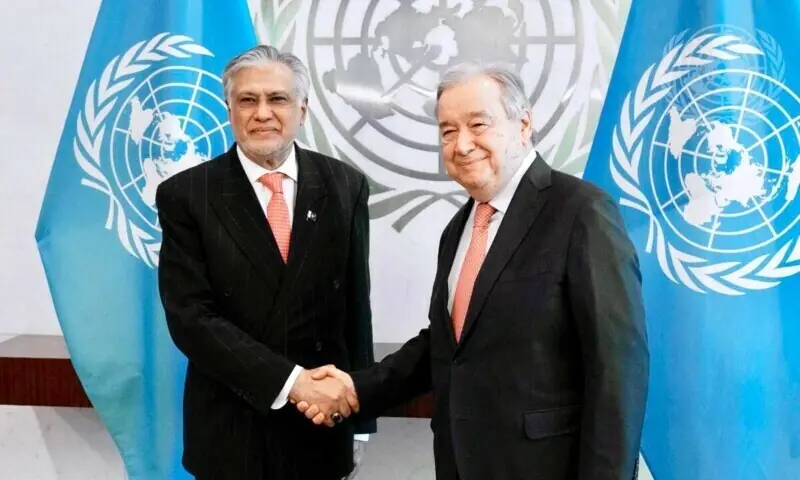
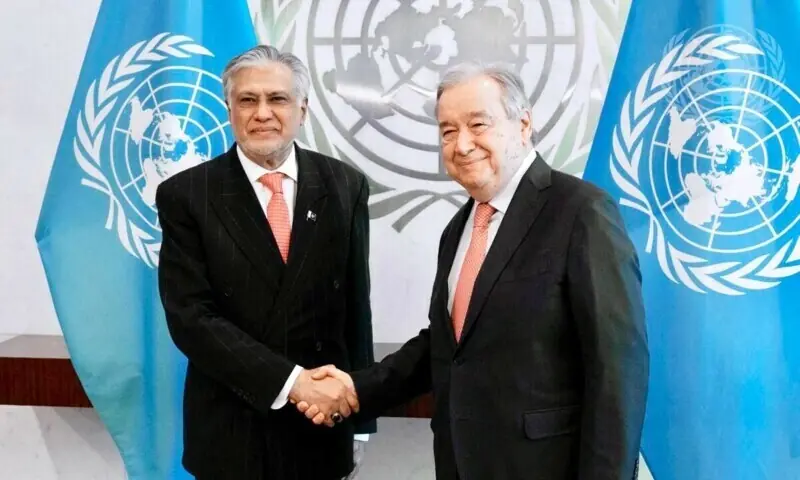
Deputy Prime Minister and Foreign Minister Ishaq Dar, who is on a two-day visit to New York, met United Nations Secretary-General António Guterres, with both sides discussing the situation in the Middle East, the Foreign Office (FO) said on Wednesday.
DPM Dar arrived in New York a day earlier.
In its statement, the FO said that during the meeting, DPM Dar lauded the UN chief’s “steadfast commitment to the UN and multilateralism” and also expressed appreciation for his “continued support and strong cooperation” with Pakistan.
As per the statement, the two leaders discussed regional developments, including the situation in the Middle East and West Asia, during which Dar thanked Guterres for his “principled position and support” for Pakistan’s mediation efforts in the US-Iran war.
DPM Dar also “highlighted Pakistan’s successful hosting of the Islamabad Talks in April, which represented an important diplomatic breakthrough,” and said the April 8 Pakistan-brokered ceasefire continued to remain in place.
Dar assured the UN chief of Pakistan’s “continued engagement and dialogue” to restore peace in the region.
As per FO, Dar “reaffirmed Pakistan’s strong commitment to upholding the principles and purposes of the UN Charter and advancing international peace and security through constructive engagement at the UN”.
FO further stated that Dar also appreciated the UN chief’s leadership in the UN80 initiative, stressing that the interests of the developing countries should remain “central” to the initiative.
The U80 initiative aims to “streamline operations, sharpen impact, and reaffirm the UN’s relevance for a rapidly changing world,” as per the UN’s website.
In his meeting with Guterres, Dar also stressed the need for “strengthening conflict prevention, the peaceful settlement of disputes, and peacekeeping and peacebuilding efforts in line with evolving global realities”.
He maintained that a comprehensive reform process should be based on “principles of sovereign equality, transparency, inclusivity, and broad-based consensus among member states”.
“These principles could only be upheld through the addition of elected members,” FO quoted him as saying.
The two leaders also exchanged views on South Asia, where Dar raised alarm over “provocative and inflammatory statements by India, which he said, “undermines regional stability”.
Dar further held that India’s unilateral move of holding the Indus Water Treaty in abeyance was a “clear violation of international law, the treaty’s provisions, and established norms governing inter-state relations”.
On India-occupied Kashmir, Dar said the dispute remained the “core issue” between Pakistan and India. He maintained that Kashmir’s “just resolution” remained “essential” for peace in the region.
On Afghanistan, Dar maintained that a “peaceful and stable” Afghanistan was “vital” for regional stability, but also expressed concern over the terrorist elements emanating from Afghan soil.
He went to reaffirm “Pakistan’s resolve to safeguard its national security and protect its citizens in accordance with international law and the UN Charter,” FO said.
The two also spoke about Palestine, and the foreign minister lauded the UN chief’s “continued advocacy” for a two-state solution as well as the implementation of the Gaza Peace Plan.
As per FO, Guterres, on his part, expressed appreciation for “Pakistan’s active engagement at the UN and its continued contributions to international peace and security, including through diplomacy and peacekeeping efforts”.
A day earlier, Dar addressed a UNSC debate chaired by Chinese Foreign Minister Wang Yi at the UN headquarters in New York, where he pushed for sustained diplomacy in the ongoing US-Iran crisis and highlighted Islamabad’s role in efforts aimed at reducing tensions between Tehran and Washington.
While a deal for a complete end to the war — which broke out on February 28 — is yet to happen, hostilities have largely ceased since the two sides agreed on a Pakistan-brokered ceasefire on April 8.
Following the ceasefire, a first round of historic direct US-Iran talks was held in Islamabad on April 11 and 12, with Pakistan playing the role of a mediator. The talks had ended without an agreement, but also without a breakdown.
Dar meets Bahrain FM
Separately, Dar also met Bahrain’s Foreign Minister Dr Abdullatif bin Rashid Al Zayani, as per FO.
“The two leaders reaffirmed the strong fraternal ties between Pakistan and Bahrain and discussed expanding cooperation in trade, investment, and economic sectors,” FO said in a post on X.
The top diplomats also discussed “regional developments and cooperation at multilateral forums, including the UN,” the statement said.
“Both sides agreed to further strengthen the Pakistan–Bahrain partnership across diverse fields, including as fellow elected members of the UNSC,” the FO further stated.
Dar also met Cuba’s Foreign Minister Bruno Rodríguez Parrilla, FO said in a separate post.
The two discussed “regional developments and reaffirmed their commitment to further strengthening Pakistan–Cuba relations and exploring new avenues of mutually beneficial cooperation”.