
Regional chauvinism that pushes people towards a separate identity over national identity often gains more political attention. Particularly in Tamil Nadu, Dravidian parties like DMK and its allies have long mastered this act, playing identity and separation politics by projecting themselves as both aggressive and victims at their convenience. Now, it appears that TVK is also trying to step into the same shoes. As per the established protocol and sequence, Vande Mataram, the National Song, and the State Song are played officially, but the issue has now been turned into a political controversy, with TVK playing the victim card in official spaces while remaining aggressive outside.
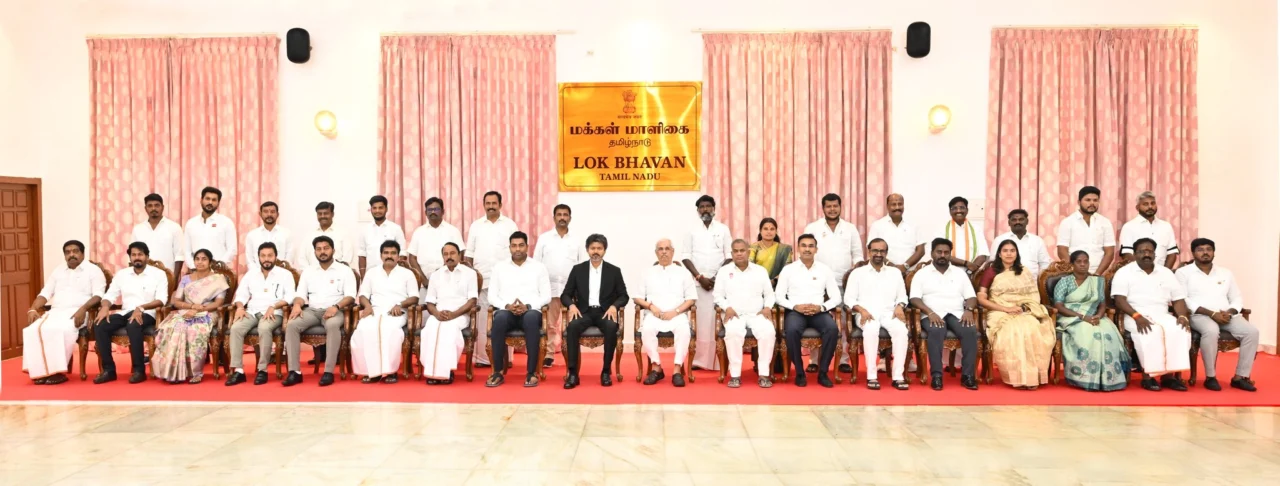
Despite outcries over Tamil Thai Vazthu (invocation to Tamil mother) being played third during the swearing-in ceremony, the same sequence was followed on May 21 at Lok Bhavan, much to the discomfort of TVK, DMK, Congress and other opposition parties.
On May 21, TVK CM Joseph Vijay expanded his cabinet by inducting more ministers. The swearing-in ceremony was held at Lok Bhavan. DMK objected to Tamil Thai Vazthu being played after Vande Mataram and the National Anthem.
The swearing-in of Chief Minister C Joseph Vijay on May 10 kicked off a political and cultural row after the Tamizh Thai Vazhthu, Tamil Nadu’s State Song, was played after Vande Mataram and the National Anthem, correcting the state’s usual custom. It drew criticism from the ruling Tamilaga Vettri Kazhagam (TVK), CPM, CPI and VCK, which are supporting the Vijay government without sharing power.
TVK Minister Aadhav Arjuna, in a post on X, linked the sequence to a recent Union Home Ministry directive mandating that all six stanzas of Vande Mataram be sung before the National Anthem whenever both are performed at the same event. He said the directive was issued as the country observes the 150th year of the National Song. The ceremony was presided over by Governor Rajendra Vishwanath Arlekar, who, according to the party, was bound by the circular.
Arjuna posted: “It was conveyed that the Governor, as the responsible authority, must act according to the new circular from the Union government. Accordingly, in an unavoidable situation, the Tamizh Thai Vazhthu was played as the third song. However, in future times, this new practice will not be followed. Instead, as per the earlier practice, the Tamizh Thai Vazhthu song will be played at the beginning of the event, and the National Anthem at the end.”
‘நீராரும் கடலுடுத்த…’ எனத் தொடங்கும் தமிழ்த்தாய் வாழ்த்துப் பாடலுக்கு நூற்றாண்டு கடந்த வரலாற்றுப் பெருமிதம் உள்ளது. இந்தப் பாடல் ‘உலகெங்கும் பரவ வேண்டும்…’ என்ற இலட்சியத்தின் தொடர்ச்சியாகவே, தமிழ்நாடு அரசு மாநிலப் பாடலாக அதை அறிவித்தது. இத்தகைய பெருமைமிக்க தமிழ்த்தாய்…
— Aadhav Arjuna (@AadhavArjuna) May 10, 2026
He further stated that the Tamil invocation song beginning with “Neerarum Kadaludutha” carries more than a century of historical pride and was declared the State Anthem by the Tamil Nadu government. He said the song has traditionally been played first at government events in Tamil Nadu, followed by the National Anthem at the end. He termed the new sequence “inappropriate for Tamil Nadu” and asserted that the TVK government would restore the earlier practice in future events.
Countering this, a netizen on X said that when the Governor attends a ceremony, the National Anthem must be played at both the start and end of the function. The user also cited the latest directive stating that Vande Mataram must precede the National Anthem at official events.
Dear Mr @AadhavArjuna & @actorvijay, Congratulations on winning Tamil Nadu and getting sworn in as the CM.
I do hope you know there are laws relating to the playing of the National Anthem at public events such as your swearing in.
The Prevention of Insults to National Honour… pic.twitter.com/xPdfl95m5U
— Sanjay Lazar (@sjlazars) May 10, 2026
Critics alleged that Left parties and DMK were selectively raising the issue despite the same protocol being followed earlier at Raj Bhavan events attended by DMK Chief MK Stalin and others. They argued that the controversy reflects a lack of political issues for the opposition to raise.
It is noteworthy that the full version of Vande Mataram was sung before the oath-taking ceremony of the VD Satheesan cabinet in Kerala.
Full Vande Mataram has been sung in Kerala before the oath taking ceremony of the VD Satheesan cabinet. Welcome change from Modi Govt where everybody irrespective of religion, ideology and stature has to stand in respect.
Governor Rajendra Arlekar can be seen singing song full. pic.twitter.com/L04gf1xM73
— Ganesh (@me_ganesh14) May 18, 2026
The silence and discomfort on certain faces said more than words ever could. 🔥🔥
“Vande Mataram” before the Kerala CM oath ceremony was enough to shake an entire ecosystem.
A reminder that Kerala is not beyond Bharat…🪷🚩
it is an inseparable part of it. 🇮🇳🔥This is New… pic.twitter.com/OpfWMh59j1
— MAHARATHI (@MahaRathii) May 18, 2026
On October 18, 2024, then Governor Ravi attended a function at Doordarshan Kendra where parts of the State Song were omitted, triggering criticism from DMK leaders and allies. However, a week later, during a government event attended by Udhayanidhi Stalin, errors during the singing of the same song were dismissed by him, who said there was “nothing wrong with the singing”.
Critics also pointed out that many politicians and students struggle to correctly recite even the truncated version of the National Anthem and questioned the selective outrage over Vande Mataram and National Anthem protocols.
#BREAKING: West Bengal Government issues order making Vande Mataram singing compulsory in all Madarsas of the state. Vande Mataram singing already was made compulsory in all schools of West Bengal during morning prayers. pic.twitter.com/N8vEAXcP2c
— Aditya Raj Kaul (@AdityaRajKaul) May 21, 2026
Recently, the West Bengal government issued an order making the singing of Vande Mataram compulsory in all madarsas in the state. The song had already been made compulsory during morning prayers in schools across West Bengal.
Critics say breaking established rules to score political points has become an old strategy, particularly in Tamil Nadu, where identity politics is increasingly being used to project a distinction from the larger national identity.