
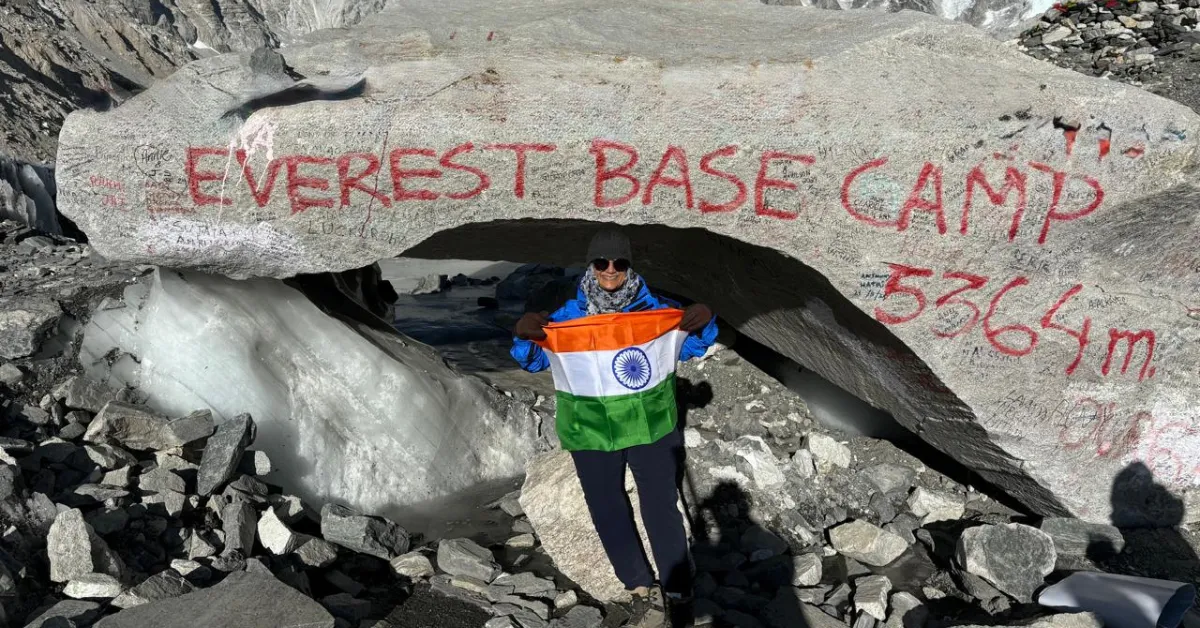
In November 2024, a little over a year after retiring from the Delhi High Court, Justice Poonam A Bamba boarded a flight to Nepal with surprisingly little idea of what she had signed up for.
The plan, if it could even be called that, belonged largely to her husband. She had not spent years preparing for Everest Base Camp, researching trekking routes or training for high-altitude endurance. In fact, she says she was never even supposed to go.
“My husband was going. I wasn’t even going to go initially,” she says, laughing at the memory. “I remember thinking, ‘How did this idea get into this man’s head?’ Eventually, only one person agreed to go with him. I thought to myself — if he can do this at 66, why can’t I?”
That impulsive moment of solidarity would take Justice Bamba — who spent 19 years in the Delhi judiciary — across suspension bridges, through dense Himalayan forests, past glaciers and frozen rivers, and all the way to the Mount Everest Base Camp at 5,364 metres. She was 64 years old.
What followed was ten days of walking nearly eight hours a day, covering over 65 kilometres of some of the most breathtaking and unforgiving terrain on the planet.
What she expected to be a physically demanding trek slowly became something far more reflective. Months later, while speaking about the journey, Justice Bamba returns repeatedly to the same ideas: fear, ageing, discipline and the strange confidence that comes from discovering your body can do more than you assumed.
A plan that was never made
Anil Bamba, Justice Bamba’s husband, is a former bureaucrat and an inveterate traveller who has visited around 100 countries. The EBC trek had been on his radar for a while. Finding companions proved harder.
/filters:format(webp)/english-betterindia/media/media_files/2026/05/12/3-2026-05-12-11-14-26.png)
Before the trip, Justice Bamba consulted a contact in the Air Force’s Mountain Flying Division, who assessed her fitness and gave her a cautious but encouraging nod. Beyond that, she did not train. “My friend told me you’re taking this very lightly,” she says. She disagrees. “I believe something like this has more to do with your mind and your mental makeup.”
Her preparation, it turned out, was simply a disciplined life. She wakes early and meditates, dances, or practices pranayama depending on her mood. “When I am feeling thoughtful,” she says, “I prefer to dance.” A five-kilometre walk every morning is, in her words, “constant, non-negotiable.” No altitude training, no gym regimen — just the daily walk, the dancing, the breath work. The mountain, in the end, seemed to agree this was enough.
They packed light and began the trek at Lukla, Nepal’s small mountain airstrip that serves as the gateway to the Everest trail. They had a Sherpa guide and carried only what they needed. They were, as Justice Bamba would say repeatedly, going for joy — not for achievement, not for proof, not to show anyone anything. “We went as the river flows,” she says. That phrase — as the river flows — turns out to be something close to her personal philosophy.
The mountain’s curriculum
What the Himalayas teach, they teach without mercy and without hurry.
Altitude does strange things to appetite, and Justice Bamba struggled to eat breakfast each morning. “Those first steps of each day required total mental strength,” she says quietly. “We would order food at the lodges and couldn’t eat much of it. Mostly we had warm soup and ginger honey tea.”
The cold was another education — bone-chilling in the truest sense, a cold that seeps through layers of clothing and finds you anyway.
/filters:format(webp)/english-betterindia/media/media_files/2026/05/12/4-2026-05-12-11-16-31.png)
The evenings brought their own ordeal. After eight hours of walking, the group had to reach their lodge before mountain darkness arrived — and in the Himalayas, darkness comes suddenly, swallowing the sky between one breath and the next. There were nights when she lay down and genuinely wondered whether her body would let her rise in the morning.
“There were moments when I was done — just done,” she says. “Lying on the bed, I felt I was not going to get up.” But she always did. And in those walks, through exhaustion and altitude and cold and doubt, something unexpected began to happen.
She started noticing her own body with an attention she had never given it before. “I felt total gratitude for every single part of my body,” she says. “Even my lungs. Even my saliva. Normally we take these things for granted — but this taught me how resilient and wondrous our own bodies are.”
The forest of stars and a Sherpa’s wisdom
One particular section of the trail has stayed with her — a long, dense, seemingly endless forest crossed in gathering darkness. The group had slowed, the trail had narrowed, and Justice Bamba found herself genuinely scared for the first time. “I didn’t even know if the guide knew the way properly,” she admits, smiling now.
But after a while, the group was asked to look up through the canopy. What met their gaze was, as she puts it, “indescribable.” “We were standing under a blanket of stars. I’ve never seen stars like that, before or since. Not even now.”
/filters:format(webp)/english-betterindia/media/media_files/2026/05/12/6-2026-05-12-11-17-24.png)
Fear was present too, threading through the wonder. It was here that she made a quiet deal with herself: guide saath hai, toh le hi jaayega — the guide is with us, he will take us through. That simple trust became the bridge that carried her.
The Sherpa, for his part, was tactful in the way only mountain people can be. When Justice Bamba’s knees began to struggle on steeper sections, slowing the group down, he did not say she was unable.
He suggested: “Ma’am, I think we could take a horse. We are taking a little more time.” She took the horse for parts of the final descent. The terrain was so steep that even the horse slipped twice.
On a bridge, above a river, beneath a glacier
Ask Justice Bamba about her most memorable moment, and she does not hesitate.
It happened on a suspension bridge. She had stopped to catch her breath — the bridge was long, it swayed, the altitude demanded pauses — when she looked up.
There was a glacier above her, white and immense. Below, the Dudh Kosi river ran its cold, milky course through the gorge. The Himalayan peaks stood all around, vast and indifferent and unutterably beautiful.
“When you’re amidst nature, you truly realise that you’re not even a speck in this humongous universe,” she says. “But conversely — and this is the strange part — you also feel expanded. As if you are part of all of it. As if you are the mountains.” I
t is the kind of paradox that mystics have spent centuries trying to articulate, and here was a retired high court judge, standing in her waterproof pants and four layers of thermal inners, living it. “I’m held,” she says simply. “By divine. I felt that more strongly after EBC than ever before.”
‘Age is just a number — I lived that’
Justice Bamba’s path to the bench was long and methodical. She graduated from Hansraj College in 1980, completed her LLB in 1983 and LLM in 1988 from Delhi University, and joined the Delhi Higher Judicial Service in 2002.
/filters:format(webp)/english-betterindia/media/media_files/2026/05/12/5-2026-05-12-11-18-43.png)
In March 2022, she was elevated to permanent judge of the Delhi High Court, retiring in August 2023 after nearly two decades of service.
The EBC trek, in that context, was not a culmination of anything she had been building toward. It was simply the next thing. “
I travel very organically. I never research. That is why my family members get really annoyed with me,” she says, laughing. “Ignorance is bliss. When you don’t know what lies ahead, you’re not scared of it.”
The adventure that came before
Before EBC, there was Antarctica — a nine-day cruise across the Drake Passage, one of the most notoriously rough stretches of ocean in the world.
“The ocean waves came up to the fourth floor of our cruise liner,” she says. “I threw up once and was fine for the rest of the journey.” It says something about a person, that Antarctica was the warm-up act.
/filters:format(webp)/english-betterindia/media/media_files/2026/05/12/2-2026-05-12-11-20-11.png)
Now, there is something she wants to say to those who have filed away their larger dreams under “someday” or “too late.” “It has nothing to do with age,” she says. “Age is just a number. I had heard that said all my life. But at EBC, I lived it.”
What next?
She is currently writing a book about the trek — nearly complete, joining a shelf that already holds five published titles including ‘Patiala House: Palace to Justice’.
When asked what adventure comes next, she laughs and says she doesn’t know yet. Probably something she hasn’t thought of. Probably something spontaneous.
That, after all, is the whole point.
“One step at a time,” she says. “That’s the only way.” For a woman who walked to the roof of the world on a whim, it sounds less like a trekking tip and more like a life philosophy — and a promise that whatever comes next, she will be ready.