
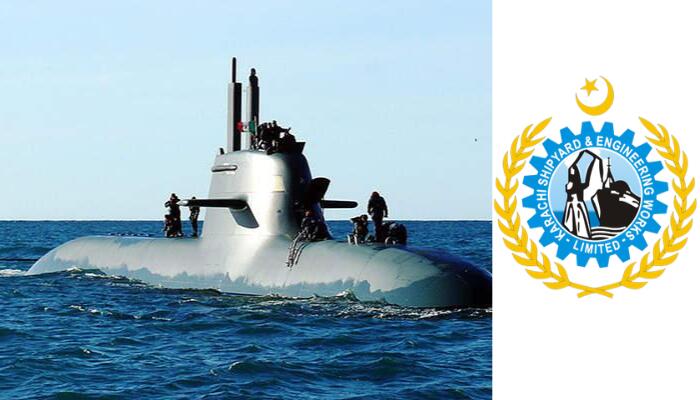
When Pakistan commissioned PNS Hangor on 30 April 2026 in Sanya, China, the first of its eight Hangor-class submarines, the ceremony was freighted with symbolism. President Asif Ali Zardari attended as the chief guest. The naval chief spoke of deterrence and maritime order.
The occasion was presented as proof that Pakistan’s largest-ever defence procurement, a programme consuming over a decade of institutional effort, had arrived.
It has, for the China-built half of the contract. The harder question, largely unaddressed by the ceremony’s participants, concerns the four submarines to be built not in Wuhan but in Karachi, at Karachi Shipyard and Engineering Works. Those boats are running behind schedule, and the gap between Pakistan’s ambitions for domestic submarine production and the demonstrated output so far is worth examining honestly.
KSEW’s Prior Experience and the Step Up Ahead
KSEW indigenously constructed Pakistan’s third Agosta 90B submarine, PNS Hamza, commissioning it in September 2008 — the first conventionally built submarine in South Asia to feature air-independent propulsion. The shipyard is the only entity in Pakistan capable of building deep-water submarines, a position built on major technology contributions from France in the 1990s and later from China.
PNS Hamza was built with extensive French technology transfer and supervision. The Hangor class is a considerably larger, heavier, and more complex platform — displacing 2,800 tons compared to the smaller Agosta 90B — and incorporates a different propulsion system, a different combat management architecture, and a weapons fit beyond anything KSEW has previously handled. Prior experience is relevant but does not eliminate the learning curve.
The Infrastructure Investment
KSEW signed a contract in July 2017 with Norwegian firm TTS Group for a Syncrolift ship-lift system capable of handling vessels up to 7,300 tons, connected to a rail system with 30 motorised trolleys and custom-designed workstations, including a covered shed measuring 135 by 38 metres.
The shipyard also installed a Ship Lift and Transfer System with two parking stations specifically allocated for submarine construction, as documented in the Ministry of Defence Production’s 2022–2024 Yearbook. China has additionally leased a Type 039A Yuan-class submarine to Pakistan for training and familiarisation ahead of the Hangor’s commissioning — a further indication that crew and technical preparation have been taken seriously.
The Schedule Delays
The steel-cutting ceremony for the fifth boat — the first KSEW-built Hangor — took place in December 2021, originally scheduled for October 2020. The keel laying for the sixth followed in February 2025. The KSEW-built units are tracking behind the original schedule and are now likely to be completed in the early 2030s.
Contributing factors are documented: the engine switch from German MTU to Chinese CHD-620 units required re-engineering, the COVID-19 pandemic disrupted operations, and the inherent complexity of scaling up to a more sophisticated submarine class introduced delays that optimistic project timelines had underweighted.
The Technology Transfer Question
Pakistani engineers and technicians at KSEW have received training primarily in submarine assembly, welding, logistics, and limited systems integration. Advanced areas — propulsion software, sonar, and AIP design — remain under Chinese control. The distinction between supervised assembly and genuine engineering knowledge transfer, the kind that would allow Pakistan to independently sustain, upgrade, or eventually design its own platform, has not been publicly addressed.
One of the programme’s stated aims is to transform Pakistan into a submarine-building navy, implying an eventual goal of domestic design capability rather than assembly under foreign supervision. Whether the current technology transfer arrangement puts Pakistan on that trajectory, or merely on a path to assembling Chinese-designed boats with diminishing supervision, will not be known for years.
What the Commissioning Actually Marks
The commissioning of PNS Hangor is a real milestone for Pakistan’s submarine arm. The remaining three Chinese-built boats — PNS Shushuk, PNS Mangro, and PNS Ghazi — were all in the final stages of sea trials by the time of the ceremony and could plausibly follow in relatively quick succession, potentially within 2026 itself. That would increase Pakistan’s AIP-equipped fleet from three Agosta 90B boats to seven within a single year — a genuine and significant capability expansion.
The KSEW programme is a different story: behind schedule, with the depth of actual knowledge transfer unverified, and facing the real challenge of building a more complex submarine than the yard has previously attempted. These are the questions the commissioning ceremony left unanswered.