
Recent events have brought to light a crucial lesson in contemporary warfare: control of the sky starts with control of information, as conflict intensifies throughout West Asia. The sophisticated ground-based systems are becoming more vulnerable in this quickly changing battlespace, where threats appear suddenly and strike with accuracy.
The US Army Navy/Transportable (AN/TPY-2) radar system, which is essential to the terminal high altitude area defence (THAAD) missile system, was destroyed by an Iranian strike at the Muwaffaq Salti air base in Jordan in March 2026, according to satellite images of the fight. The loss of the radar is anticipated to have an impact on air and missile defence in the area since it was essential in identifying and monitoring incoming ballistic missile threats.
Australia deployed its early-warning aircraft to identify planes, drones, and missiles following the event at the request of Gulf countries. In order to help protect airspace, the E-7A Wedgetail, an airborne early warning and control (AEW&C) aircraft, is positioned in the area to conduct long-range surveillance. It was first put into use about than four weeks ago.
The episode highlights a distinct change in contemporary warfare: aerial early warning technologies are increasingly guaranteeing surveillance continuity and real-time control of the battlefield, even though ground-based systems are still crucial.
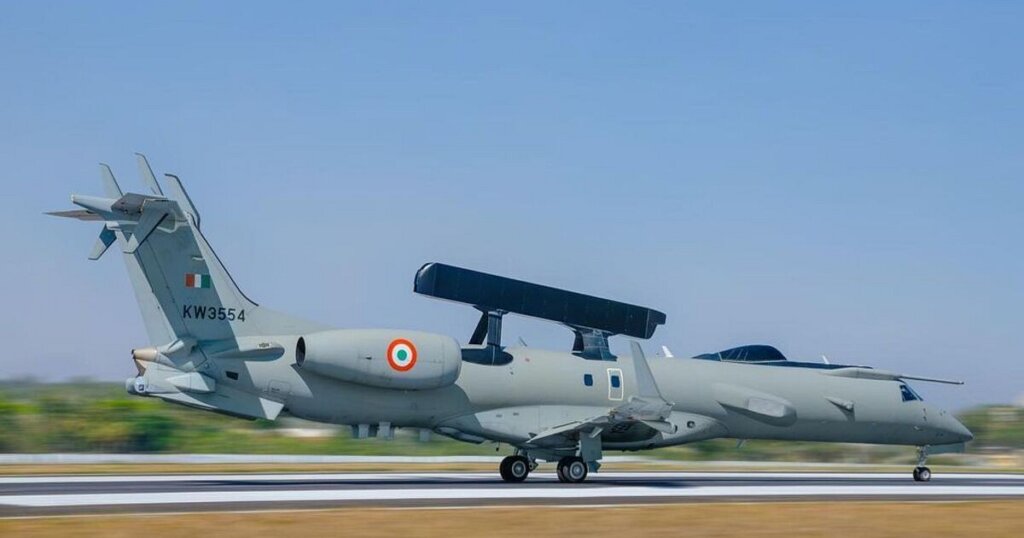
India’s capacity for aerial surveillance has steadily increased, but it is still rather small. Based on the Russian IL-76 platform and equipped with Israeli Phalcon radar, the Indian Air Force (IAF) has three airborne warning and control system (AWACS) aircraft. Additionally, a few AEW&C aircraft are equipped with active electronically scanned array (AESA) radars under the domestic Netra program. These radars are based on Brazilian Embraer EMB-145 aircraft.
They both carry out surveillance functions, although their capacities and scopes vary. Larger systems with more potent radars, AWACS can handle intricate air operations over wide regions and usually provide 360-degree coverage and greater detection ranges. They can coordinate several aircraft and operations at once, acting as airborne command centres. Designed for tactile missions, the AEW&C systems are lighter and more affordable. Their radar coverage is limited to around 240 degrees, but they give more deployment flexibility. Because they are inexpensive and need little upkeep, they may be used more frequently and are more appropriate for regional monitoring.
Real-time communication, electronic intelligence collection, and long-range detection are all improved by these systems. But even in a possible two-front situation, their small numbers still make it difficult for India to maintain constant, 24-hour surveillance over a vast and intricate battlefield.
Maintaining constant surveillance over a large area of airspace that crosses two active borders and a long coastline is equally as difficult as the quantity of planes.
Limited numbers
Former Central Air Command Air Officer Commanding-in-Chief Air Marshal Ravi Kapoor (retired) emphasized the extent of the operational disparity. “In reality, there are only four aircrafts available at any given time—this is woefully insufficient for continuous surveillance, especially when you take maintenance cycles and operational commitments into account.”
He said that a changing threat landscape and a large geographic area must be taken into consideration while evaluating the IAF’s request. He continued, “India requires at least 20 airborne early warning platforms for a two-front scenario to ensure seamless and uninterrupted surveillance as well as effective control of airspace in a dense and dynamic environment.”
Against nearly 7,000 kilometres (km) of borders (China and India) and approximately 11,000 km of coastline, current numbers are simply not sufficient to meet operational requirements,” the gap reveals a significant weakness in sustaining continuous surveillance during a crisis situation.
A major step toward developing domestic aerial surveillance capabilities was taken in 2017 with the launch of India’s own Netra AEW&C program, however growth has been sluggish. Although the IAF is now researching other platforms, such as bigger AWACS systems based on Airbus aircraft for Netra Mark2 (Mk2) with a detection range of up to 400-500 km, the rate of induction still raises questions.
With a total inventory of about 50 AEW&C, comprising several platforms of KongJing-2000 (KJ-2000), KJ-200, and the more sophisticated KJ-500 series aircraft, China has one of the largest airborne early warning fleets in the area, according to a Eurasian Times article.
Conversely, Pakistan has been running about ten AEW&C platforms—more than India—including four ZDK-03 aircraft from China and six Saab 2000 Erieye systems.
Pakistan has a sizable aerial surveillance capacity despite media claims of AWACS struck by the IAF during last year’s Operation Sindoor, highlighting India’s ongoing deficiency in this area.
In terms of situational awareness and airspace control, “China and Pakistan together can maintain far more persistent surveillance,” Kapoor said.
Airborne surveillance systems, which act as platforms for real-time detection, coordination, and airspace control, are still essential to modern warfare even with satellites and ground-based radars.
Without the line-of-sight restriction of ground radars, these high-altitude aircraft can detect aircraft, drones, and missiles at vast distances. They serve as airborne command centres, directing combat aircraft, designating targets, and overseeing airspace in real time.
“AWACS is not just a radar; it is the nerve centre for controlling airspace in a highly dynamic and congested battlespace where multiple platforms are operating simultaneously,” stated Kapoor.
As demonstrated in Operation Epic Fury, when Kuwaiti air defences mistakenly shot down three US Air Force F-15E fighters, they also play a crucial role in maritime surveillance and force protection through identification to precisely distinguish friendly assets from hostile ones and coordinate in a way that prevents friendly fire.
Additionally, it helps in intelligence collection; the US Navy’s carrier-based E-2 Hawkeye is known for having carried out this task in Operation Epic Fury against Iran.
“Only with AWACS, which provides a clear and real-time air situation picture, is safe and effective airspace control possible with drones, missiles, and aircraft operating in the same volume of airspace,” Kapoor clarified.
Although ground-based radars are useful, they have some drawbacks and are unable to give a full “air situation picture,” particularly in challenging terrain and at low altitudes. This highlights the necessity of airborne systems, which are essential for creating a whole picture of the situation.
According to industry analysts, the need of aerial surveillance is only growing as threats continue to change.
Dr. Vivek Lal, the CEO of General Atomics Global Corporation, a drone manufacturer with headquarters in the United States, emphasized how combat is changing. “Even brief gaps in situational awareness can be catastrophic in modern conflicts due to the speed of operations and the proliferation of threats, such as swarms of drones and hypersonic missiles,” he stated.
Layered defence against several threat kinds is made possible by airborne early warning systems. They make it possible to coordinate dispersed forces across large regions and locate time-sensitive targets early, particularly in marine conditions.
Uncrewed alternatives
Nevertheless, despite their vital significance, these platforms are however vulnerable in contentious contexts. According to Kapoor, “AWACS are valuable assets with large radar signatures and can be detected at ranges beyond 400 km, making them visible targets in a modern battlespace.”
They are susceptible to long-range air-to-air and surface-to-air missiles because to their low speed, flying altitude, and consistent flight patterns during operation.
Although the discussion has shifted to unmanned options because to these weaknesses, experts are still skeptical of their practicality. The MQ-9B platform with airborne early warning capabilities, which General Atomics has given India, is anticipated to start flying tests later this year. According to Lall, “unmanned systems like the MQ-9B deliver huge advantages with their extraordinary endurance, without the need to replace a human pilot due to fatigue.”
However, given Operation Epic Fury’s notable MQ-9 Reaper deaths in disputed airspace, survivability concerns are still relevant.
Eleven MQ-9 Reaper drones have been lost in operations against Iran, according to US-based broadcaster CBS News, which cited two US sources. This shows how vulnerable these platforms are to sophisticated air defence systems.
High-threat scenarios pose a concern, according to Group Captain R K Narang (retired), who is currently employed at the government defence think tank Manohar Parrikar Institute for Defence Studies and Analyses in New Delhi. “In contested environments where advanced air defence systems are in play, low-speed drones with high RCS radar cross section are relatively easy targets,” he stated.
He went on to say that a thorough assessment is necessary due to the operating environment in India. “It doesn’t seem like a very promising platform in the current scenario when looking at the Iran war,” he stated, adding that it has to be carefully considered for India’s operational environment.
However, according to Kapoor, “UAVs can certainly augment airborne surveillance, but they cannot replace AWACS, particularly in terms of controlling and managing complex airspace.”
They still have a limited function in crowded combat zones, he clarified. “They are unable to manage several tasks at once in a crowded area, which is necessary for efficient airspace management.”
He emphasized that, with proper integration, such systems may still be beneficial. He clarified, “The ideal model is integration, where AWACS stay in depth to control the battlespace while UAVs feed data forward.” It is preferable to use unmanned platforms as forward sensors in a protected ecosystem as opposed to stand-alone alternatives.
From an industrial standpoint, the picture is still more promising, though. The idea is already technically possible, according to Lall. “An unmanned platform like MQ-9B can easily adopt the same capabilities that are currently flying on piloted AWACS aircraft.”
He cited current initiatives to put these systems into practice. “We are working with Saab to pair the MQ-9B platform with advanced AEW sensors, and we intend to demonstrate this capability later this year.”
He said, “The coverage will be the same, but the real advantage lies in long-range endurance and the ability to operate without concerns about pilot fatigue.”
Additionally, he emphasized how adaptable these platforms are for carrying a broad range of payloads. “We frequently integrate ISR (Intelligence, Surveillance, and Reconnaissance) or nearly any other type of capability with MQ-9B, which has a payload capacity of 4,750 pounds (2,155 kg) with nine hard points,” Lall stated.
“Software and artificial intelligence have become the backbone that makes these systems effective… enabling real-time analysis, pattern detection, and reducing operator workload,” Lall added, describing the increasing influence of software on future systems. He described a change in the way that operational thinking is approached.
“The future of airborne ISR is moving towards interconnected systems combining satellites, unmanned aerial vehicles, and manned aircraft,” he said, characterizing a networked surveillance grid as opposed to dependence on a single platform.
The significance of self-reliance
In the midst of calls to increase the capacity for aerial surveillance, attention is being paid to the construction and maintenance of platforms as well as their acquisition.
Narang stressed the need of strengthening indigenous capacity. “Long-term security requires self-reliance and co-development, especially in a geopolitical environment where dependencies can become vulnerabilities.”
He cautioned against depending too much on any one nation.
“Even close partners may not always be trustworthy, as geopolitics has demonstrated, making indigenous capability even more crucial.”
“If we want indigenous programmes to succeed, we must improve inefficiencies in testing, certification, and decision-making,” Narang added.
“An indigenous radar alone is not enough – what matters is how it integrates with the entire mission system, which includes multiple sensors and communication networks,” according to Kapoor.
He emphasized the need for indigenous efforts to accelerate, saying, “The biggest challenge lies in integrating imported components without access to source codes or interface data, which creates delays and technical obstacles.”
Lall pointed out that contemporary surveillance systems mostly rely on software, underscoring the rising significance of data-driven operations. “Software is crucial for managing massive amounts of data, correlating data from multiple sensors, filtering noise, and enabling real-time analysis during missions.”
He continued by saying that AI has improved these systems’ operating capacity through predictive analytics, automated target recognition, pattern recognition, and operator task reduction.
Converting these skills into an integrated operational network is still difficult. India’s secure data lines have an operational flaw, according to Kapoor.
The waveform, the signal format that describes how data is encoded, transmitted, encrypted, and received over radio frequencies, serves as the common language for these systems to communicate. A data link is the secure communication network that enables real-time information sharing between aircraft, drones, and ground systems like radar and command centres.
The efficacy of even sophisticated systems is limited if several platforms run on distinct waveforms and cannot readily interact with one another.
According to Kapoor, “India purchased software-defined radios from Israel to be used as data links, but the waveform is not common across systems, so they are unable to communicate seamlessly.”
“All systems will be able to communicate with each other once that commonality is achieved, and India is currently developing its own indigenous waveform.”
“The gap is still there,” he added. “Work has begun, but there is still a long way to go before we have a highly secure high-bandwidth data link connecting all of our airborne and ground systems.”
The Defence Acquisition Council has approved the purchase of six improved Netra Mk1A aircraft, as India continues to expand its fleet of AEW&C and AWACS. Experts emphasize that timely implementation is the true problem.
“The real question is not just numbers, but how to speed up programmes, increase efficiency, and eliminate process delays,” Narang stated. According to him, structural changes might hasten these initiatives. “Progress can be greatly accelerated by an empowered team with expedited approvals and more industry involvement.
This disparity is no longer a secondary issue since it draws attention to the fundamental problem where result is determined by power over knowledge.
Although there are plans to increase the surveillance fleet, concerns about the speed of induction, data integration, and reliance on foreign systems remain: Can India wait to develop a two-front networked surveillance architecture? And can a combination of manned and unmanned technologies be adequate to counter new threats?
According to experts, India requires at least 20 airborne early warning platforms to provide continuous coverage along its large borders; in order to satisfy the expectations, quicker execution, indigenous capacity, and system integration are required.
Building a unified, network-centric environment where platforms, data linkages, and sensors collaborate in real time must take precedence over incremental additions. How soon India can construct more eyes in the sky is the question, not whether it needs more.
According to Kapoor, “India purchased software-defined radios from Israel to be used as data links, but the waveform is not common across systems, so they are unable to communicate seamlessly.”