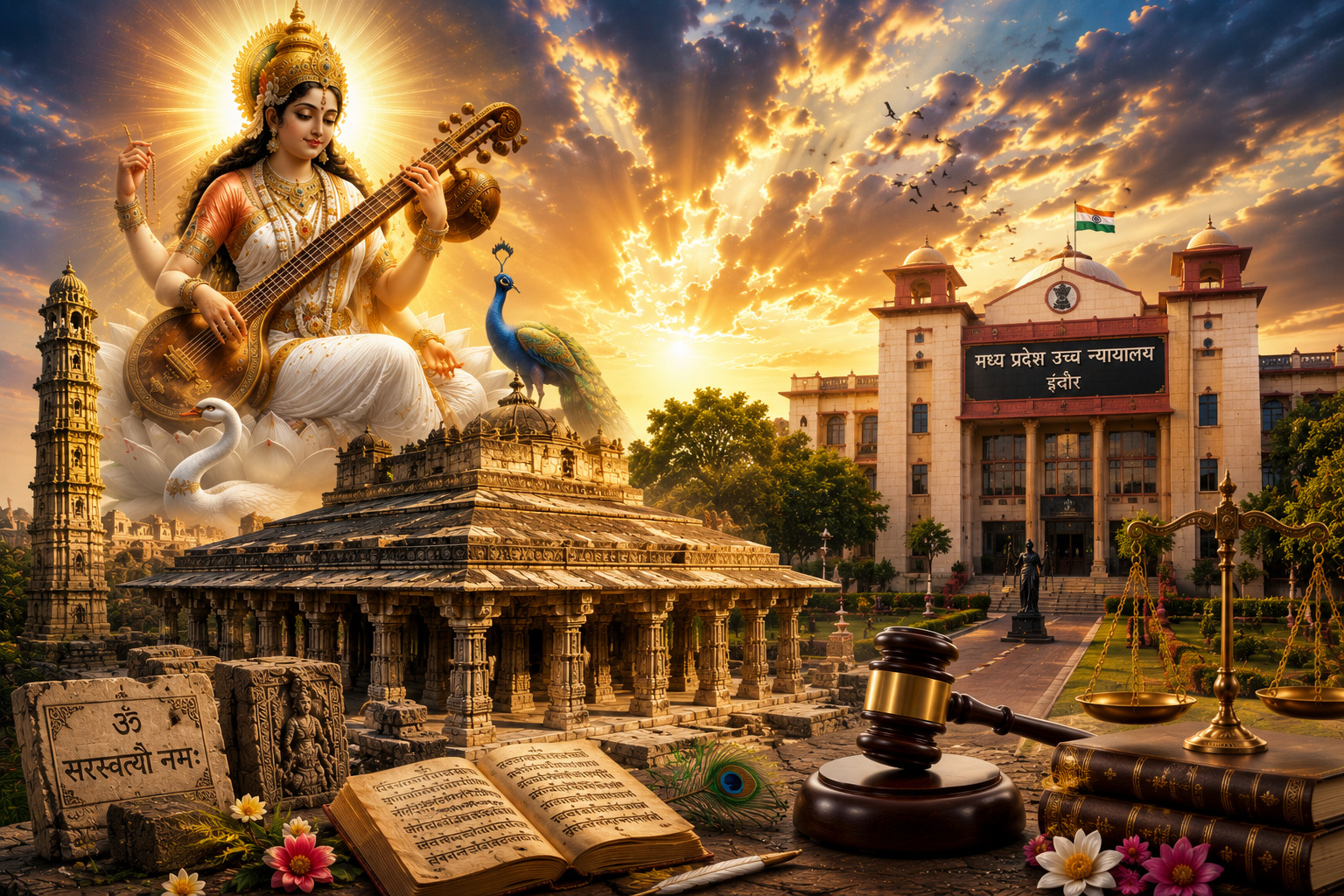
Justices Vijay Kumar Shukla and Alok Awasthi delivered a historic 242-page judgement in Writ Petition No. 10497 of 2022 and related matters on May 15, 2026, in the quiet courtroom of the Madhya Pradesh High Court in Indore. The suit, which was filed by the Hindu Front for Justice (Regd. Trust No. 976) through its president, Ms Ranjana Agnihotri, aimed to return the Bhojshala-Kamal Maula complex in the Dhar district to its original state.
The court ruled unequivocally that the site is a protected monument under the Ancient Monuments and Archaeological Sites and Remains (AMASR) Act of 1958, but its fundamental religious identity is that of Bhojshala, a Sanskrit learning centre and temple dedicated to Goddess Vagdevi (Saraswati).
The Archaeological Survey of India’s (ASI) 7 April 2003 order, which limited Hindu worship rights and allowed Muslim services on Fridays, was decisively quashed by the bench. The decision was based on meticulous evidence, including centuries-old historical writings, architectural hints, inscriptions, and the ASI’s own thorough scientific investigation. It was a moment when the law finally reflected what generations had long understood in their hearts about this sacred Parmar era shrine, and for many Hindus, it felt like a peaceful return home.
Bhojshala: The enduring legacy of Raja Bhoj
One must go back to the eleventh century in order to fully understand the verdict. The famous ruler of the Parmar dynasty of Malwa, Raja Bhoj (c.1010-1055), was a polymath king who was a poet, scholar, engineer, and devoted supporter of education. Grammar, philosophy, literature, and the devotion of Goddess Saraswati (also known as Vagdevi, the goddess of speech and wisdom) flourished side by side in Bhojshala, which he founded as a splendid centre of Sanskrit education.
A clear picture of a temple complex where students and devotees congregated to learn and pray is painted by contemporary texts, inscriptions, and subsequent historical records. A sacred area devoted to the goddess of wisdom is suggested by the architectural design, literary allusions, and themes. The core character of Bhojshala persisted in local memory, folklore, and academic records even during mediaeval upheavals, such as the time under Alauddin Khilji when portions of the building were utilised again.
Nearly 1,000 years ago, Maharaja Bhoj built the Bhojshala in Dhar as a major centre of Sanskrit learning dedicated to Maa Saraswati.
Historical accounts say the site was later occupied by Muslim invaders, who built the so-called Kamal Maula Mosque there.
Following the High… pic.twitter.com/kQy35Zvgci
— OpIndia.com (@OpIndia_com) May 15, 2026
The British era authorities acknowledged its heritage worth by the early 20th century. First safeguarded by the Ancient Monuments Preservation Act of 1904, it was subsequently placed under ASI custody under the 1958 Act. The site’s dual name, Bhojshala-Kamal Maula, represents centuries of complex history, but the court’s careful investigation made it clear that Hinduism was the site’s principal and original feature.
The dispute and the flawed ASI order
Competing claims to religious practice led to the contemporary dispute. Hindus wanted unrestricted access to worship and traditional education based on historical continuity. The nearby mosque and a 1935 proclamation from the former monarch of Dhar allowing namaz were cited by the Muslim community. The ASI’s administrative order on April 7, 2003, which established a rota system with Friday prayers for Muslims and restricted puja days for Hindus, was the turning point.
Petitioners stated that this order was arbitrary since it limited their fundamental rights under Articles 25 and 26 of the Constitution (freedom of religion and the right to conduct religious matters) and overlooked significant historical evidence. Technical concerns were raised by the other side, which argued that a civil lawsuit would be the best course of action due to the disputed facts. However, the High Court asserted writ jurisdiction based on well-established precedents and the public significance of the matter. The judges pointed out that when the ASI itself has the knowledge to reveal the site’s actual character, heritage issues of this kind cannot be left in limbo.
Court’s rigorous, evidence centric reasoning
The bench used a thorough, evidence-based approach, largely relying on the Supreme Court’s 2019 Ayodhya decision (M. Siddiq v. Mahant Suresh Das). From that historic case, they extracted ten fundamental principles and applied them precisely. Courts must consider the weight of the evidence rather than strict title suits in disputes involving the religious character of historical places, particularly when the state (via the ASI) has already carried out scientific examinations.
The court examined historical writings from the Parmar period, which repeatedly identified Bhojshala as a Saraswati temple and a seat of learning. Evidence from architecture and epigraphy, such as pillars, motifs, and structural alignments, clearly indicated the presence of pre existing temple features. The ASI’s significant scientific survey report, which was produced in response to previous court orders, was the actual game changer. Ten volumes of thousands of pages contained excavations, ground penetrating radar scans, and thorough documentation of more than 150 Sanskrit inscriptions and 94 sculptures.
Hindu symbols like Om and Swastika, temple architecture parts reused in later projects, and inscriptions expressly honouring Saraswati are among the most notable discoveries. The court considered one inscription that reads ‘Om Sarasvatyai Namah’ to be particularly significant. The temple’s ancient presence and ongoing cultural importance were supported by a compelling archaeological narrative that included these details, which were not selected at random.
Key legal nuances that escape the naked eye
The court’s finding regarding the persistence of Hindu worship is among the most significant but subtle judgements in the ruling. The bench stated unequivocally that despite centuries of interruption and legal limitations, ‘the continuity of Hindu worship at Bhojshala was never extinguished.’ This nuance is essential. Legally speaking, this means the petitioners did not have to demonstrate uninterrupted physical possession in the modern sense. It was sufficient to have persisting local customs, occasional availability, and the site’s long-standing relationship with Goddess Saraswati in Hindu culture.
The judges emphasised the state’s constitutional obligation under Articles 25 and 26 as well as Article 49, which protects monuments of national significance. They explained that worship rights are inextricably linked to the site’s inherent religious character, even if the ASI retains complete responsibility for conservation under the AMASR Act. The 2003 order was struck down because it was an administrative order that went against the overwhelming body of evidence; it unjustly curtailed Hindu rights and allowed actions that were inconsistent with the monument’s known history.
The court also skilfully handled the Places of Worship Act, 1991, pointing out that it was still able to determine the site’s character for the current petitions notwithstanding ongoing constitutional challenges elsewhere. In its operative section, it granted the Hindu writ petitions, dismissed the opposing ones, and defined the disputed area’s religious status as ‘Bhojshala with a temple of Goddess Vagdevi.’ The ASI was instructed to provide Hindus with access to education and places of worship, but Muslims might request alternative land from the state government if they so desired.
The ASI’s prompt compliance order of 16th May 2026
In keeping with the spirit of judicial-executive harmony, the ASI advanced remarkably quickly. The compliance order, signed by the Director (Monument) and Subramanyam on behalf of the Director General, was issued on May 16, 2026, barely one day after the court’s decision.
The order cites the High Court’s principal findings as follows:
i) Knowing that Bhojshala was a temple devoted to the worship of Goddess Vagdevi (Saraswati) and a center for learning and research on Sanskrit language, grammar, and literature, the Hindu community will have unrestricted access to the Bhojshala Complex in relation to the ancient practice of learning and worshipping Goddess Saraswati.
ii) Because the Bhojshala Complex is still a protected site under the AMASR Act 1958, the Superintending Archaeologist will determine the time of access for visitors/Hindu devotees together with the District government.
iii) The Superintending Archaeologist, in cooperation with the District administration, shall assess the acceptable activities of the Hindu community for study and worship, while ensuring the conservation and protection of the monument under the terms of the AMASR Act 1958.
All prior orders made in this regard will be superseded by this one.
Copies were sent to the Chief Secretary of Madhya Pradesh, the District Collector of Dhar, and senior ASI officials, directing prompt execution while focusing on conservation.
Restoring balance
It established the monument’s religious nature, a well known concept in Indian cultural jurisprudence, rather than granting title or ownership, which would fit in a civil lawsuit. The court made the judgement nearly infallible on merits by grounding its decision on the ASI’s own expert findings and uncontested historical records.
The lesson is straightforward but significant for the general public, administrative systems cannot take precedence over historical and archaeological facts. The emphasis now switches to actual application, creating visitor guidelines that respect both preservation and devotion.
Conclusion
The ASI’s prompt compliance order the next day, which followed the Bhojshala judgement of May 15, 2026, is a potent example of the victory of evidence over expediency. It reiterates that protected monuments are living treasures of India’s civilizational continuity rather than blank slates for political compromise. The High Court has found a constitutionally sound balance that respects both religious freedom and heritage by acknowledging the site’s genuine character as a temple of Goddess Vagdevi, Saraswati, while maintaining its status under the AMASR Act.
Images of devotees silently praying at Bhojshala in the days following the judgement revealed something more profound than a legal triumph. There was a distinct sense of quiet joy, the gentle pride of a community having its long-suppressed cultural memory validated by the High Court. The goddess whose temple had once lighted minds under Raja Bhoj could once again welcome knowledge seekers without artificial obstacles, providing emotional closure to many Hindus.
To maintain calm in Dhar, security was suitably enhanced, demonstrating the administration’s commitment to a seamless transition.
In an era where history is frequently weaponised, the Madhya Pradesh High Court has demonstrated that thorough analysis and sound law can instead serve as tools for truth and reconciliation. The 242-page judgment and the ASI’s quick follow-up reflect a new beginning, one in which India’s heritage is protected while its deepest spiritual roots are acknowledged.