
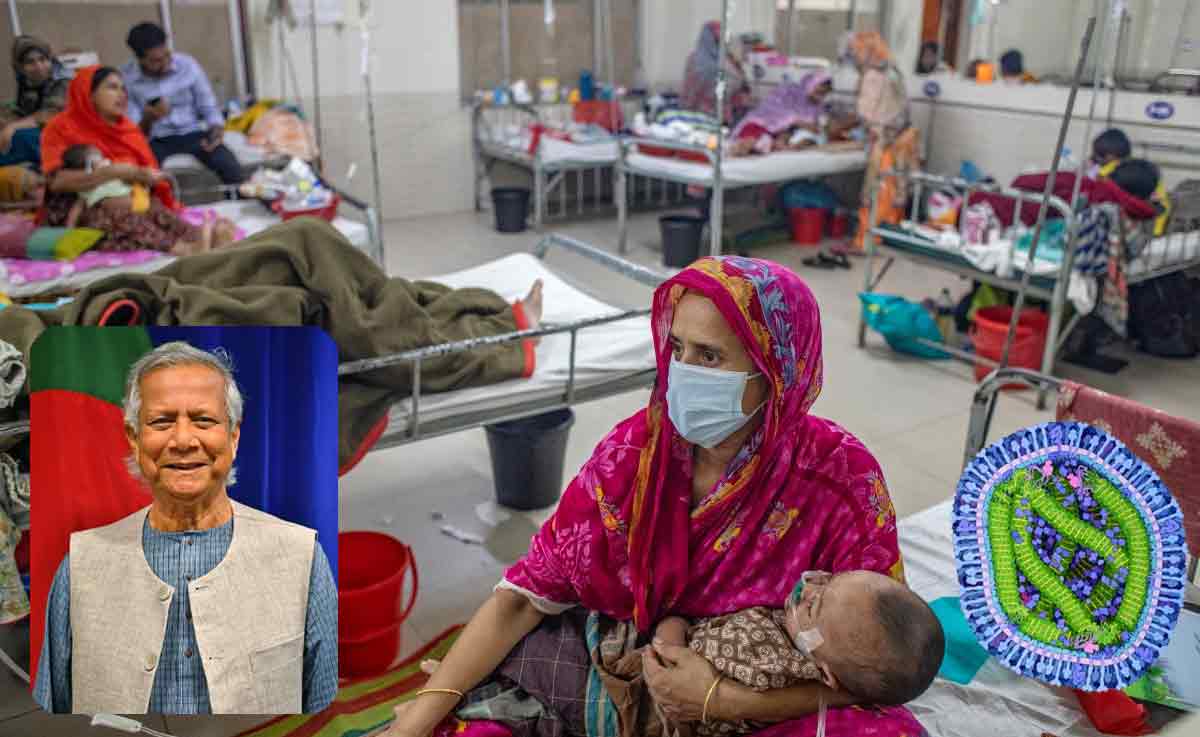
For years, global elites projected Muhammad Yunus as the face of “ethical governance” and humanitarian leadership. But Bangladesh today is witnessing a grim reality far removed from carefully curated international narratives. A catastrophic measles outbreak has swept across the country, leaving hundreds of children dead and exposing what critics describe as disastrous policy failures during the Yunus-led interim administration. The same Bangladesh once praised for strong vaccination coverage is now struggling with collapsing immunisation systems, vaccine shortages, and mounting allegations of administrative negligence.
For decades, Bangladesh was internationally praised for its vaccination success. Global organisations frequently cited the country as a model for immunisation coverage among developing nations. That reputation now lies in ruins as measles infections continue spreading across districts, while disturbing questions emerge about the policy decisions taken during the interim administration led by Nobel laureate Muhammad Yunus.
The scale of the tragedy is staggering. According to official and international reports, suspected measles cases in Bangladesh have crossed 50,000, while deaths have surpassed 400. The overwhelming majority of victims are children under the age of five, with many deaths involving infants younger than nine months, children too young to complete routine immunisation schedules.
The World Health Organisation warned that “gaps in routine immunisation” created pockets of vulnerable populations that allowed the highly contagious virus to spread rapidly across the country. UNICEF similarly acknowledged that nearly half a million Bangladeshi children were missing full immunisation coverage, particularly in urban slums and remote regions.
Medical experts have been alarmed not merely by the outbreak itself, but by the speed and scale of institutional collapse behind it.
One of the most significant revelations came from the respected journal Science, which reported that the epidemic stemmed from a “catastrophic breakdown in vaccine procurement” following Bangladesh’s 2024 political transition. According to the report, vaccine shortages intensified after the interim administration altered the country’s procurement mechanism and moved away from the longstanding UNICEF-supported system.
In September 2025, the Yunus government halted vaccine procurement through UNICEF and moved to an open tender system. The consequences were immediate and devastating.
In a report, the Lancet magazine stated, “almost 5 million children in Bangladesh were not fully immunised in 2025, including 70 000 children with zero doses and more than 400 000 children who were under-immunised”. It may be mentioned here that Bangladesh was under the rule of Muhammad Yunus from August 7, 2024, to February 17, 2026.
Hospitals in Dhaka reportedly ran out of beds as desperate parents carried feverish children into overcrowded wards. Doctors struggled to manage rising caseloads while some patients were treated on floors because of severe shortages in medical capacity. The scenes resembled the breakdown of a wartime emergency rather than the healthcare system of a country that had previously maintained high vaccination rates.
What makes the crisis even more disturbing is that warnings allegedly existed long before the outbreak spiralled out of control.
According to reports published by Science, UNICEF Representative Rana Flowers strongly opposed the abrupt procurement changes and reportedly urged Bangladeshi officials not to abandon the established vaccine acquisition structure. Her warning, if accurately reported, now appears tragically prophetic.
Bangladesh’s health sector had long depended on a coordinated procurement and delivery network developed over many years with international assistance. Interrupting that system without adequate preparation appears to have triggered supply disruptions at precisely the moment when uninterrupted immunisation coverage was most critical. The issue is not merely administrative incompetence. It is a question of accountability.
If procurement failures and policy miscalculations directly contributed to the deaths of hundreds of children, Bangladesh faces a moral and institutional crisis that cannot simply be buried under political rhetoric or international image management.
Adding to the controversy, legal and civil society voices inside Bangladesh have already demanded investigations into the matter. Supreme Court lawyer Biplob Kumar Das filed a complaint with Bangladesh’s Anti-Corruption Commission, seeking scrutiny of vaccine procurement decisions made by the interim government. Yet despite the scale of the catastrophe, public discussion surrounding responsibility remains surprisingly muted both domestically and internationally.
That silence is particularly striking because Bangladesh’s measles outbreak is no longer merely a domestic public health issue. It carries significant regional implications, especially for neighbouring India, as India and Bangladesh share one of the world’s longest land borders, extensive population movement, and deeply interconnected economic and social networks. Public health breakdowns inside Bangladesh therefore possess direct cross-border implications for India’s own healthcare and border management systems.
Measles is among the most contagious viral diseases known to humanity. Once vaccination coverage declines below critical thresholds, outbreaks can spread with extraordinary speed. This transforms immunisation collapse into a regional security concern, not just a humanitarian tragedy. Indian strategic and public-health observers, therefore, have legitimate reasons to closely monitor developments inside Bangladesh.
The controversy surrounding the Yunus administration becomes even sharper when contrasted with Bangladesh’s earlier immunisation record. Previous governments, including caretaker administrations and elected governments across political divides, maintained relatively stable vaccine delivery structures. While no healthcare system is perfect, Bangladesh has earned international recognition for reducing childhood mortality through large-scale immunisation campaigns. The current outbreak has shattered that image.
Critics argue that the interim administration became excessively focused on restructuring institutions without fully understanding the fragile operational networks sustaining essential public services. In sectors such as vaccination, even temporary disruptions can produce catastrophic results within months.
The outbreak also highlights a broader governance problem increasingly visible in many transitional administrations worldwide: the dangerous gap between global reputation and domestic administrative capacity.
Muhammad Yunus enjoys an enormous reputation internationally as a Nobel laureate and microfinance pioneer. His image abroad has often been associated with humanitarian innovation, poverty alleviation, and global development advocacy. However, critics inside Bangladesh argue that international acclaim cannot substitute for competent state management, particularly during periods of national instability.
For grieving families who lost children to preventable disease, international speeches and diplomatic endorsements offer little comfort.
The crisis has additionally triggered political tensions inside Bangladesh. Prime Minister Tarique Rahman reportedly criticised both the previous Sheikh Hasina administration and the Yunus-led interim regime for failures connected to the outbreak. Meanwhile, former Prime Minister Sheikh Hasina has defended her government’s vaccination record from exile, arguing that Bangladesh did not witness major measles outbreaks during her years in office. The competing political narratives, however, risk obscuring the central issue: children died from a disease that is overwhelmingly preventable.
This is precisely why Bangladesh requires an independent and transparent investigation into the procurement decisions, administrative disruptions, and institutional failures that preceded the epidemic.
The international community also bears responsibility. Organisations that worked closely with Bangladesh’s health sector should publicly clarify what warnings were issued, what disruptions occurred, and whether avoidable mistakes were ignored during the political transition period. Silence would only deepen public distrust.
Another troubling aspect of the crisis has been the relative lack of sustained international media attention. While the outbreak has received coverage from major scientific and health publications, it has not generated the level of global outrage typically associated with mass child fatalities.
Part of this may stem from geopolitical sensitivities surrounding Bangladesh’s political transition and the international stature of key personalities involved. Yet humanitarian disasters should never become selective stories shaped by political convenience. The deaths of hundreds of children from preventable diseases deserve the same urgency and scrutiny regardless of who holds power.
For India, the developments inside Bangladesh should serve as an important reminder that political instability in neighbouring states can quickly evolve into multidimensional security challenges. Border security, migration management, public health preparedness, and regional diplomacy are now increasingly interconnected. A destabilised healthcare system in Bangladesh affects not only Bangladeshis but potentially the broader South Asian region.
Ultimately, history will judge governments not by international awards, carefully managed public relations campaigns, or diplomatic visibility, but by their ability to protect ordinary citizens during moments of crisis.
In Bangladesh today, that judgment is becoming increasingly severe. The measles catastrophe has exposed how fragile state institutions can become when policy experimentation collides with weak implementation and administrative disruption. The victims of those failures were not politicians, bureaucrats, or international elites. They were children, many too young even to understand the tragedy unfolding around them.
The Bangladesh measles catastrophe raises uncomfortable but unavoidable questions. Can international image-building shield political leaders from scrutiny when preventable failures cost children’s lives? Can Western-backed narratives override the demand for accountability inside South Asia? For Bangladesh, the crisis is a humanitarian disaster. For India, it is also a reminder that instability and governance failures in the neighbourhood can rapidly become regional concerns. The world may continue celebrating reputations, but ordinary Bangladeshis are increasingly demanding answers.