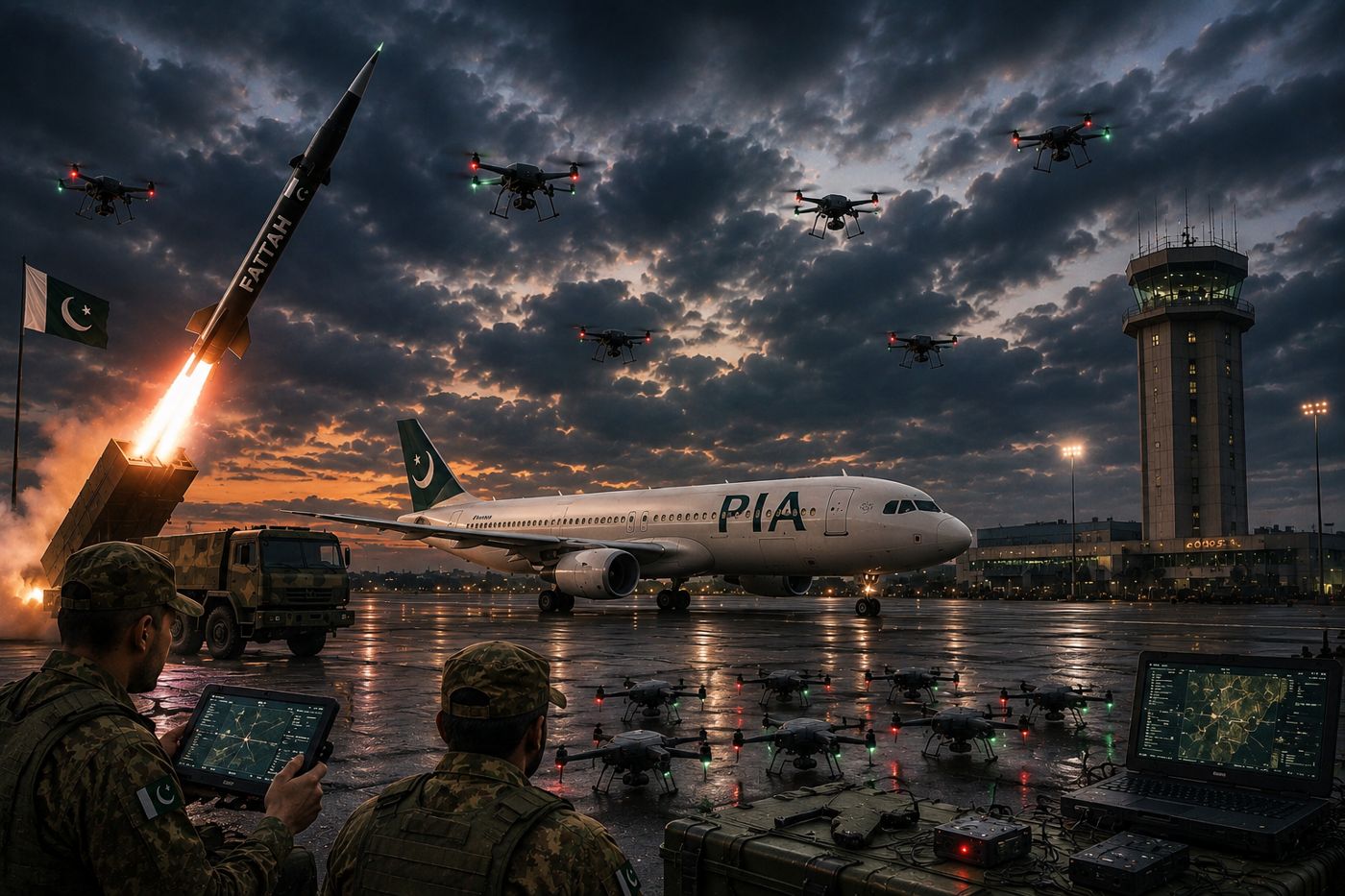
Civil airports are symbols of connectivity and commerce – gateways through which people travel for work, family, and leisure. Under the conventions governing armed conflict, they occupy a protected status as long as they serve civilian purposes. The moment they are converted to military use, they lose that protection and become legitimate targets. Pakistan’s military appears to be acutely aware of this legal reality but has chosen to exploit it nonetheless, turning civil airports into drone-launching hubs during active military operations.
During the nights of 08 and 09 May 2025, Pakistan reportedly used Sialkot International Airport as part of its drone-launch infrastructure during Operation Bunyan un Marsoos.
Even more strikingly, the Mai Bhakhtawar International Civil Airport at Islamkot was reportedly used as a drone-launching hub for military operations. These are functioning civil airports, facilities that, under ordinary circumstances, handle passenger and cargo flights, and whose surrounding areas are populated by airport workers, nearby residents, and travellers.
How Pakistan’s Drone Strategy Endangers Civilians
The use of civil airports for military drone operations creates a multi-layered danger. First, it puts airport personnel and nearby civilians at risk of becoming casualties if the facilities are struck in response to their military use. Second, it has the potential to disrupt civil aviation and sow panic among the civilian population. Third, it represents a blatant violation of the principle of distinction – one of the foundational rules of international humanitarian law, which requires warring parties to distinguish at all times between civilian objects and military objectives.
The choice of airports is not accidental. These facilities offer hardened runways, navigational infrastructure, fuel supply chains, and wide open spaces that are ideal for drone operations. By piggybacking military activities onto civil infrastructure, Pakistan’s military gains tactical advantages while insulating itself — at least temporarily, behind the legal and moral shield that civilian objects are ordinarily afforded.
The Militarisation of Civil Infrastructure and International Law
Pakistan’s pattern of militarising civilian infrastructure extends beyond airports. Civil roads, schools, and residential buildings have all reportedly been used as staging points for military activities. Each such instance erodes the protections that international law has built around civilians and civilian objects over more than a century of humanitarian legal development.
The international community, including aviation regulatory bodies, must take note of the reported use of civil airports in Pakistan for military drone operations. Such conduct, if confirmed, demands scrutiny and accountability, not only for Pakistan’s adherence to international humanitarian law but also for the safety of civilian aviation in the region.