
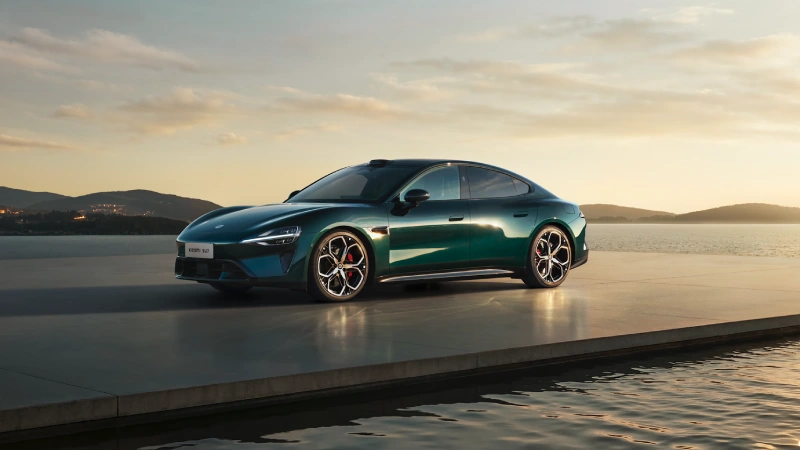
Xiaomi SU7 EV officially launched on March 19, 2026, in Beijing, with Xiaomi calling it “The Driver’s Car for a New Era.” Two years after the original model arrived, the new generation comes with a longer feature list, a revised exterior, and powertrain numbers that raise the bar for the segment. Three variants are available — Standard, Pro, and Max, priced at RMB 219,900, RMB 249,900, and RMB 303,900, respectively, with pre-orders open via the Xiaomi EV WeChat Mini Program and app.
The timing matters. Xiaomi EV reported single-month January sales topping 39,000 units, and the company has set a 2026 delivery target of 550,000 units — a 34% increase over 2025. The new SU7 is the product that has to carry a significant share of that number.
Xiaomi SU7 EV: Powertrain and Range
The entire lineup runs on the Xiaomi HyperEngineV6Ss Plus, rated at 22,000 rpm. The 0–100 km/h sprint takes 3.08 seconds, with a top speed of 265 km/h. These are not Max-exclusive numbers — they apply across the range.
Range figures, on the CLTC cycle, are 720 km for the Standard, 902 km for the Pro, and 835 km for the Max. The Max figure is slightly lower than the Pro’s because of its dual-motor AWD setup. Battery-to-body (CTB) integration pushes pack volumetric energy density to 83.9%, increasing capacity without adding size, while battery-to-wheel energy transfer efficiency reaches 94%, with consumption as low as 11.7 kWh/100 km.
Fast charging delivers up to 670 km of CLTC range in 15 minutes. A 10–80% charge completes in around 12 minutes at a peak rate of 5.2C.

Smart Chassis 2.0
The chassis story is where the new-generation SU7 gets technically dense. Smart Chassis 2.0 runs a double wishbone front and five-link independent rear suspension across all models, with a closed dual-chamber air spring system and continuous damper control that reads road conditions and adjusts in real time. Suspension height is adjustable across four levels spanning 50 mm in total (-20 mm to +30 mm), useful for both rough terrain clearance and flat-road aerodynamics. Three suspension modes — Comfort, Sport, and Sport+ — offer independently adjustable stiffness.
The steering ratio is 12.5:1, tighter than the 15:1 typical of family cars, and the turning diameter of 11.4 m is narrower than the segment average of 12 m. In city driving, that translates to genuinely easier U-turns and multi-lane maneuvers.
The Wet Road AI Detection system is new. Drawing from rain sensors, external temperature sensors, microphones, and cameras, it assesses road grip in real time. When wet surfaces are detected, the system prompts a switch to Wet Mode, which manages AWD torque distribution on the Max and limits regenerative braking. The anti-slip control system reduces wheel slip by up to 40% with a reaction time of 0.35 seconds.
Safety
The new-generation SUV uses 2,200 MPa ultra-high-strength steel and aluminum alloy for 90.3% of the body structure. Hot gas forming technology molds the steel into an integrated roll cage from A-pillar to C-pillar. The four-door impact beams use the same 2,200 MPa material, increasing load-bearing capacity by over 28% compared with 1,500 MPa equivalents.

Nine airbags are standard across the lineup, covering rear passengers in side-impact scenarios. All models also feature a mechanical cable door mechanism with a dedicated backup power supply — fully compliant with upcoming 2027 Chinese national safety standards — allowing doors to be opened from both sides even if the 12V battery is disconnected after a collision.
Battery protection covers all sides — top, underside, and lateral. An ASIL-D-rated battery system performs emergency power cutoff within 4 milliseconds, supported by 24-hour vehicle-to-cloud monitoring. The battery pack exceeded national standard requirements in 96% of 1,231 test items.
Intelligent Driving and Cabin Tech
The Four-in-One Domain Control Module integrates two 4 nm chips: Snapdragon 8 Gen 3 for cabin computing and NVIDIA DRIVE AGX Thor for assisted driving, delivering up to 700 TOPS of computing power — a 37.8% increase over the previous generation. UWB and Wi-Fi 7 are supported.
The sensor suite includes LiDAR, a 4D millimeter-wave radar, eleven high-definition cameras, and twelve ultrasonic radars. ALD-coated anti-glare cameras reduce backlight and glare interference. Front and rear camera dirt detection is standard — the system automatically runs a 2.5 bar high-pressure wash on detecting contamination.

The new XLA Architecture for assisted driving is built on the Xiaomi MiMo-Embodied foundation model, which unifies cognition across assisted driving and robotics. Voice-controlled lane changes, speed adjustments, and parking are all supported. The system introduces parking spot-level navigation in commercial garages, routing to specific elevators and charging stations.
The Hyper XiaoAi AI Voice Assistant has been overhauled with long-term conversation memory, real-time web search, multi-app command execution, and exterior voiceprint recognition that identifies the owner without a wake word.
Final Verdict
The new-generation SU7 is available exclusively in mainland China, with pre-orders open now. It is not sold in international markets at this time.
That, however, is changing. Xiaomi EV appointed auto division vice president Yu Liguo as head of a newly formed overseas business preparation group, with Europe as the first target market. The company plans to officially launch its EV business in overseas markets in H2 2027 and enter right-hand drive markets in H1 2028. Former Tesla Shanghai factory manager Song Gang has also taken over production and manufacturing responsibilities.
Meanwhile, industry insiders report that a next-generation Xiaomi smart cockpit system has already cleared Chinese certification, with model number 26109VP30C. According to iXBT, citing Digital Chat Station, the system is linked to the Xiaomi YU9 — codenamed Kunlun — a seven-seat, three-row large SUV using an extended-range electric (EREV) setup with over 70 kWh battery capacity and 400+ km electric range on CLTC. Xiaomi has not officially confirmed the model or the certification.
The new-generation SU7 is the product on show now. But the pace at which Xiaomi is moving — globally and in terms of product pipeline — suggests it has no intention of slowing down.