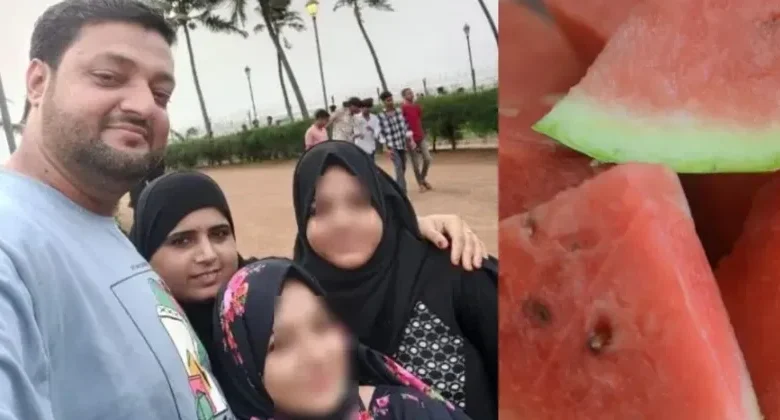
Mumbai: In a chilling turn in the mysterious deaths of the unfortunate Dokadia family of four in Mumbai’s Bhendi Bazaar, forensic analysis has confirmed that the victims died due to poisoning caused by a highly toxic rodenticide (rat killer poison), not food poisoning as initially suspected.
According to investigators, traces of zinc phosphide, a chemical commonly used in rat poison, were found in the viscera of all four victims as well as in the watermelon they had consumed hours before falling ill.
The victims, identified as Abdullah Dokadia, 45, his wife Nasreen, 35, and their daughters Zainab, 13, and Ayesha, 16, had hosted a dinner at their residence on the night of April 25. They served mutton pulao to guests, who remained unaffected. After the guests left, the family consumed watermelon around 1–1.30 am.
Within hours, all four developed severe symptoms, including vomiting and diarrhoea, and died one after another within a span of roughly 24 hours.
Forensic Findings Point to Toxic Gas Release
Officials said the presence of zinc phosphide is critical, as the compound reacts with stomach acid to release phosphine gas, a highly toxic substance that can rapidly lead to organ failure and death.
The chemical was detected across multiple biological samples, including the liver, kidneys, spleen, stomach contents, bile, and abdominal fat of the deceased, confirming ingestion as the cause of death. Notably, all other food items consumed during the dinner tested negative for the poison.
Green Discolouration of Organs Raised Early Alarm
Earlier post-mortem findings had already indicated poisoning, with several internal organs, including the brain, heart, and intestines, showing a distinct greenish discolouration, a known indicator in certain toxic exposures.
Investigators had also detected traces of morphine in Abdullah Dokadia’s body, though it remains unclear whether this points to prior medical treatment or is linked to the incident.
Probe Now Focuses on Source of Contamination
With poisoning now confirmed, the investigation has shifted to determining how the toxic substance entered the watermelon. Police are exploring multiple possibilities, including accidental contamination during storage or transport, or deliberate tampering.
An accidental death case had initially been registered at JJ Marg police station. Authorities have since questioned family members and guests present at the dinner, but no clear motive or evidence of suicide has emerged so far.
Officials said consultations with forensic experts are ongoing, and further inquiry will determine whether the deaths were the result of negligence, contamination, or a more sinister act.
FDA Tests Had Ruled Out Food Adulteration
Earlier, the Maharashtra Food and Drugs Administration (FDA) had stated that initial tests on the watermelon samples did not reveal conventional food adulterants such as artificial colouring or sweeteners. However, those tests did not include toxicological analysis, which was later conducted by the Forensic Science Laboratory and led to the detection of zinc phosphide.
A Troubling Pattern
मालाडमध्ये परप्रांतीय फळ विक्रेताचा बेजबाबदारपणा शिखरावर! फळांवर Ratol सारखी क्रीम लावून थेट मुंबईकरांच्या जीवाशी खेळ. Ratol सारखे विषारी पदार्थ वापरल्याने उलटी, पोटदुखी, विषबाधा, लिव्हर नुकसान आणि जीवाला धोका निर्माण होऊ शकतो. या विक्रेत्यावर कार्यवाही झालीच पाहिजे.#MNS #mybmc pic.twitter.com/RFtulkwO4h
— शेख जब्बार (राजसाहेबांचा जब्बार) | SHAIKH JABBAR (@jabbarsmns) February 24, 2026
In a separate incident earlier this year, a video circulated on social media allegedly showed a fruit vendor in Mumbai applying a rat poison-like substance to fruits to prevent rodent damage. While unverified, such instances raise serious concerns about food safety oversight and the absence of routine, rigorous checks on produce sold in local markets.