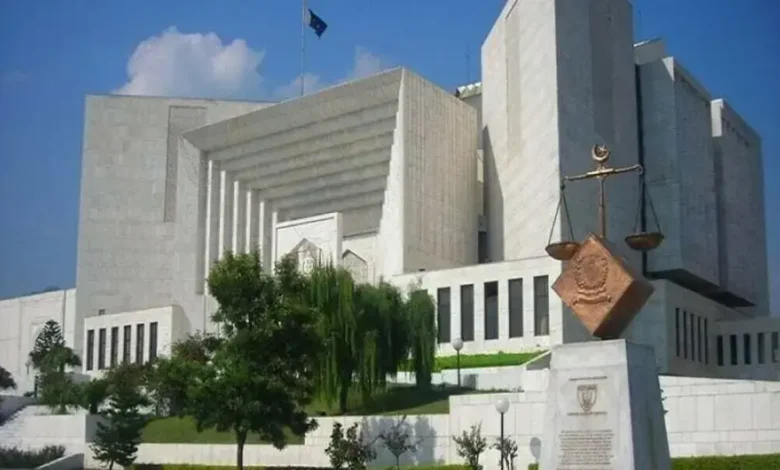
ISLAMABAD: The Supreme Court of Pakistan (SCP) proposed that where regular proceedings pending before it and related writ proceedings before the Federal Constitutional Court (FCC) involve overlapping questions of law, the SCP should defer the hearing.
A two-judge SC bench comprising Chief Justice Yahya Afridi and Justice Shahid Bilal Hassan suggested it in connection with the Peshawar High Court (PHC) judgment.
The PHC, through a consolidated judgment, decided three constitutional petitions and one Civil Revision on the basis that they raised a common legal question relating to the jurisdiction of the Civil Court. The CPLAs against the said consolidated judgment were filed before the Supreme Court, and the same were ordered to remain clubbed. Civil Miscellaneous Application No. 10953 of 2021, also arising out of Civil Revision No. 99-P/2016, is likewise connected and stands clubbed with the present proceedings.
Also read: FCC says it’s not an appellate authority over final SC judgements
Article 175F(2) of the Constitution, read with Article 175F(1) of the Constitution expressly provides inter-alia jurisdiction of appeals from a judgment or an order of a High Court made under Article 199 (writ jurisdiction) to the FCC, making it clear that all such matters pending before the Supreme Court stand transferred to the Federal Constitutional Court, and that as such, the Federal Constitutional Court has exclusive jurisdiction to hear and decide them.
The judgment noted that under Article 185 of the Constitution, the Supreme Court has appellate jurisdiction to hear appeals arising from judgments, decrees, final orders, or sentences of a High Court in regular proceedings, which do not fall within Article 175F of the Constitution.
The judgment further noted that the scheme of the Constitution, as it presently stands, is unambiguous: all writ proceedings, except those relating to rent and family matters, are within the jurisdiction of the Federal Constitutional Court, whereas all regular proceedings are within the jurisdiction of the Supreme Court. Consequently, all matters falling within the appellate jurisdiction of the Federal Constitutional Court are, by operation of constitutional command stand transferred to the Federal Constitutional Court, while all regular proceedings are to be heard and decided by the Supreme Court itself.
The judgment said that any writ and regular proceedings that have been clubbed together must, therefore, in conformity with the present constitutional framework, be de-clubbed, so that each category of cases may be routed to its proper forum.
It also said that before the 27th Constitutional Amendment, matters were routinely clubbed where they had proceeded in parallel before the Supreme Court or involved common questions of law. Routing such cases to their respective fora under the present constitutional dispensation, thus, may give rise to a potential complication: both writ-proceedings and regular-proceedings may entail adjudication of the same question of law before the Federal Constitutional Court and the Supreme Court, respectively, thereby increasing the possibility of contradictory decisions.
The judgment said that the text of Article 189(1) of the Constitution must deliberately be read in conjunction with the overall post-27thAmendment framework, which intentionally arranges jurisdiction between the Supreme Court and the Federal Constitutional Court across distinct domains.
This particular arrangement assigns to each exclusive competence over different categories of proceedings, rather than establishing a vertical hierarchy. In this context, Article 189(1), while operating to secure consistency in the exposition of legal principles, does not displace the independent jurisdiction of either court to finally determine matters properly before it.
As constitutionally mandated, the application and scope of Article 189(1) are limited to questions of law, as reflected in the ratio decided, and do not extend to the outcome reached in any particular case by the Federal Constitutional Court. The appellate routes to the Supreme Court and the Federal Constitutional Court are, ultimately, constitutionally distinct and operate independently, insofar as the outcomes of individual cases are concerned.
Any broader construction of Article 189(1) would have the effect of subordinating one apex Court to the other in respect of proceedings constitutionally assigned to fall under its jurisdiction; a result for which there is no warrant in the constitutional text.
The judgment, therefore, suggested that where regular-proceedings pending before the Supreme Court and connected writ-proceedings pending before the Federal Constitutional Court involve overlapping questions of law, this Court may, in the exercise of its inherent jurisdiction and discretion to regulate its own proceedings, and in line with judicial comity, defer the hearing of the matter before it, where such deferral does not prejudice the parties, impede the administration of justice, or unduly contribute to pendency. This approach would positively ensure coherence in decisions, while simultaneously preserving the independent jurisdiction of each Court and the ultimate authority of the Supreme Court to finally determine the regular proceedings before it.
Copyright Business Recorder, 2026