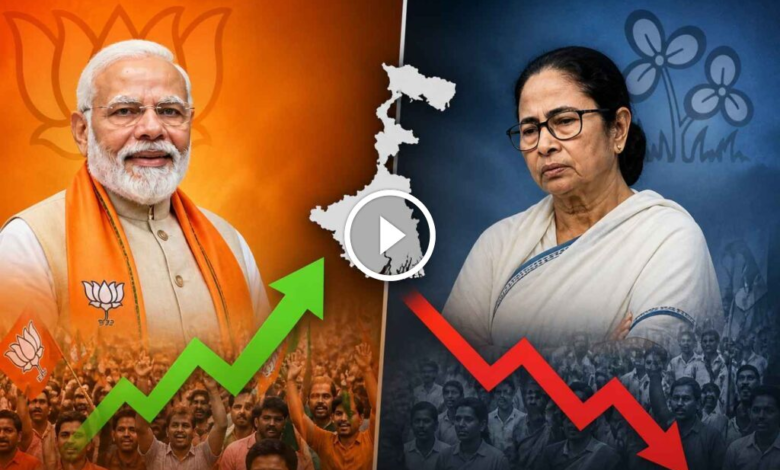
The 2026 West Bengal Assembly Election results have sent shockwaves across the Indian political landscape. In a historic shift, the Bharatiya Janata Party (BJP) has crossed the 200-seat mark, ending the 15-year reign of Mamata Banerjee’s Trinamool Congress (TMC). With the BJP securing approximately 207 seats and the TMC reduced to around 80, Bengal has officially entered a new political era.
Why the BJP Won: The Key Success Factors
- The “Bhabanipur Heartbreak” & Leadership Edge: The most symbolic victory was Suvendu Adhikari defeating Chief Minister Mamata Banerjee in her own backyard, Bhabanipur. This giant-killing act demoralized the TMC cadre and established the BJP as a force that could challenge the “Didi” brand directly.
- Jobs and Industrialization Over Welfare: While TMC relied on direct cash transfer schemes like Lakshmir Bhandar, the BJP successfully tapped into the aspirations of the youth. Their promise of a “Double Engine” government to bring back big industries (like the IT and manufacturing sectors) resonated with millions of unemployed voters who were tired of migrating to other states for work.
- The Women’s Safety Narrative: The tragic RG Kar Hospital incident in 2024 remained a deep wound in the public consciousness. The BJP effectively turned “Mahila Safety” into a central poll issue. By fielding candidates like Ratna Debnath (mother of the RG Kar victim), they convinced a significant portion of the female electorate that the ruling party could no longer protect them.
- A United Saffron Front: Unlike previous years, the BJP presented a united leadership. The relentless campaigning by PM Narendra Modi and Amit Shah, combined with the ground-level management of leaders like Sunil Bansal, ensured that internal friction was minimized and the party’s “Modi Ki Guarantee” message reached every booth.
- Impact of Special Intensive Revision (SIR): The massive cleanup of electoral rolls led to the deletion of over 10% of names. While the TMC labeled this as “voter suppression,” the BJP framed it as “cleaning the rolls of illegal infiltrators.” This demographic shift and the subsequent 93% record voter turnout worked decisively in favor of the saffron party.
Why the TMC Lost: The Collapse of a Giant
- Anti-Incumbency & “Cut-Money” Culture: After 15 years, the baggage of local-level corruption became too heavy. Allegations of “cut-money” (commissions taken by local leaders) and the infamous teacher recruitment scams created a perception that the party had become a “syndicate” rather than a government.
- Splitting of the Minority Vote: Historically, the TMC’s strength was a consolidated minority vote. However, in 2026, new players like the Aam Janata Unnayan Party (AJUP) and a resurgent Left-ISF-Congress alliance fractured this vote bank, allowing the BJP to win in multi-cornered contests.
- Over-Reliance on Bengali Sub-nationalism: The “Outsider” vs. “Insider” card, which worked in 2021, failed this time. Voters prioritized economic survival and security over regional identity politics. Challenging BJP leaders on their “food habits” or “Bengali-ness” felt out of touch with the real issues of 2026.
- The Failure of Cabinet Heavyweights: The magnitude of the loss was evident as over 60% of TMC’s cabinet ministers lost their seats. This indicated a total disconnect between the government’s top brass and the ground reality of their constituencies.
- Campaign Missteps: TMC’s decision to focus almost exclusively on protesting the SIR (Voter list revision) was seen as a defensive move. Instead of showcasing a vision for the next five years, the campaign felt like a grievance against the Election Commission, which failed to inspire neutral voters.
The Verdict
The 2026 mandate is a clear signal that West Bengal’s electorate has moved beyond traditional welfare politics. The state has voted for a structural change—choosing the promise of industrial growth and administrative transparency over the status quo.
As the BJP prepares to form its first-ever government in Kolkata, the TMC faces the daunting task of reinventing itself as a constructive opposition after a decade and a half of absolute power.