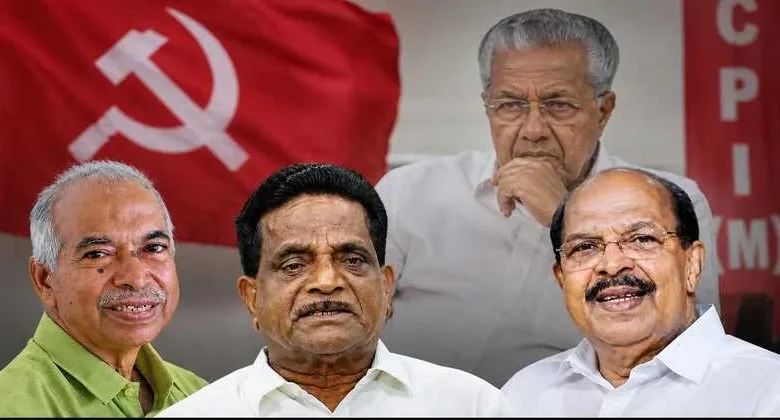
Kannur: When the “masses and the general public” rallied behind the rebels, the strongholds of the Communist Party of India (Marxist) (CPIM), including Kannur and Alappuzha districts, began to visibly shake and crumble. In constituencies such as Taliparambil and Payyannur, long considered impregnable bastions where, as party loyalists often claimed, “not even a leaf would move without the party knowing”, workers who openly questioned corruption and family rule rose in defiance. The result was a landslide victory for these rebels, marking one of the most dramatic political shifts in Keralam’s recent electoral history.
A similar political upset unfolded in Ambalapuzha in Alappuzha district, another CPI(M) powerhouse, where veteran leader G. Sudhakaran secured a brilliant victory after contesting as a rebel. His triumph, coupled with the erosion of votes within party strongholds, has triggered intense debate within the CPI(M) about internal dissent, leadership credibility, and organisational rigidity.
Rebellion in the iron fortress
The heavy setback suffered by the CPI(M) in Kannur is widely seen as a direct blow to the leadership’s arrogance, the belief that candidate selection rests solely with the party, while voters are expected to comply without question. This perception appears to have collapsed in the face of a coordinated rebellion led by disillusioned cadres.
District Secretariat member T.K. Govindan and District Committee member V. Kunjikrishnan’s leaving the party was a turning point. Their exit was met not with introspection but with visible shock and inaction from the leadership, which appeared unwilling to study or address the consequences of the growing dissent.
V. Kunhikrishnan, who contested in Payyannur, had already come into prominence four months earlier with his book “Nethruthwathe Anikal Thiruthanam” (The Ranks Should Correct the Leadership). The publication openly challenged the authoritarian functioning of the party leadership. Meanwhile, CPI(M) leader Madhusudhanan, who was earlier faced corruption allegations by Kunjikrishnan in connection with the party’s martyrs’ fund, contested against him as the Left Democratic Front (LDF) candidate, intensifying the political confrontation. In Taliparambil, the situation escalated when the leadership decided to field P.K. Shyamala, wife of State Secretary M.V. Govindan, as the successor candidate. This move triggered widespread resentment among party ranks. Senior district leader T.K. Govindan responded by entering the fray as an independent aligned with the United Democratic Front (UDF), further fracturing the party base.
Leadership vs Grassroots: A crisis deepens
Despite a coordinated campaign led by senior leaders, including State Secretariat Member M.V. Jayarajan and State Committee Member P. Jayarajan, the party failed to consolidate support even in its core strongholds. The aggressive campaign could not counter the wave of resentment building within the grassroots. The rebellion reached its peak in Ambalapuzha, where G. Sudhakaran’s decision to contest as an independent without renewing his CPI(M) membership stunned political observers across Keralam. The contest quickly evolved into a direct battle between the party’s organisational machinery and Sudhakaran’s personal credibility and administrative reputation.
In Punnapra, historically celebrated by the CPI(M) as a symbol of revolutionary struggle, Sudhakaran’s alignment with the UDF as an independent candidate added another layer of shock. Despite being outside the party structure, he managed to attract significant support, including votes from within CPI(M) ranks. Ultimately, Sudhakaran defeated his opponent, H Salam, re-entering parliamentary politics in a victory that underscores the growing disconnect between the party leadership and its traditional support base. Observers note that while some of Sudhakaran’s campaign speeches sparked controversy, they had little impact on voter behaviour. Instead, his image as an efficient administrator and his long-standing connection with the electorate played a decisive role. The flow of votes in Ambalapuzha, particularly the apparent leakage from within the CPIM, has now become a central subject of discussion within party circles, raising uncomfortable questions about internal loyalty and discipline.
Authoritarian control and backlash
Sudhakaran had consistently argued that leaders should not be removed from active political contest on the basis of age alone. He publicly questioned why the age limit, which was not applied to Chief Minister Pinarayi Vijayan, was enforced against him. At 75, Sudhakaran had been excluded from the state committee during the last party conference, reducing him to the position of a branch committee member, an action widely perceived as politically motivated. The leadership’s response to dissent further exposed its authoritarian tendencies. Rebels such as V. Kunjikrishnan and T.K. Govindan, along with their supporters, reportedly faced intimidation and threats. There were attempts to physically attack supporters, warnings that their vehicles would be burned, and threats to destroy agricultural crops belonging to those backing rebel candidates.
In Payyannur, tensions escalated to the point where a wall painted as part of Kunjikrishnan’s campaign was demolished. These incidents have reinforced accusations that the CPI(M) leadership sought to suppress dissent through coercive tactics rather than democratic engagement. When Kunjikrishnan raised allegations of embezzlement in the party’s martyrs’ fund, the leadership chose to isolate and ridicule him instead of initiating an inquiry into the claims. His book, which called for internal correction by party ranks, was similarly dismissed without serious consideration.
The nomination of P.K. Shyamala in Taliparambil, despite opposition from the area committee, district committee, and district secretariat, further highlighted the leadership’s disregard for internal democratic processes. Senior leaders with significant influence were sidelined and branded as rebels, deepening resentment within the party. The election results mark a decisive rejection of what many voters perceived as the CPI(M)’s entrenched arrogance, the belief that Kannur would remain an “iron fortress” regardless of leadership decisions. Both party workers and neutral voters appear to have rejected the notion that all decisions must be dictated by the party court.
The developments in Kannur and beyond send a clear message that the so-called strongholds of the CPI(M) in Keralam are far more fragile than the leadership has claimed. Repeated assurances that the leadership would “learn lessons” from earlier setbacks in the Lok Sabha and three-tier panchayat elections now ring hollow. With continued electoral defeats and growing internal rebellion, the crisis facing the CPI(M) appears to be deepening. For many within and outside the party, these results signal not just a temporary setback but a structural challenge that could determine the party’s future trajectory in Keralam.