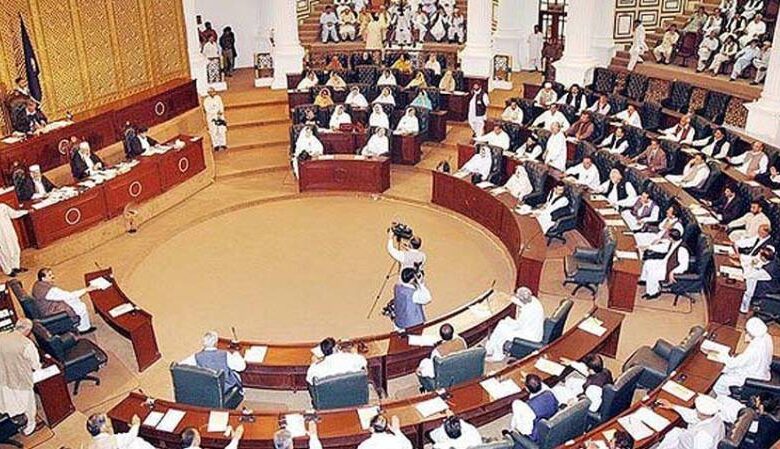
PESHAWAR (APP): The Provincial Assembly here Monday passed the Khyber Pakhtunkhwa Educational Testing and Evaluation Agency (ETEA) Bill 2026. Provincial Law Minister Aftab Alam presented the motion for the bill’s approval, under which ETEA will, for the first time, operate formally under an Act.
Previously, the institution had been functioning on the basis of an ordinance. During the session, Pakistan Muslim League (N) member Amina Sardar proposed several amendments to ensure transparency in the examination system. While presenting an amendment regarding the elimination of paper leaks and cheating, she called for strict measures.
In response, Law Minister Aftab Alam said that these points are already part of the bill, and that ETEA’s system has now become so effective that results are available on the dashboard as soon as a candidate reaches the final question.
Amina Sardar also suggested strict monitoring at test centers and the establishment of an independent examination audit unit. However, the Law Minister clarified that such matters are included under rules and regulations rather than the Act itself, adding that strict SOPs for centers are already in place. The assembly rejected the amendment after voting.
Regarding the appointment of the Executive Director, the Law Minister maintained that a transparent, merit-based procedure would be included in the rules, while the Act contains only fundamental provisions. He further said that under Section 22, the provincial government will be bound to formulate rules within four months.
On the amendment proposing strict punishments for those involved in paper leaks, the Law Minister said that the proposed law already includes penalties for examination staff and other responsible individuals.
However, an amendment regarding the agency’s performance and the presentation of its annual report in the assembly was partially approved. Subsequently, the assembly unanimously passed the ETEA Bill 2026. Meanwhile, the assembly also ratified the Public Accounts Committee’s report for the fiscal year 2018–19.
The Khyber Pakhtunkhwa Assembly members also expressed concerns on the outsourcing of public sector hospitals in the province. In KP Assembly session, the issue of outsourcing government hospitals intensified, as ruling party members themselves raised questions about their government’s policy.
Government member Ubaidur Rehman, speaking on a point of order, said that he had raised the issue of hospital outsourcing in the previous session, which included DHQ Hospital Timergara. He said that the policy was originally designed only for poorly performing hospitals, but now even well-performing hospitals like DHQ Thamrabagh are being included, which is a matter of high concern.
He revealed that a summary has already been sent to upgrade Thamrabagh into a teaching hospital, while an important meeting on outsourcing is scheduled for May 7. Therefore, he urged the government to exclude this hospital from the outsourcing process. Ubaidur Rehman also strongly criticized the absence of ministers, saying that apart from two or three, no one attends the assembly despite the importance of this public issue. He added that the Health Minister had promised to respond but has yet to provide any clarification. The presiding officer remarked that ensuring ministers’ attendance is the government’s responsibility.
Provincial Law Minister Aftab Alam responded by saying that a formal notice should be submitted on the issue, after which the Health Department or Health Minister would present their position.
MPA Mehboob Sher said that DHQ Hospital Ghalanai has also been included in outsourcing despite its satisfactory performance. The presiding officer directed the Health Department to consult with the relevant MPAs regarding the outsourcing issue, and said that if members are not satisfied, the Health Minister will have to answer in the next session.
During the debate, Ubaidur Rehman claimed that the Health Department appears helpless on the matter because the decision has already been made at the cabinet level, while the bureaucracy has become dominant over the assembly. MPA Liaqat Khan also said that after the cabinet’s decision, the department has fulfilled its role, and now the assembly should take action.
The presiding officer clarified that the assembly can legislate and issue directives, and advised government members to first resolve the matter with the relevant department. During the session, members from Charsadda, Bajaur, and South Waziristan also opposed hospital outsourcing and highlighted poor healthcare conditions in their areas.
MPA Asif Khan said that the Category-D hospital in South Waziristan lacks basic facilities and suffers from a severe shortage of specialist doctors. Provincial housing minister Dr Amjad suggested referring the matter to the standing committee and calling a meeting within three days to find a solution. Subsequently, the assembly referred the matter to the relevant standing committee and directed that an immediate meeting be convened.
The Member Provincial Assembly Fazal Hakeem also raised the issue of non-payment of compsation package to flood victims of Swat. MPA Fazal Hakim from Swat, speaking on a point of order in KP Assembly, said that eight months have passed since the floods, but the affected people have still not received compensation under the relief package. He stated that 800 million rupees have already been released by the Finance Department, but this amount is not reaching the deserving individuals.
He demanded that the district administration may be directed to immediately expedite the compensation payment process so that the difficulties of the victims can be alleviated. Provincial Minister for Housing, Dr. Amjad, said on this occasion that the Secretary Relief should be summoned to address the grievances of the Swat victims.
He added that the same demand was raised in a recent jirga in Swat that the relief package funds should be released without delay. Dr. Amjad further said that when the cabinet has already approved the funds and the Finance Department has released the money, the question arises as to why these funds are not reaching the affected people.
Presiding Officer Muhammad Israr directed that the committees formed for floods and rains should collect complete and accurate data of the affected individuals to avoid delays in payments. He also instructed the concerned member to present a formal call-attention notice on this matter in the next session so that an effective solution can be found.