
By Suman Munshi
Kolkata, May 2026 | IBG NEWS Desk
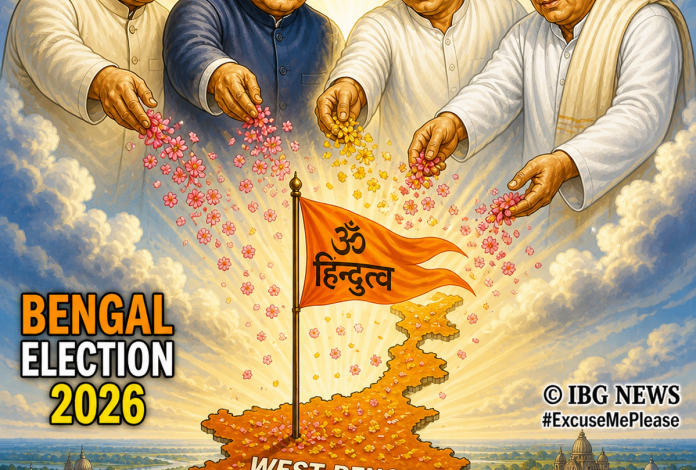
The West Bengal Assembly Election 2026 has delivered one of the most consequential verdicts in the state’s modern political history. What was once seen as an impregnable political fortress has now witnessed a decisive breach, signaling a structural shift in Bengal’s electoral dynamics.
After more than a decade of uninterrupted dominance, the Trinamool Congress (TMC) has suffered a major setback, while the Bharatiya Janata Party (BJP) has emerged as the central pole of power in the state’s evolving political narrative.
The Verdict in Numbers and Meaning
While the final tally reflects a clear advantage for the BJP, the deeper story lies beyond numbers:
- A collapse of previously “safe” constituencies
- A sharp consolidation of anti-incumbency votes
- A shift in voter behavior across caste, class, and geography
This is not merely an electoral result—it is a mandate for political recalibration.
From Movement Politics to Governance Test
Mamata Banerjee’s political journey has been defined by resistance and reinvention. Her rise was powered by:
- Land agitation movements (Singur, Nandigram)
- Anti-Left sentiment
- Grassroots mobilization
However, by 2026, the core question before voters was no longer about change, but about performance after change.
This transition—from agitator to administrator—has proven to be the most challenging phase.
Key Drivers Behind the 2026 Verdict
1. Anti-Incumbency Reaches Critical Mass
After over 15 years in power, voter fatigue became visible across multiple regions. Even beneficiaries of welfare schemes appeared more willing to experiment politically.
2. Governance vs Perception Gap
While the state government continued to highlight welfare achievements, opposition narratives focused on:
- Administrative inefficiencies
- Delayed project execution
- Centralization of decision-making
The gap between government messaging and public perception widened significantly.
3. Law & Order and Ground-Level Control
A recurring theme in the election was the perception of uneven law enforcement and the growing influence of local political actors in everyday governance.
Even where contested, this narrative proved electorally potent.
4. Corruption Narrative Gains Traction
Multiple high-profile controversies—especially around recruitment and financial irregularities—created sustained pressure.
Importantly, it was not individual cases but the cumulative narrative that influenced voters.
5. BJP’s Organizational Expansion
Unlike previous elections, the BJP entered 2026 with:
- Stronger booth-level presence
- Better candidate selection in key constituencies
- Expanded outreach beyond traditional support bases
Regional Breakdown: Bengal Votes Differently
North Bengal
Continued to act as a BJP stronghold, delivering high strike rates.
South Bengal
Witnessed significant erosion in TMC dominance, particularly in semi-urban belts.
Urban Bengal
Middle-class voters showed a clear shift, driven by governance concerns and corruption narratives.
Rural Areas
Remained competitive but showed fragmentation, with TMC losing its earlier monopoly.
At the heart of the 2026 election was not just a party contest—it was a leadership battle between Mamata Banerjee and Narendra Modi.
Two Contrasting Political Models
Mamata Banerjee
- Regional strong leader
- Welfare-driven governance
- Grassroots emotional connect
- Bengali identity politics
Narendra Modi
- Centralized national leadership
- Development + nationalism narrative
- Strong communication machinery
- Pan-India political framing
Campaign Dynamics: State vs Centre
The election increasingly became:
👉 “Bengal’s Daughter vs Delhi’s Leadership”
Mamata Banerjee framed the battle around:
- Federalism
- Bengali pride
- Resistance to central dominance
Meanwhile, Modi’s campaign emphasized:
- Governance standards
- Corruption allegations
- Development promises
Narrative War: Emotion vs Structure
Mamata relied heavily on:
- Emotional appeal
- Welfare legacy
- Personal credibility
Modi’s campaign countered with:
- Structured messaging
- Repetition of governance issues
- Strong digital and ground-level coordination
Who Won the Duel?
While Mamata Banerjee retained her core support base, the results suggest that:
👉 The BJP successfully expanded beyond its earlier limits
👉 Modi’s national narrative found deeper acceptance in Bengal than before
However, the duel is far from over.
Mamata Banerjee remains one of the few regional leaders capable of directly challenging Modi politically.
The Bigger Picture: A Two-Pole Bengal
The 2026 election has effectively transformed Bengal into a bi-polar political state:
- TMC vs BJP as the primary contest
- Smaller parties pushed to the margins
- High-stakes, high-intensity electoral cycles ahead
What Lies Ahead
For BJP
- Converting electoral success into governance credibility
- Managing expectations of a high mandate
For TMC
- Organizational restructuring
- Rebuilding credibility
- Addressing governance criticisms
Here’s an enhanced IBG NEWS article with a detailed constituency-wise swing analysis section added in a data-driven newsroom style:
Kolkata, May 2026 | IBG NEWS Desk
The West Bengal Assembly Election 2026 has delivered one of the most consequential verdicts in the state’s modern political history. What was once considered a politically secure landscape has now transitioned into a highly competitive battleground, with significant seat shifts and voter realignment across regions.
The Verdict in Perspective
Beyond headline seat counts, the 2026 results reflect:
- Collapse of multiple long-held strongholds
- Emergence of new political geographies
- Significant vote transfer across party lines
This is not just an electoral outcome—it is a structural reshaping of Bengal politics.
A granular look at constituency-level data reveals how the mandate was constructed.
1. High-Impact Swing Constituencies (10%+ Vote Shift)
These constituencies witnessed double-digit vote swings, directly contributing to seat turnovers:
- Dumdum
- Barasat
- Krishnanagar North
- Ranaghat South
- Tamluk
- Kharagpur Sadar
Trend:
Urban and semi-urban dissatisfaction, combined with strong opposition mobilization, resulted in decisive swings.
2. Narrow Margin Seats (Decided by <5,000 Votes)
These constituencies played a kingmaker role:
- Bally
- Chandernagore
- Asansol South
- Howrah North
- Balurghat
Insight:
Even marginal shifts (2–4%) in vote share flipped outcomes, highlighting the importance of booth-level management.
3. Rural Belt Fragmentation Zones
Traditionally strong rural seats showed vote fragmentation rather than outright swings:
- Murshidabad cluster (multiple seats)
- Malda region
- Birbhum interiors
Observation:
Instead of a uniform shift, votes split across parties, weakening earlier dominance patterns.
4. BJP Expansion Corridors
Certain constituencies demonstrated consistent swing patterns toward BJP:
- Alipurduar
- Cooch Behar South
- Purulia
- Jhargram
Key Factor:
Long-term organizational work combined with consolidation of anti-incumbency votes.
5. TMC Retention Strongholds (Low Swing Zones)
Despite the broader trend, TMC held ground in:
- South Kolkata constituencies
- Parts of North 24 Parganas
- Select minority-dominated belts
Reason:
Welfare schemes + loyal voter base + candidate familiarity.
6. Urban Swing Map
Major urban centers showed clear directional shifts:
| City/Region | Swing Direction | Impact |
|---|---|---|
| Kolkata (fringe) | Moderate shift | Tight contests |
| Howrah | Strong swing | Multiple seat flips |
| Asansol-Durgapur | High swing | BJP gains |
| Siliguri | Consolidated | Opposition advantage |
7. Swing by Voter Segment
Women Voters
- Continued support in welfare-heavy zones
- Slight drift in urban areas
Youth Voters
- Noticeable shift toward opposition in employment-focused regions
Middle-Class Urban Voters
- Strong swing driven by governance and corruption narratives
Net Swing Summary
- Average Swing Range: 4%–8% statewide
- Critical Swing Seats: ~60 constituencies decided by swing >5%
- High Volatility Zones: Border districts + industrial belts
At the core of the 2026 election was a direct political clash between Mamata Banerjee and Narendra Modi, shaping both narrative and voter perception.
Battle Themes
- Regional Identity vs National Narrative
- Welfare vs Governance Debate
- Emotional Connect vs Structured Campaigning
Outcome Insight
While Mamata retained a loyal base, Modi’s campaign succeeded in expanding the opposition footprint significantly across regions where it previously lacked depth.
The Bigger Picture: Bengal Becomes Bipolar
The election has firmly established:
👉 A TMC vs BJP binary
👉 Reduced relevance of smaller parties
👉 High-stakes future electoral contests
For Bengal, this marks the beginning of a new political equilibrium—dynamic, competitive, and unpredictable.
The Bengal Election 2026 is not just a political result—it is a statement from the electorate.
It signals:
- Demand for accountability
- Willingness to shift loyalties
- Rejection of political complacency
For Mamata Banerjee, this is not necessarily the end—but it is undeniably a moment of reckoning.
For Bengal, it marks the beginning of a new, intensely competitive political era.
Conclusion: A Mandate Built Seat by Seat
The 2026 verdict was not shaped by a single wave—it was constructed constituency by constituency, through:
- Micro-level swings
- Tactical voting
- Narrative-driven shifts
© IBG NEWS | #ExcuseMePlease