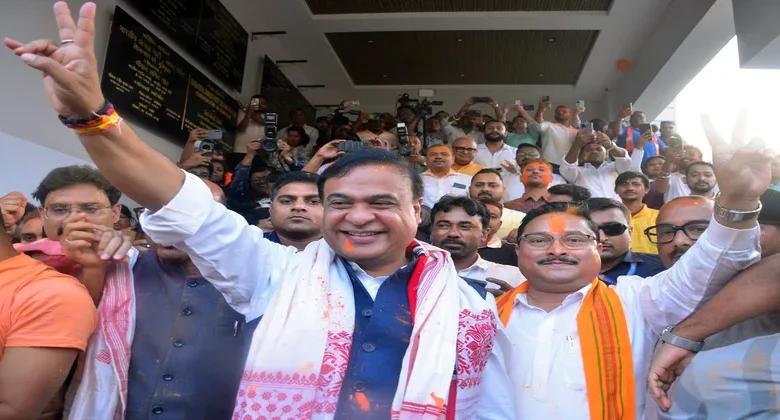
Guwahati, May 4, 2026: BJP created history in Assam politics as NDA won 102 out of 126 seats in the state. And for the Bharatiya Janata Party, it does not get much better than this.
CM Himanta Biswa Said, “PM Modi ji’s passion for the development of Assam and BJP’s relentless effort to serve the people of the state has been rewarded by the people of Assam.”
Assam has handed the BJP an absolute majority on its own — with the National Democratic Alliance crossing the 102-seat mark in the 126-member state assembly. Chief Minister Himanta Biswa Sarma, who staked his entire political reputation on this election, has not just won. He has won by a distance that leaves no room for ambiguity, and no question about who Assam has chosen to lead it into the next five years.
The man himself provided the evening’s most emphatic personal statement — winning his traditional Jalukbari constituency in Guwahati by a staggering margin of over 85,000 votes, returning to the assembly for a sixth consecutive term. In a night full of milestones, that number alone tells you something about the scale of what the BJP has achieved.
On West Bengal’s splendid win CM Sarma said, “Bengal’s win is nation’s win. I said 100 in Assam and 200 in Bengal, it was not my quote, it was Maa Kamakhya’s blessing through me. It is for the security and safety of our nation.”
“Bharat is a Hindu nation and it will remain a Hindu rashtra till the sun and moon are there”, CM Sarma said.
But if there is one image that captures the drama of May 4 more than any other, it is not a winner celebrating. It is a loser conceding — and the loser in question is Congress’s deputy Leader of Opposition and the opposition’s declared Chief Ministerial face, Gaurav Gogoi, who fell to three-time BJP MLA Hitendra Nath Goswami in Jorhat by a crushing margin of 23,182 votes.
The man the Congress had held up as its answer to Himanta Biswa Sarma did not make it past his own constituency.
A wipeout across the heartland
The story of this election is not just the BJP’s victory — it is the geography of that victory, which tells a far more detailed and consequential story about where Assam’s political centre of gravity now sits.
Across upper Assam — the districts of Dibrugarh, Tinsukia, Golaghat, Jorhat, and Sonari — Congress failed to win a single seat. Not one. In Sibsagar, the party’s ally Raijor Dal managed to scrape through by a narrow margin, but that was the closest the opposition came to relevance in the entire upper Assam belt.
On the North Bank of the Brahmaputra, Congress could manage just one seat — the SC-reserved Nowboicha constituency. Districts like Dhemaji, Biswanath Chariali, and Sonitpur were swept clean by the ruling party, leaving the opposition without a foothold in regions it once contested seriously.
In southern Assam, the pattern repeated itself. BJP took all the Hindu-majority seats without exception. In the Barak Valley, the saffron party won nine seats while Congress managed four — all of which, significantly, came from constituencies with substantial minority populations.
In Bodoland Territorial Area, Bodo voters turned their backs on Congress comprehensively — the party won just one seat there, and that too from a constituency with over 60 percent minority voters. In the hill districts of Karbi Anglong and Dima Hasao, tribal voters similarly rejected the grand old party. The tea garden communities of upper and north Assam, long considered a swing constituency, did not give Congress a single seat.
The conclusion is unavoidable — the Congress party has been pushed out of Assam’s political mainland, reduced to a narrow geographic and demographic foothold that the party’s own leaders will find difficult to explain away.
What Congress is left with
Congress won 19 seats in total. Of those 19 winners, 18 are Muslim candidates. Just one Hindu Assamese Congress candidate managed to cross the finishing line anywhere in the state.
Fifteen of those victories came from Miya-Muslim dominated constituencies spread across Dhubri, Barpeta, Goalpara, and Darrang districts in lower Assam — areas where demographic realities gave the party a floor it could not fall below regardless of the broader wave against it.
It is a result that raises uncomfortable questions for the Congress leadership about the party’s identity and appeal in Assam — questions that go beyond one bad election cycle and point toward a deeper structural problem with the party’s outreach beyond its current vote base. Newly elected BJP MLA Bhupen Bora who defected from Congress just ahead of the election said, “ Congress is a party whose leaders’ integrity towards our country is doubtful. Congress couldn’t justify the secret visit of Gaurav Gogoi to Pakistan, how can the people of Assam trust the party?”
Adding to Congress’s difficulties, Badruddin Ajmal’s AIUDF — which draws from the same minority voter pool that Congress now depends on — was reduced to just two MLAs. The consolidation of the minority vote did not translate into seats the way the opposition had hoped, and the competition between Congress and AIUDF for the same constituency base may have cost both parties in key contests.
The two issues that decided everything
The BJP fought this election on two planks, and made no apology for either of them.
The first was development — ten years of visible infrastructure growth, road connectivity, urban transformation, and welfare delivery that gave the party a tangible record to campaign on rather than promises alone. Across the state, voters were asked to compare 2016 Assam with 2026 Assam, and by the evidence of Sunday’s result, a decisive majority liked what they saw.
The second plank was the protection of indigenous Assamese identity — a theme that Himanta Biswa Sarma made the defining emotional argument of the campaign. Under his leadership, the BJP government had taken a series of bold and often controversial steps — massive eviction drives targeting encroachment of forest land, government land, and land belonging to Hindu religious institutions and Satras by illegal settlers. These were not quiet administrative actions. They were deliberate, visible, and politically charged — and they clearly resonated with a substantial portion of the electorate that felt its cultural and demographic identity was under pressure.
Assam’s voters, it appears, endorsed both arguments simultaneously — rewarding the government for what it built, and for what it stood against.
Himanta’s personal triumph
For Chief Minister Himanta Biswa Sarma, this is a result that cements his status as the dominant political figure in the Northeast and arguably one of the most consequential regional leaders in the country.
Six consecutive assembly wins from Jalukbari. A BJP majority without coalition dependency. The opposition’s CM candidate was defeated in his own backyard. The AIUDF was reduced to irrelevance. And a personal majority of over 85,000 votes in his home constituency.
Whatever political battles lie ahead — and in Assam, they always do — Sunday’s mandate has given Himanta Biswa Sarma something that is genuinely rare in Indian politics: an unambiguous, unencumbered popular endorsement to govern on his own terms. Dispur has its answer. The curtain rises on the third act.