In a striking demonstration of soft power and strategic cultural outreach, Prime Minister Narendra Modi has once again placed India’s indigenous tribal traditions at the heart of diplomacy during his recent five-nation tour. By gifting specially curated tribal and regional handicrafts to leaders including Sweden’s Crown Princess Victoria, Italy’s Prime Minister Giorgia Meloni, and the Queen Mother of the United Arab Emirates, PM Modi has not only celebrated India’s civilisational diversity but also created new global pathways for local artisans under the banner of Aatmanirbhar Bharat.
These thoughtful gestures go far beyond symbolism. They actively promote Vocal for Local, One District One Product (ODOP), the PM Vishwakarma Scheme, and TRIFED’s tribal cooperative marketing efforts, turning high-level diplomacy into a powerful tool for generating international demand for Indian crafts.
The Gifts: A celebration of tribal craftsmanship
During the tour covering the UAE, Netherlands, Sweden, Norway, and Italy, PM Modi presented gifts deeply rooted in India’s tribal and indigenous heritage.
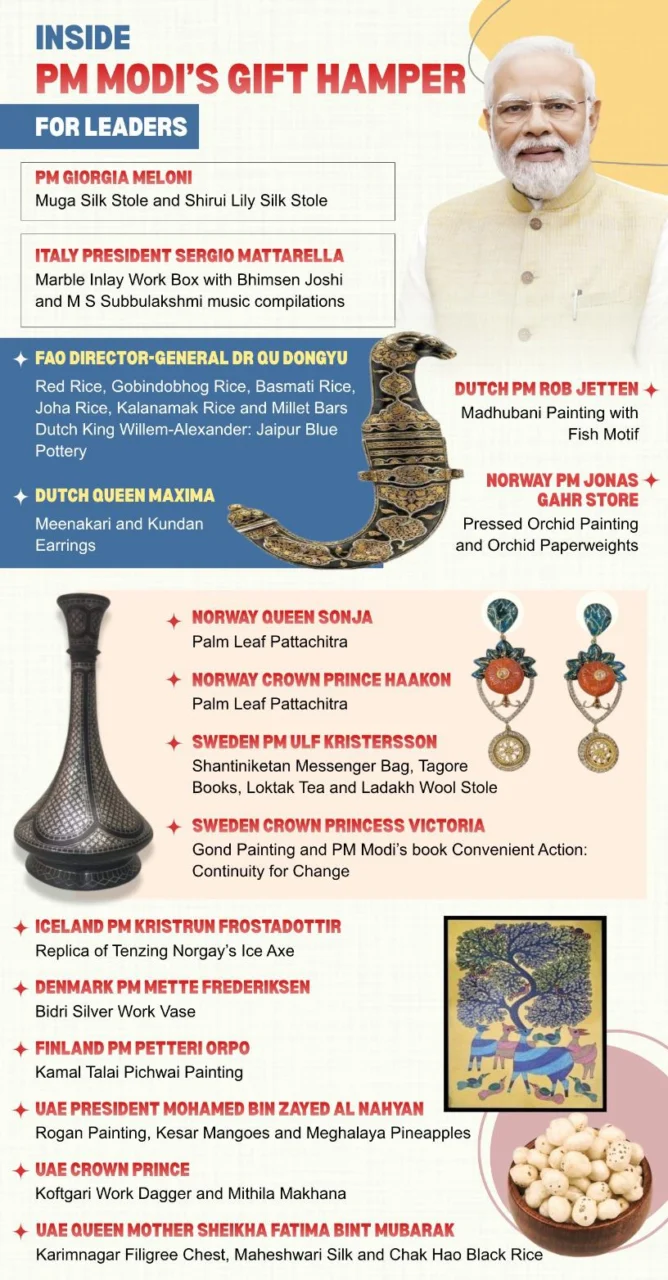
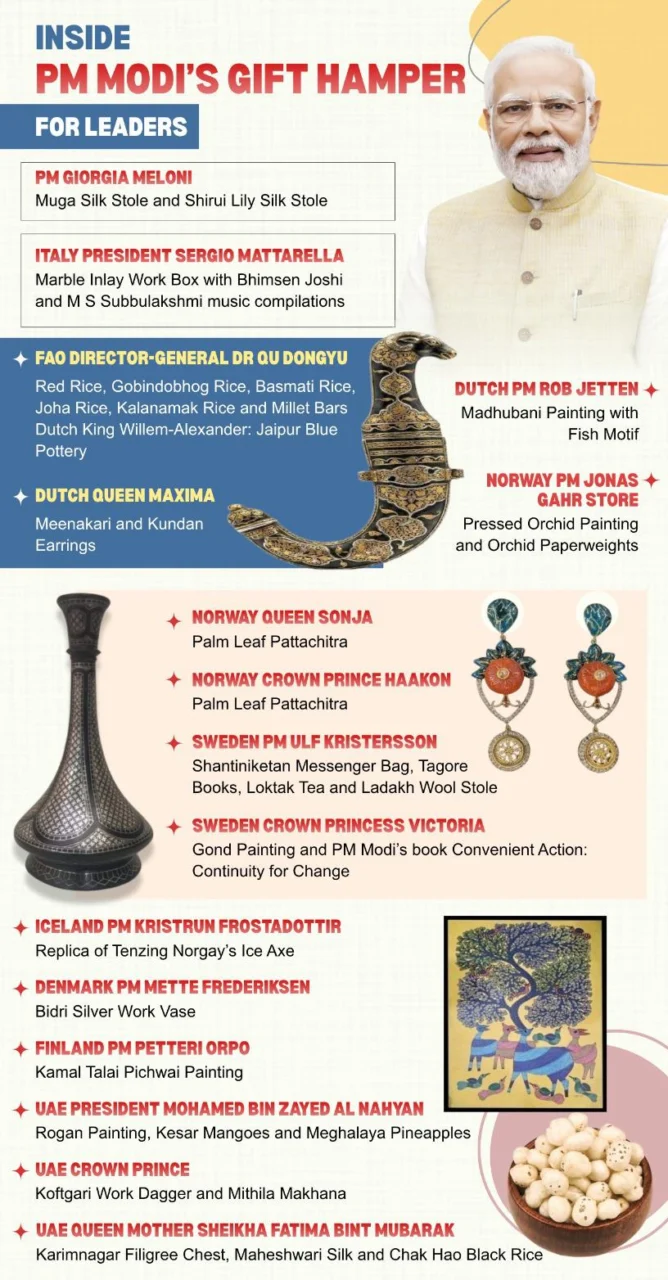
To Crown Princess Victoria of Sweden, he gifted a traditional Gond painting from Madhya Pradesh. Created by the Gond tribal community, this vibrant art form features intricate dot-and-line patterns, nature-inspired motifs, and colours derived from natural sources, sustaining livelihoods for thousands of central Indian tribal artisans.
Italian Prime Minister Giorgia Meloni received two exquisite stoles: one made from Assam’s renowned Muga silk, celebrated for its natural golden sheen, durability, and GI tag, and another Shirui Lily-inspired stole crafted by the Tangkhul Naga community of Manipur. The Shirui Lily design draws from the rare state flower that blooms only in Manipur’s Shirui hills, embodying the cultural identity and artistic excellence of Northeast frontier tribes.
To the Queen Mother of the UAE, PM Modi presented Manipur’s heritage black rice, locally known as Chak-Hao. Traditionally cultivated by tribal hill communities, this nutrient-rich grain carries significant medicinal and cultural value, showcasing India’s indigenous agricultural traditions.
PM Modi gifted the Kamal Talai Pichwai painting to the PM of Finland, Petteri Orpo. The painting reflects the serene beauty and devotional artistry of the Nathdwara tradition of Rajasthan. Centred around lotus-filled waters, the composition symbolises purity, harmony, and spiritual reflection.
PM Modi gifted a replica of the Ice-Axe used by Tenzing Norgay to Iceland’s PM Kristrun Frostadottir.
The Replica of the Ice Axe pays tribute to the legendary tool carried by Tenzing Norgay during the first successful ascent of Mount Everest in 1953 with Sir Edmund Hillary. Crafted in steel with a polished wooden shaft, the replica reflects the simplicity, resilience, and precision essential to high-altitude mountaineering.
These items are not random choices. They represent a deliberate strategy to spotlight tribal and regional products that have long been overlooked in conventional diplomacy.
Linking diplomacy to self-reliance: Aatmanirbhar Bharat in action
PM Modi’s gifting approach is deeply integrated with flagship government initiatives aimed at empowering artisans and opening global markets. Under Aatmanirbhar Bharat and Vocal for Local, the focus has shifted to promoting “Made in India” products, particularly those from rural and tribal economies.
The One District One Product (ODOP) scheme identifies and scales unique local specialties, such as Muga silk from Assam or tribal weaves from Manipur while the PM Vishwakarma Scheme provides training, credit, and market access to traditional artisans and craftsmen.
TRIFED (Tribal Cooperative Marketing Development Federation of India) plays a pivotal role here, organising business conclaves and export promotion drives for tribal produce and handicrafts. Recent efforts, including the Bharat Tribes Business Conclave 2026, have specifically targeted increasing exports of forest produce, handcrafted textiles, and sustainable tribal products. These diplomatic gifts serve as live advertisements, generating international visibility and demand that directly benefits TRIFED-empanelled artisans.
The results are measurable. India’s handicraft exports (excluding hand-knotted carpets) have grown substantially from Rs 20,082.53 crore in 2014-15 to Rs 33,122.79 crore in 2024-25, showing a strong upward trajectory. Driven by policy support and global promotion. In the first half of FY2025, textiles and apparel exports, which include many handicraft categories, stood at US$ 18,235.44 million. Key segments such as woodwares, embroidered goods, handprinted textiles, and art metal wares have shown robust demand, particularly in markets like the US and Europe.
Diplomatic gifting under the Modi government has contributed to this momentum by creating a “surge effect” heightened international interest and orders for GI-tagged and tribal products. Artisans report increased inquiries and sales following high-profile exposures, turning cultural diplomacy into economic opportunity for rural and frontier communities.
Geopolitical depth: Northeast crafts and the Act East Policy
The inclusion of Northeast gifts, Assam’s Muga silk, Manipur’s Shirui Lily and Chak-Hao rice, and similar tribal textiles and bamboo crafts, carries clear geopolitical significance. These items align directly with the Act East Policy, upgraded in 2014 from the earlier Look East framework. The policy emphasises deeper economic, cultural, and strategic integration with ASEAN and East Asian nations while mainstreaming India’s frontier communities politically and economically.
By showcasing Tangkhul Naga craftsmanship and Mizo-influenced textiles on the global stage, Modi’s gifts highlight the Northeast’s rich heritage and its role as a bridge to Southeast Asia. This approach fosters greater political mainstreaming of tribal communities in states like Manipur, Nagaland, and Mizoram, addressing historical marginalisation while creating market access for their bamboo crafts, tribal ornaments, and handlooms.
It transforms the Northeast from a remote periphery into a vibrant hub of cultural and economic diplomacy.
From Nehru-UPA era to Modi’s inclusive diplomacy
This proactive, grassroots-focused gifting strategy marks a clear departure from earlier eras. During the Nehru period, cultural diplomacy often emphasised classical Indian heritage, non-alignment ideals, and high-brow symbols of unity in diversity, with limited spotlight on tribal or regional artisan products. Gifts tended to reflect a more centralised, elite vision of Indian culture rather than celebrating diverse indigenous traditions.
The UPA years under Manmohan Singh followed a largely conventional diplomatic playbook. While economic reforms continued, cultural outreach remained subdued and less strategically tied to domestic self-reliance schemes or tribal empowerment. There was minimal emphasis on using GI-tagged tribal crafts or Northeast heritage as tools for soft power or export promotion.
In contrast, the Modi era has recalibrated cultural diplomacy as a core pillar of foreign policy. By foregrounding tribal art, GI products, and frontier community crafts, it projects an inclusive, vibrant, and self-reliant India. This shift not only strengthens soft power but also delivers tangible economic benefits through schemes like ODOP and TRIFED, creating international markets for local artisans who were previously confined to domestic or niche sales.
A new chapter in Indian diplomacy
Prime Minister Modi’s cultural gifts during the recent tour exemplify a sophisticated blend of heritage preservation, economic empowerment, and strategic diplomacy. By linking tribal craftsmanship to global leadership engagements, the government is not only preserving India’s diverse traditions but actively expanding opportunities for millions of artisans under Aatmanirbhar Bharat.
From Gond paintings in Madhya Pradesh to Muga silk in Assam and black rice in Manipur, these gestures are quietly building brand India on the world stage, one authentic, handcrafted gift at a time. As handicraft exports continue their upward journey and Northeast communities gain greater visibility through Act East initiatives, Modi’s approach stands as a model of how cultural diplomacy can drive both national pride and economic growth in the 21st century.