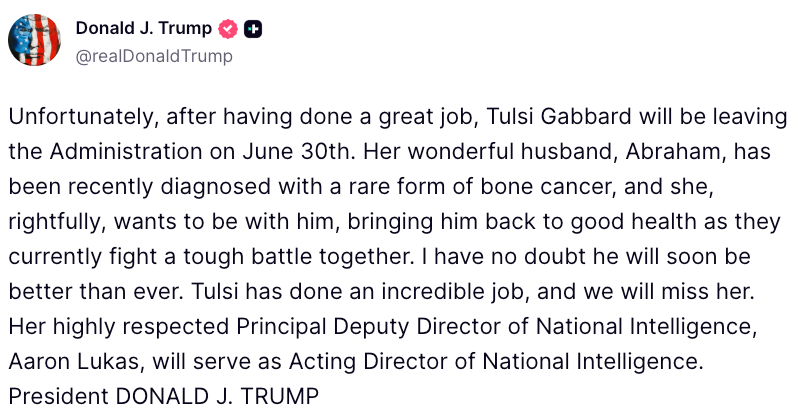
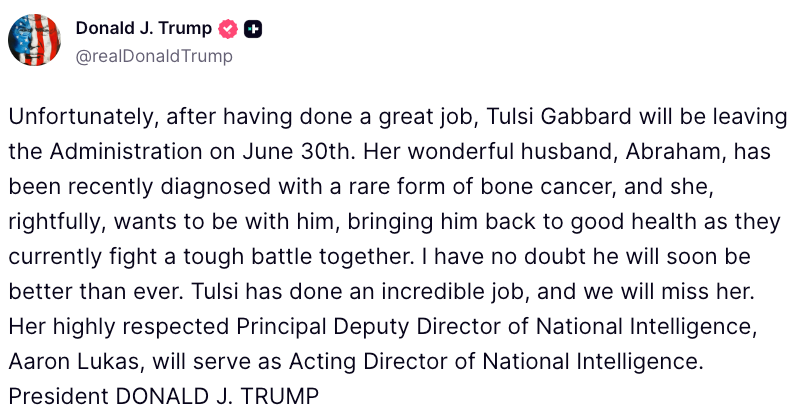
On Friday, 22nd May, US Director of National Intelligence Tulsi Gabbard announced her resignation from one of the most sensitive national security positions in the United States government. Gabbard said her resignation would take effect on 30th June.
In a statement posted on X, Gabbard revealed that her husband, Abraham Williams, had been diagnosed with an extremely rare form of bone cancer. She said she was stepping away from public office to focus entirely on caring for him and supporting her family during the difficult period.
In her resignation letter to US President Donald Trump, Gabbard thanked him for the opportunity to serve in the administration and said she was proud of the work done during her tenure.
I am deeply grateful for the trust President Trump placed in me and for the opportunity to lead @ODNIgov for the last year and a half.
Unfortunately, I must submit my resignation, effective June 30, 2026. My husband, Abraham, has recently been diagnosed with an extremely rare… pic.twitter.com/PS0Dxp5zpd
— Tulsi Gabbard 🌺 (@TulsiGabbard) May 22, 2026
The White House later confirmed that Gabbard’s deputy, Aaron Lukas, would serve as acting Director of National Intelligence until a permanent replacement is announced.
Gabbard, an Army veteran, former Congresswoman and former presidential candidate, had taken charge as DNI in early 2025 after joining the Trump administration. Her appointment had drawn massive attention because of her past criticism of US foreign interventions, especially wars in the Middle East.
Speculation grows over alleged fallout with the White House
Although Gabbard clearly stated that her husband’s health condition was the reason behind her resignation, there are some speculations of an alleged fallout with the White House, as there were growing tensions between her and parts of the Trump administration.
Tulsi Gabbard was frozen out of the planning to capture Nicolás Maduro and clashed with President Trump over Iran’s nuclear ambitions. Here are key moments from Gabbard’s difficult tenure as the top U.S. intelligence officer. https://t.co/gxjj1670uB
— The Wall Street Journal (@WSJ) May 22, 2026
For months, there had been reports suggesting that Gabbard had increasingly found herself isolated within sections of Trump’s national security team because of her opposition to regime-change wars and military escalation against countries like Iran and Venezuela.
Several reports claimed that some senior officials in the administration were uncomfortable with Gabbard’s non-interventionist views, especially at a time when the White House was taking a more aggressive posture toward Iran and other geopolitical flashpoints.
Questions around her position became even stronger after reports emerged that she had been sidelined from sensitive discussions related to Venezuela and had publicly differed from Trump on Iran’s nuclear programme.
Even then, Trump publicly defended her at multiple moments. During one interaction with reporters, Trump said, “She’s a little bit different in her thought process than me, but that doesn’t make somebody not available to serve.” Still, speculation about internal tensions never fully disappeared.
Tulsi Gabbard’s disagreement with Trump over Iran and nuclear weapons
One of the biggest areas of disagreement between Gabbard and Trump emerged over Iran and the question of whether Tehran was actively building nuclear weapons.
In March 2025, Gabbard testified before Congress that the US intelligence community believed Iran was not actively developing a nuclear bomb. According to her assessment, Iran’s Supreme Leader had not authorised the revival of the country’s nuclear weapons programme, which US intelligence agencies believed had remained suspended since 2003.
During her testimony, Gabbard stated, “The intelligence community continues to assess that Iran is not building a nuclear weapon.” At the same time, she warned that Iran possessed an “unprecedented” stockpile of enriched uranium and that public discussions around nuclear weapons inside Iran had increased significantly in recent years.
Three months later, Trump publicly rejected her assessment while speaking to reporters aboard Air Force One. “I don’t care what she said,” Trump remarked bluntly. “I think they were very close to having one.”
The public contradiction created headlines across the United States because it was unusual for a president to openly dismiss the conclusions of his own intelligence chief on such a sensitive issue. The disagreement became even more politically explosive after the United States and Israel intensified military operations connected to Iran’s nuclear infrastructure.
At a Senate Intelligence Committee hearing after the conflict escalated, Gabbard submitted a written statement saying there had been “no efforts” by Iran to restart its nuclear-enrichment programme following attacks on several nuclear facilities. However, she reportedly chose not to read that section aloud during the hearing.
Later, according to a report by CNN, US intelligence assessments still believed Iran was not actively pursuing a nuclear weapon and remained years away from developing one. Israel, however, maintained that Iran was approaching a critical stage in its nuclear capability development.
Gabbard’s warning about nuclear war
The tensions surrounding Gabbard’s views became more visible in June 2025 when she released a video warning about the dangers of nuclear conflict. The video included footage from her visit to Hiroshima, one of the Japanese cities devastated by atomic bombing during World War II. It also showed simulated scenes of nuclear destruction, including visuals resembling an attack on the Golden Gate Bridge in San Francisco.
I recently visited Hiroshima, and stood at the epicenter of a city scarred by the unimaginable horror caused by a single nuclear bomb dropped in 1945. What I saw, the stories I heard, and the haunting sadness that remains, will stay with me forever. pic.twitter.com/TmxmxiGwnV
— Tulsi Gabbard 🌺 (@TulsiGabbard) June 10, 2025
In the video, Gabbard warned that the world was moving dangerously close to catastrophe. “As we stand here today, closer to the brink of nuclear annihilation than ever before, political elite warmongers are carelessly fomenting tensions between nuclear powers,” she said.
The timing of the video surprised many inside the administration because it was released during intense internal discussions over military options involving Iran. Gabbard’s long-standing opposition to military interventions had always been central to her political identity. Even before joining the Trump administration, Gabbard had frequently criticised what she called “regime-change wars” carried out by the United States in different parts of the world.
Reports say Gabbard was sidelined during the Venezuela operation
Another controversy surrounding Gabbard involved reports that she had been excluded from planning discussions related to an operation which captured Venezuelan President Nicolás Maduro.
Absolute humiliation for Tulsi Gabbard. The White House literally excluded their own Intelligence Director from planning the illegal regime change in Venezuela. Aides openly mocked her, joking DNI stands for Do Not Invite.
The Trump administration is an absolute chaotic mess! pic.twitter.com/sL20GxEeal
— Furkan Gözükara (@FurkanGozukara) May 23, 2026
According to multiple reports, senior White House officials had limited the number of people informed about the operation, and Gabbard was kept outside the core planning group despite serving as the country’s top intelligence official.
At the time, Trump’s national security team was discussing military and intelligence options linked to Venezuela, including operations involving intelligence gathering around Caracas.
Reports claimed that while final discussions were taking place in Washington, Gabbard was in Hawaii and was unaware of many operational details.
One senior administration official said Trump wanted to keep the circle very small and believed Gabbard “didn’t need to know” the full details. Secretary of State Marco Rubio was also among officials who preferred that Gabbard remain outside the inner discussions.
Still, administration officials publicly denied that there was any major division inside the national security team. Vice President JD Vance dismissed reports of deliberate exclusion and said the operation had simply been restricted to a small group of cabinet-level officials.
Gabbard had long opposed American intervention in Venezuela. Back in 2019, she publicly wrote, “The United States needs to stay out of Venezuela. Let the Venezuelan people determine their future.” Her past criticism of interventionist policies reportedly made some officials uneasy as the administration explored aggressive options against Maduro’s government.
Exit of a close ally added to speculation
Questions about internal disagreements inside the administration had already intensified earlier this year after Joe Kent, one of Gabbard’s close allies and the Director of the National Counterterrorism Centre, abruptly resigned in March.
Kent’s departure was widely viewed as one of the first public signs of internal discomfort within parts of the administration over America’s handling of the Iran conflict.
The resignation also renewed attention on Gabbard’s earlier criticisms of US military involvement in the Middle East.
A controversial but influential tenure
Tulsi Gabbard’s tenure as Director of National Intelligence remained controversial from beginning to end. Supporters viewed her as an independent-minded leader willing to challenge Washington’s foreign policy establishment. Critics, meanwhile, often accused her of taking positions that clashed with traditional US strategic thinking.
In 2019, in a speech criticising Trump, Gabbard had announced, “These powerful politicians dishonour the sacrifices made by everyone of my brothers and sisters in uniform, and their families. They pay the price for these wars. In fact, every American pays the price for these wars. These wars have cost us trillions of dollars since 9/11. Every dollar that we spend on regime change wars, the new cold wars, and this nuclear arms race is a dollar that comes out of our pockets, dollars that should be used to address the very urgent and real needs of our people and communities right here at home.”
Tulsi Gabbard’s 2019 campaign launch condemned regime-change wars — a stance she can’t disown without losing credibility pic.twitter.com/wpqnXLJn0g
— HatsOff (@HatsOffff) January 9, 2026
Despite the controversies, Gabbard remained one of the most recognisable faces in Trump’s national security setup over the past year and a half.
Her resignation now leaves a major vacancy at the top of America’s intelligence structure at a time when the United States is dealing with rising tensions involving Iran, Russia, China and several global conflict zones.
For now, Gabbard says her focus is no longer politics or intelligence operations, but her family. “My priority now is to be fully present for Abraham and our loved ones during this difficult time,” she said in her statement announcing her resignation.