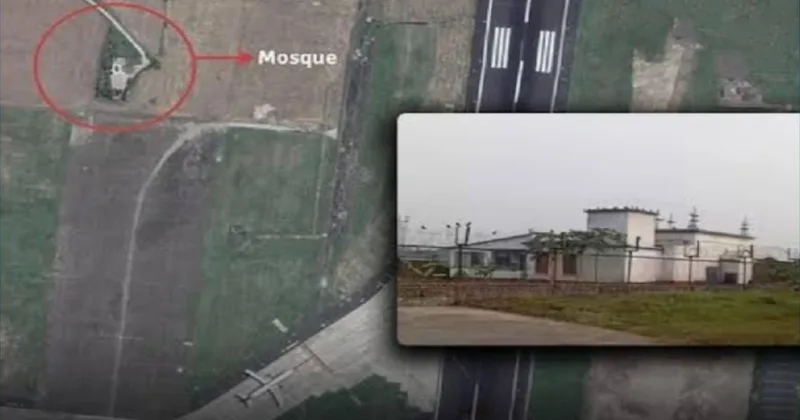
Kolkata: The long-standing proposal to relocate the 136-year-old Gouripur Jame Masjid, also known as the Bankra Mosque, located inside the operational area of Netaji Subhas Chandra Bose International Airport, has received renewed attention after fresh coordination between the West Bengal state government and the Centre. The development comes as authorities step up efforts to resolve a decades-old aviation safety issue involving the mosque’s proximity to the airport’s secondary runway.
Joint inspection and renewed push
A recent visit by officials from the district administration and the Airports Authority of India (AAI) to the mosque site marked the beginning of renewed discussions on the issue. This was followed by a meeting at the North 24 Parganas District Magistrate’s office, where airport authorities reiterated the operational challenges posed by the structure. According to officials, the state government has now aligned with the Centre’s position supporting relocation, giving fresh momentum to a proposal that has been under consideration for over three decades.
Safety and operational concerns
The mosque is located approximately 165 metres north of the secondary runway and around 150 metres inside the airport boundary, placing it within a critical aviation safety zone. Authorities have flagged multiple operational concerns:
The structure restricts full utilisation of the secondary runway, particularly during winter fog conditions when the primary runway is unavailable. The reduced safety clearance falls short of the recommended buffer distance of 240 metres for runway-adjacent structures. The mosque’s location affects the installation of advanced landing systems (ILS) on the secondary runway, limiting low-visibility operations.
Officials also noted that while the secondary runway can handle narrow-body aircraft like Airbus A320 and Boeing 737, it is inadequate for wide-body aircraft such as Boeing 787 and Airbus A330 under certain conditions.
Aviation experts and security agencies have also raised concerns that the mosque lies within the approach path of aircraft, making it a potential hazard during emergency landings or overshoot scenarios.
Additionally, the Central Industrial Security Force (CISF) has flagged security management challenges due to civilian access into a high-security operational zone, where worshippers are routinely screened before entry.
During recent meetings, airport officials stressed the need for relocation, citing “safety, security, and operational constraints.”
A decades-old unresolved issue
The dispute over the mosque’s location has persisted for more than 30 years, with multiple attempts at resolution under different state and central administrations failing to materialise. Earlier proposals, including runway redesigns and alternate access arrangements, were explored but never implemented due to administrative and political complexities.
Government alignment brings new momentum
What makes the current phase significant is the reported alignment between the state government and the Centre on the relocation proposal. This convergence is being viewed as a critical shift that could finally break the long-standing deadlock. However, officials have indicated that no immediate action will be taken, as consultations are still underway with stakeholders, including religious representatives and civil aviation authorities.
While safety concerns and operational constraints continue to drive the relocation proposal, the issue remains sensitive due to its historical and religious significance. For now, the matter is under active review, with further discussions expected before any final decision is announced.