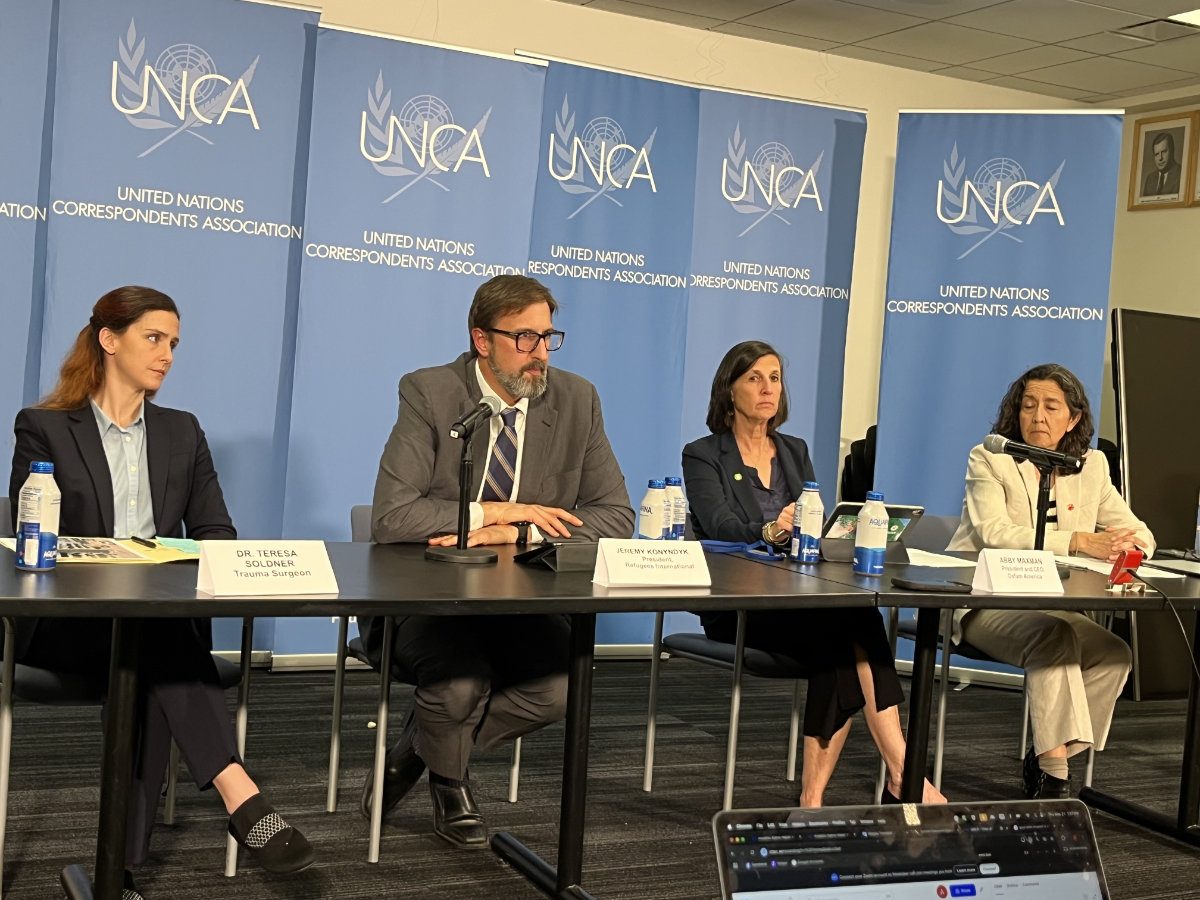
NEW YORK CITY: Shortly after the UN Security Council met to discuss the first report by the Board of Peace and the implementation of Resolution 2803 in the language of diplomacy, international aid leaders stood before reporters to describe a far harsher reality in Gaza.
Speaking at UN headquarters in New York on Thursday, they described a situation in which children continue to go without schooling, surgeons without supplies, and families live in tents beside open sewers.
They depicted a population still trapped in a humanitarian disaster — six months after a widely praised peace agreement was supposed to transform life in Gaza.
The officials and a trauma surgeon who recently returned from Gaza’s Al-Shifa Hospital painted a picture of a territory caught in an unending nightmare. Although no longer under constant bombardment, Gazans remain unable to secure even the most basic conditions of life.

The speakers said peace agreements have been signed and promises made, but the reality on the ground remains catastrophic.
At the same time, several emphasized that the broader peace framework itself was not necessarily the problem, but rather the failure to fully implement it and allow humanitarian organizations to carry out the work it envisioned.
“There are tangible improvements,” Janti Soeripto, president and CEO of Save the Children US, told the briefing. “No endless bombardments, no more famine conditions. There is more food, and shoes have entered Gaza for the first time in years.”
“Shoes,” she repeated, pausing for emphasis. During a visit to Gaza two years earlier, she recalled being struck by “how many children were running around without them.”

But mere survival, she said, should not be celebrated as an achievement. “Having a not-in-famine condition cannot be the mark of success in 2026 in any context,” she said.
Security Council Resolution 2803 and the broader peace framework promised far more than a reduction in the humanitarian crisis. The plan called for unrestricted humanitarian aid, restoration of infrastructure, rehabilitation of hospitals and water systems, and pathways to recovery.
Instead, aid leaders described a place where children remain severely malnourished, schools are closed, and critical infrastructure has been almost entirely destroyed.
“Six months on, children in Gaza are still not in school, malnourished, and not being treated for their wounds,” Soeripto said.
She said 90 percent of Gaza’s electricity grid and water infrastructure remains out of service, while more than 600,000 children are entering “the third year running” without meaningful schooling.
Despite provisions in the ceasefire agreement requiring expanded humanitarian access, she said aid organizations continue to face severe restrictions.

“Save the Children has been blocked from bringing in medicine and other supplies for months,” she said.
“And then, in terms of other items, ultrasound machines, incubators are still not allowed in dual-use lists. We see multiple babies in one incubator, and lack of ultrasound machines leads to more deformities at birth than you would expect in any able population.”
The shortages extend across nearly every aspect of civilian life: fuel, spare parts, shelter materials, sanitation equipment, and water supplies.
“There is more food in Gaza thanks to the ceasefire,” she said. “Most people, though, cannot afford it.” Flour prices remain drastically inflated. Eggs, she said, “disappeared from the market months ago.”
Summer temperatures, she warned, will intensify the public health crisis.
“People are living in open sewage,” she said. “There are rats everywhere. Children are sick and cannot get treatment for the simplest of things: diarrhea and other waterborne diseases.”


Israel insists it is balancing humanitarian access with the need to stop the Palestinian militant group Hamas from rebuilding its capabilities through the aid system.
Israeli officials say the humanitarian crisis is being driven in part by Hamas, not by a deliberate policy of aid denial, arguing that restrictions on some organizations and staff are necessary because aid must be screened to prevent weapons, cash, and dual-use materials from reaching Hamas.
Also speaking at the briefing, Abby Maxman, president and CEO of Oxfam America, said the scale of Gaza’s humanitarian disaster cannot simply be measured by the number of trucks or tonnes of goods entering the enclave.
Rather, it should be measured by “whether families can sleep without fear of attack, feed their children, find clean water, access medical care, and live with dignity,” she said.
“By those measures, the ceasefire is failing.”

Oxfam staff and local partners, she said, continue to hear daily accounts of hunger, displacement, fear, and exhaustion. Families spend hours waiting to fill a single jerry can of clean water, while parents raise children in makeshift shelters surrounded by rodents and sewage.
The humanitarian dependency now defining Gaza, she argued, is not inevitable. Nor, she said, is it what Palestinians want. “No one, especially Palestinians, wants a future of being dependent on humanitarian aid,” Maxman said.
Yet she described a reconstruction process constrained by scarcity and control. While commercial goods have increased since last October, she said, only a narrow group of merchants has been permitted to bring products into Gaza, often at prices beyond the reach of ordinary people.
“The stock at market means little when the majority of people cannot afford to buy what is to be sold, when 80 percent of people are unemployed, prices are wildly inflated, and when basic public services and the ability to grow and produce food has been destroyed.”
For Maxman, the danger lies in a peace process conducted without Palestinians at the table. “As the future of Gaza is discussed in various frameworks, boards, and reconstruction plans, Palestinian voices in Gaza remain too often sidelined,” she said.
Any sustainable peace, she argued, must center on “Palestinian ownership and governance, accountability, justice, and the fulfillment of fundamental rights.”
Otherwise, she said, “this will only be another pause before the next escalation of violence.”
Ending her remarks, Maxman shared the words of a colleague in Gaza named Wesson.
“Despite all of this, we are still here,” Maxman read. “We continue to work, we continue to support communities, and we continue holding hope, because in Gaza, hope is not something you feel. It is something you must choose every single day.”
Jeremy Konyndyk, president of Refugees International, told the briefing he believed the parties to the peace plan — rather than the process itself — were at fault.
“The problem is not the ceasefire plan itself,” he said. “The problem is that it is failing. The parties are failing to uphold it.”

Konyndyk said the Israeli government had continued to “systematically obstruct humanitarian aid and humanitarian organizations,” while the US and other guarantors had failed to impose meaningful accountability.
He described the obstruction of aid not merely as a political failure, but as a legal one.
“It is an outright violation of obligations under international humanitarian law,” he said. “International law bars the arbitrary blockage of humanitarian aid. It bars the collective punishment of a civilian population.”
Aid agencies, he said, continue to face closed border crossings, restricted imports, deregistration threats, and bureaucratic impediments, even though the ceasefire agreement specifically stipulated expanded humanitarian access.
Humanitarian work was being treated as “the low-hanging fruit of the ceasefire deal,” he said. “And it is failing because it is being made to fail.”
Konyndyk separately told Arab News that medical evacuations remain severely restricted.
Before the war, he said, as many as 100 people per day routinely left Gaza for treatments unavailable inside the territory. Since the ceasefire began, however, only around 700 people had been evacuated in total, based on his organization’s latest compliance scorecard.
“There remain about 18,500 individuals who need a critical level of care they cannot get inside Gaza,” he said, including thousands of children. “Every single one of those needs the approval of the Israeli government.”
Konyndyk also expressed frustration with what he described as evasive language in recent international reporting on Gaza’s humanitarian situation.
A recent report by the Board of Peace submitted to the Security Council, he argued, discussed ongoing suffering “in very oblique, roundabout terms” without explicitly acknowledging the policies driving it.
What disturbed him most, he said, was the normalization of conditions that should be considered intolerable.
“There are people who are still dying today at a much elevated level relative to what ought to be normal,” he said.
“If the international community cannot uphold basic humanitarian obligations to civilians in Gaza, it is really a moment of despair for the international system and for international law.”
The Board of Peace is the international body launched by US President Donald Trump to oversee Gaza’s transitional administration, reconstruction, and security while a nonpolitical Palestinian committee runs day-to-day services.

An accompanying 20-point plan calls for an immediate ceasefire, hostage release, phased Israeli withdrawal, humanitarian aid, Hamas disarmament, a temporary stabilization force, eventual reconstruction, and a possible pathway to Palestinian statehood if conditions are met.
The scale of the task, however, is formidable.
Dr. Teresa Soldner, a trauma and intensive care specialist from Saint Paul, Minnesota, recently returned from two weeks working at Al-Shifa Hospital in Gaza. Speaking at Thursday’s briefing, she said: “The degree of destruction was most striking for me.”
“It’s one thing to read the news and the statistics and the numbers. It’s another to stand among the rubble of all of the buildings as people are living in tents pitched on top of the rubble.”

Medical staff, she said, had become experts in improvisation. They salvaged lights and equipment from bombed hospital buildings. They rebuilt operating rooms from wreckage. They continued training surgical residents amid the devastation.
But ingenuity has its limits.
“Once you run out of medications, once you run out of implants, once you run out of the basic necessities to provide surgery, even the most brilliant surgeon in the world lacks the capacity to care for their population,” she said.
“My orthopedic colleagues needed reconstructive surgeries for patients with non-functional limbs or chronic wounds,” Soldner said, responding to an Arab News question. “But we are unable to offer them the surgery that our surgeons know how to do because of lack of supplies.
“Implants are a one-to-one thing. Once they come in, and once they’re used on one patient, it’s gone.”
She also described problems with anesthetics.

“I had one patient that I started a surgery on,” she said. “And halfway through he started experiencing the sensation of the whole surgery.”
Every day she was there, new trauma patients arrived. Explosions were common enough that staff instinctively prepared for mass casualty events. Patients came in with shrapnel injuries and gunshot wounds.
One story has remained lodged in her memory.
Three young men — a groom and his two future brothers-in-law — had spent the day going house to house inviting friends and relatives to a wedding celebration planned for the following day.
“All three of these men came into the hospital shot by bullets,” she said.
She successfully operated on the two brothers, but the groom died before the wedding.

What haunted her most about the incident was not the violence itself. Waiting outside the operating room with one of the wounded men, she observed none of the panic or fear she normally sees in trauma patients.
“He was quiet and resigned,” she said. “As if he knew this was always coming.”
“It’s not a normal reaction to being shot,” she added.
What she witnessed, she said, was “the habituation to violence” — a population conditioned by years of war to expect catastrophe.
Still, amid the devastation, Soldner spoke with admiration for Gaza’s medical workers.
“I commend the healthcare professionals in Gaza who have done heroic, inhuman amounts of work to serve their population,” she said.
Opinion
This section contains relevant reference points, placed in (Opinion field)
What united the speakers at the briefing was the sense that Gaza’s suffering is neither abstract nor inevitable — that the promises embedded in ceasefires and Security Council resolutions can be measured in sewage systems repaired, medical evacuations approved, schools reopened, and children fed.
“We and a number of other humanitarian organizations have certainly reached out to the Board of Peace in various ways,” Soeripto said.
“We have offered meetings, published reports saying this is what we’re seeing on the ground vis-a-vis the 20-point plan, and we are very willing to offer our assistance and insights.
“We’re not here to criticize the Board of Peace per se, and the plan itself is good. The fact that there is a Board of Peace that is diverse, multistate, multifaction, and multifunctional is, on paper, a good thing.
“But it must be allowed to do its work, to work with organizations like ours and many others to help provide humanitarian assistance, which, as we’ve said, is really not rocket science. That responsibility lies with member states.”