On the evening of May 10, 2026, Prime Minister Narendra Modi addressed the nation with an appeal to use less fuel, avoid foreign travel for a year, reconsider gold purchases, reduce cooking oil consumption, and revive work-from-home practices. “The need of the hour is also to use petrol, gas, diesel and such things with great restraint,” he said.
The situation is difficult to ignore. Brent crude has been trading above $100 per barrel since the West Asia conflict escalated in late February 2026 and the US naval blockade of Iranian ports was announced in April. This week, it has crossed $110, as per ET Now. India, which imports approximately 88% of its crude oil requirements and relies on the Strait of Hormuz for a significant portion of its energy supply, is absorbing the full weight of this disruption. The IMF has projected India’s current account deficit at $84.457 billion for 2026.
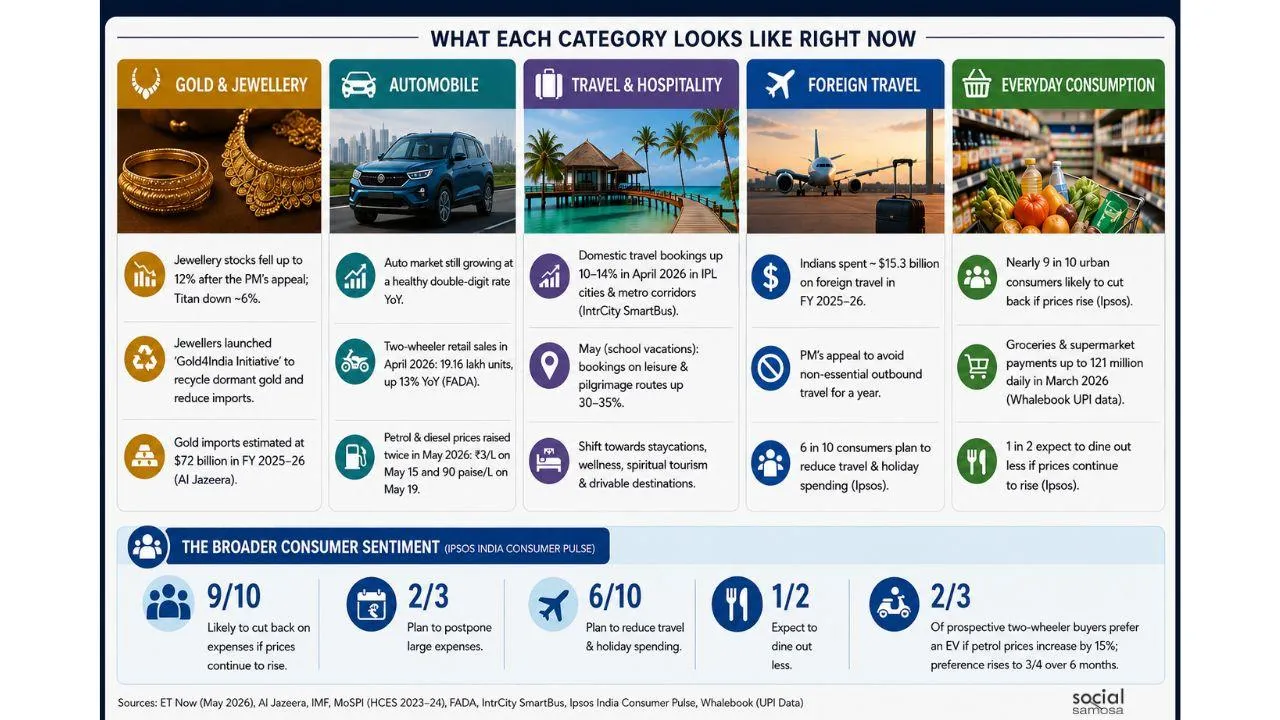
Gold, India’s second-largest import category after crude, has cost the country an estimated $72 billion in the 2025-26 fiscal year alone, according to Al Jazeera. Foreign travel adds another layer of pressure on forex reserves, as Indians spent approximately $15.3 billion on foreign travel during the 2025-2026 financial year.
Against this backdrop of rising import pressures and economic uncertainty, the Prime Minister’s appeal is signalling towards recalibrating consumption patterns in categories that weigh heavily on India’s import bill. While the broader impact on consumer spending is still unfolding, some sectors have already begun responding.
Gold’s weight on the economy
The first category to take a hit was the jewellery industry. Jewellery stocks led the decline, falling up to 12%, with Titan dropping close to 6%. The jewellery sector has been among the first to respond. Within two days of the Prime Minister’s address, Kalyan Jewellers announced the ‘Nation First – Gold4India Initiative’, a four-pillar programme aimed at activating India’s dormant household gold rather than importing more. The initiative, the company said, is designed to target a reduction in imports by five tonnes of gold over the financial year.
T S Kalyanaraman, Managing Director, Kalyan Jewellers India Limited, shares, “The ‘Nation First – Gold4India Initiative’ is far beyond just a promotional campaign. The initiative will strive to spark a behavioural shift in consumers, from viewing gold solely as a static asset preserved indefinitely, to recognising it as a renewable domestic resource capable of continuously generating economic value within the country.”
The programme includes old gold exchange counters, dedicated ‘Encash Gold’ windows offering scientifically calibrated purity assessment and transparent valuation, and a grassroots recirculation drive leveraging its network of over 1,100 My Kalyan centres and 4,300 associates. Its fourth pillar seeks to encourage wider adoption of 18K jewellery over the more gold-intensive 22K format that has historically dominated the Indian market.
Kalyanaraman adds, “The recirculation of gold cannot remain confined to policy discussions or urban consumption patterns. Its long-term success depends on participation from the very households and communities where India’s gold ownership is most deeply rooted.”
Similarly, brands like PNG Jewellers, Indriya and more have come up with initiatives to reduce the country’s dependence on gold imports.
However, marketing hasn’t seen a decline as of yet. Brands including House of Senco and Malabar Gold and Diamonds had a visible presence at the 79th Cannes Film Festival this month, with content creator Rida Tharana spotted wearing a lab-grown diamond necklace by Sennes by Senco, and actor Alia Bhatt appearing in bespoke sapphire and diamond jewellery by Malabar Gold and Diamonds.
/socialsamosa/media/post_attachments/7f4e15da-636.jpg)
Auto sector is still growing at a double-digit rate
The speech arrived at a complicated moment for India’s consumption economy more broadly. Preeta George, Professor of Economics and Policy at S.P. Jain Institute of Management and Research (SPJIMR), offers context on just how exposed discretionary spending is to sustained pressure.
“Private Final Consumption Expenditure as a proportion of GDP is 61.5% with a growth rate of 7%. India’s demographic dividend has played a critical role in the country’s consumption growth story.”
George notes that non-food spending had grown from 14% of monthly per capita expenditure in 1980 to around 50% in 2024, according to the Household Consumption Expenditure Survey released by MoSPI, while still remaining underpenetrated compared to the world average. For context, only 8% of Indians own a car, compared to 80-90% in the US, China, and Europe. She argues that the dip in consumer spending is likely to be temporary and is expected to abate with a revival in sentiment.
“The automobile sector is an essential lever of the GDP growth due to the large number of people it employs and its linkages with other sectors in its value chain, such as OEMs, steel, paint and lubricants. An oil price shock impacts the sector severely and potentially triggers a contractionary ripple effect on GDP growth, since fuel is not only a resource but also a complement for automobiles.”
The two-wheeler segment has been resilient as of now. According to FADA retail data for April 2026, the segment recorded sales of 19.16 lakh units, up 13% year on year, the highest-ever April sales on record for the Indian auto industry. Hero MotoCorp led with 5.52 lakh units, followed by Honda at 4.72 lakh units and TVS Motor at 3.69 lakh units. Bajaj Auto recorded retail sales of 2.02 lakh units, supported by steady demand for commuter motorcycles and its Chetak electric scooter range. Yet FADA also flagged that possible fuel price hikes could affect demand momentum in the months ahead.
This week, state-run oil marketing companies raised petrol and diesel prices by Rs 3 per litre for the first time in nearly four years. On May 19, a further hike of 90 paise per litre followed, the second increase in a week.
Atul Sood, Senior Vice President of Sales and Marketing at Kia India, says the company had not yet observed a direct shift in consumer sentiment linked to the broader economic climate. “At this stage, if you look at the industry and vehicle registrations, the market is still growing at a healthy double-digit rate compared to last year. It is still a little early for us to comment on whether broader economic developments have had a direct impact on consumer sentiment or purchase behaviour.”
Sood adds that rigorous ROI discipline on marketing spend has been standard practice at Kia, irrespective of external conditions. The brand has remained active in sponsorship, continuing its long-standing tennis association, recently announcing a three-year deal with Tennis Premier League.
Travel and tourism see a boost in domestic
If the automobile sector is watching carefully, the hospitality and travel industry are both anxious and quietly optimistic. Renuka Kaushik, Head of Marketing at Jaypee Hotels and Resorts, acknowledges, “The hospitality and travel sector entered 2026 on a strong footing, driven by domestic tourism, weddings, MICE activity, experiential travel, and premium leisure demand. In this context, the Prime Minister’s appeal to avoid non-essential outbound travel and discretionary spending, including large weddings, may lead to a more cautious consumer mindset in the short term, especially among middle-income households.”
The near-term data, however, pointed in a different direction for domestic travel. IntrCity SmartBus, which operates over 630 routes in 16 states, reported a 10-14% increase in bookings across IPL host cities and metro corridors in April 2026. From the second week of May, as school vacations commenced across several states, bookings on major leisure and pilgrimage routes, including Dehradun, Manali, Goa, Tirupati, and Ujjain, jumped by 30-35%.
Kaushik sees an opportunity within this shift. “This could benefit the Indian hospitality sector by redirecting demand towards staycations, wellness retreats, spiritual tourism, and drivable leisure destinations. Resorts, heritage properties, hill stations, and premium domestic leisure markets are expected to gain from this trend.” She adds that the industry had not yet seen a significant slowdown in bookings and that the more likely adjustment was in spending patterns rather than travel intent itself.
The broader consumer picture was captured in an Ipsos India Consumer Pulse survey. Nearly 9 in 10 urban consumers surveyed say they are likely to cut back on expenses if prices continue to rise. Two-thirds say they plan to postpone large expenses, 6 in 10 intend to reduce travel and holiday spending, and 1 in 2 expect to dine out less. On fuel specifically, two-thirds of prospective two-wheeler buyers say they would prefer an electric vehicle if petrol prices increase by 15%, with that preference strengthening to three-fourths over a six-month outlook.
For marketers across categories, the signals require careful interpretation.
Ashita Aggarwal, Professor of Marketing at SPJIMR, points to data that shows the caution was not confined to lower-income households. “Net spending intent has turned negative across many discretionary and semi-discretionary categories, while necessity-driven categories remain positive. This shift is visible across all income groups, not just lower-income consumers. When even higher-income segments pull back, the caution is structural, rather than merely stress-driven.”
She cites UPI transaction data from Whalebook showing that daily payments for non-essential services, including restaurants and beauty shops, declined in March 2026 compared to February, while grocery and supermarket transactions rose to 121 million daily. The stock market declines in jewellery and aviation, she notes, offer forward-looking indicators of consumption intent. She believes, “Performance-led digital campaigns, quick commerce advertising, and vernacular-language value messaging are likely to hold up better than brand-building on linear TV. Brands that go dark now may face disproportionately higher recovery costs later.”
India has navigated similar periods of external shock before, from the Global Financial Crisis to the Covid-19 pandemic, and consumption demand has historically been among the faster-recovering components of the economy. What the current moment adds is the weight of a Prime Minister’s direct appeal, targeted at specific categories, in the middle of an unresolved global conflict.