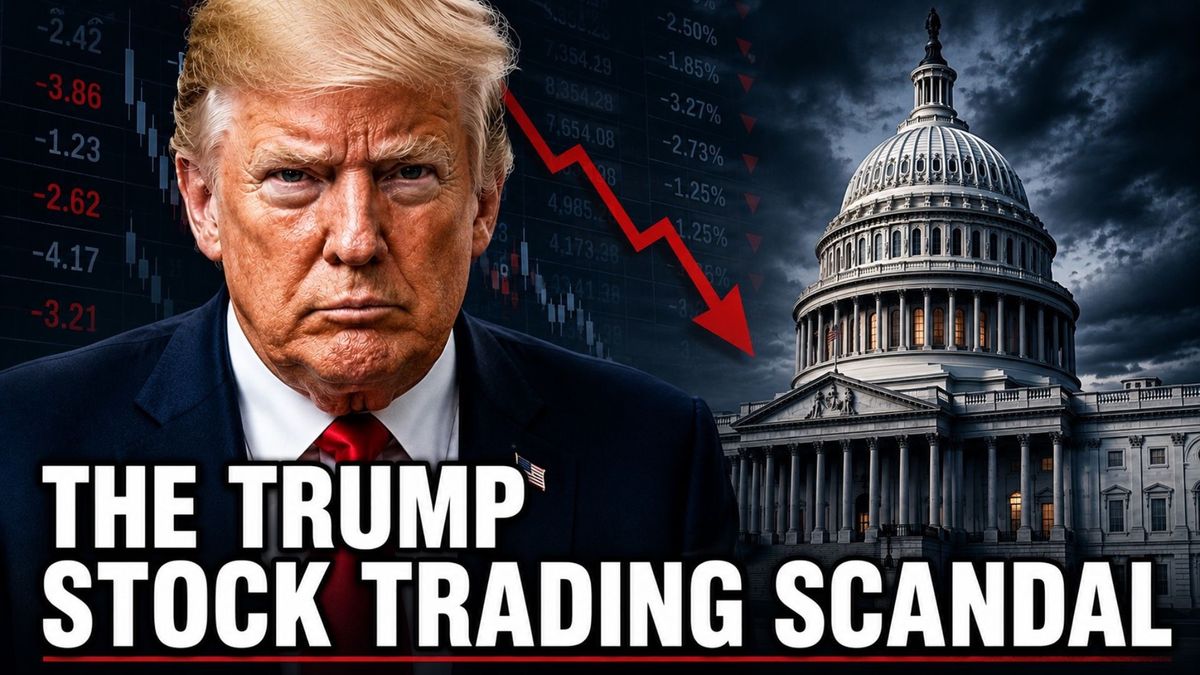
When the Trump Stock Trading Scandal Detonated Across Washington
On the morning of 14 May 2026, the U.S. Office of Government Ethics quietly released a filing that detonated like a slow-motion bomb across Washington. One hundred and thirteen pages. More than 3,700 individual stock and bond transactions executed between January and March 2026—an average of nearly 40 trades every single market day. A cumulative value estimated between USD 220 million and USD 750 million. And at the centre of it all: the name of the sitting President of the United States, Donald J. Trump.
The companies? Nvidia, Oracle, Intel, Boeing, Microsoft, Meta, Amazon, Paramount Skydance, Netflix—names that read less like a diversified portfolio and more like a map of every major policy battlefield the Donald Trump administration was simultaneously fighting on. In any other era of American history, in any other democracy worthy of the name, this would have been a constitutional crisis. In the spring of 2026, it became a political firestorm—and the most searching test of whether America’s ethical architecture could survive the most audacious presidency in its modern history. The Trump stock trading scandal would prove to be precisely that test.
Also Read:Donald Trump and Epstein Files: The Scandal Behind the Iran Conflict
The Tradition That Trump Shattered
To understand how extraordinary this moment is, we may need to understand just how unbroken the tradition of presidential financial restraint had been before Trump arrived to torch it. From Franklin Roosevelt onwards, the unwritten but ironclad convention was that a president cannot personally profit from the same corporate landscape he controls. By Lyndon Johnson’s time, the instrument of choice was the qualified blind trust—a vehicle in which the president’s assets are handed to a genuinely independent trustee, the president surrenders all knowledge of and input into investment decisions, and the appearance of conflict is structurally eliminated. Richard Nixon used it. George H.W. Bush used it. Bill and Hillary Clinton created their blind trust within months of entering the White House and ultimately liquidated it entirely when she ran for president in 2007, converting everything to cash to prevent even the shadow of conflict. Barack Obama simply parked his wealth in U.S. Treasury bills and widely diversified mutual funds, consciously avoiding individual equities. George W. Bush went the full blind trust route with a genuinely independent manager.
Advertisment
None of this was required by law. Under Title 18, Section 208 of the U.S. Code—the principal federal conflict-of-interest statute—presidents and vice presidents are explicitly exempt from the restrictions that apply to every other executive branch employee. It was constitutional convention, not criminal compulsion, that for nearly two centuries kept the commanders-in-chief from steering the ship of state toward their own private harbours. As Richard Painter, President Bush’s former chief ethics lawyer, crystallised it: since the Civil War, every president had consciously avoided conflicts. Not because they had to. Because they understood that the republic itself demanded it. Trump, in both his terms, chose to sail a very different course.
Trump Stoc
When the Trump Stock Trading Scandal Detonated Across Washington
On the morning of 14 May 2026, the U.S. Office of Government Ethics quietly released a filing that detonated like a slow-motion bomb across Washington. One hundred and thirteen pages. More than 3,700 individual stock and bond transactions executed between January and March 2026—an average of nearly 40 trades every single market day. A cumulative value estimated between USD 220 million and USD 750 million. And at the centre of it all: the name of the sitting President of the United States, Donald J. Trump.
The companies? Nvidia, Oracle, Intel, Boeing, Microsoft, Meta, Amazon, Paramount Skydance, Netflix—names that read less like a diversified portfolio and more like a map of every major policy battlefield the Donald Trump administration was simultaneously fighting on. In any other era of American history, in any other democracy worthy of the name, this would have been a constitutional crisis. In the spring of 2026, it became a political firestorm—and the most searching test of whether America’s ethical architecture could survive the most audacious presidency in its modern history. The Trump stock trading scandal would prove to be precisely that test.
Also Read: Donald Trump and Epstein Files: The Scandal Behind the Iran Conflict
The Tradition That Trump Shattered
To understand how extraordinary this moment is, we may need to understand just how unbroken the tradition of presidential financial restraint had been before Trump arrived to torch it. From Franklin Roosevelt onwards, the unwritten but ironclad convention was that a president cannot personally profit from the same corporate landscape he controls. By Lyndon Johnson’s time, the instrument of choice was the qualified blind trust—a vehicle in which the president’s assets are handed to a genuinely independent trustee, the president surrenders all knowledge of and input into investment decisions, and the appearance of conflict is structurally eliminated. Richard Nixon used it. George H.W. Bush used it. Bill and Hillary Clinton created their blind trust within months of entering the White House and ultimately liquidated it entirely when she ran for president in 2007, converting everything to cash to prevent even the shadow of conflict. Barack Obama simply parked his wealth in U.S. Treasury bills and widely diversified mutual funds, consciously avoiding individual equities. George W. Bush went the full blind trust route with a genuinely independent manager.
Advertisment
None of this was required by law. Under Title 18, Section 208 of the U.S. Code—the principal federal conflict-of-interest statute—presidents and vice presidents are explicitly exempt from the restrictions that apply to every other executive branch employee. It was constitutional convention, not criminal compulsion, that for nearly two centuries kept the commanders-in-chief from steering the ship of state toward their own private harbours. As Richard Painter, President Bush’s former chief ethics lawyer, crystallised it: since the Civil War, every president had consciously avoided conflicts. Not because they had to. Because they understood that the republic itself demanded it. Trump, in both his terms, chose to sail a very different course.
Trump Stock Trading Scandal: The Numbers That Shock
The Q1 2026 disclosures are, on their face, staggering in their scale and specificity. The headline purchases—each valued between USD 1 million and USD 5 million—include Nvidia, Oracle, Microsoft, Boeing, and Costco. In the technology sector, Trump (or his designated advisers) bought into Apple, Broadcom, Motorola, Texas Instruments, and Dell. His (however indirect these may have been) largest single-category sales—ranging from USD 5 million to USD 25 million each—involved Microsoft, Amazon, and Meta. Beyond equities, there were significant investments in S&P 500 index funds and hundreds of transactions in municipal bonds.
But what transforms this from mere financial disclosure into a full-blown political firestorm is the direct, undeniable overlap between these companies and specific Trump administration policy decisions playing out in real time. Nvidia is the world’s dominant AI chip designer, and Trump has been aggressively courting its technology for an American AI supremacy strategy. Oracle secured a pivotal role in the TikTok restructuring deal finalised in January 2026—in which the administration helped the company become the security partner and primary auditor for the new U.S. TikTok joint venture—and Trump is reported to have purchased Oracle stock in early 2026 precisely around the time that deal was being engineered.
The U.S. government simultaneously negotiated and executed an USD 8.9 billion purchase of a 10% equity stake in Intel in August 2025, with Intel’s stock subsequently climbing 20% in Q1 and doubling in April following government-endorsed sales estimates—and Intel also features prominently in Trump’s trading disclosures. And then there is the media triangle: Warner Bros. Discovery, Paramount Skydance, and Netflix are locked in a titanic USD 80–108 billion acquisition battle requiring Department of Justice and FCC approval—and Trump has acknowledged personally purchasing stakes in all three while initially declaring he would be “personally involved” in the review of those very deals. The Trump stock trading scandal encompasses all these nexuses, raising questions that demand urgent scrutiny.
The filing itself is conspicuously opaque. It does not consistently specify whether transactions are stocks, bonds, or derivatives. It does not identify which accounts the trades ran through, who precisely executed them, or what instructions were given. Some transactions are labelled “unsolicited”—but the filing offers no explanation of what that designation means in the context of an investment programme ostensibly run by independent advisers. Forty trades a day, yet the paper trail offers more shadows than light.
Also Read: Trading War? How $2.6B Oil Bets Triggered DOJ Probe
A Galaxy of Parallel Conflicts
The stock-trading disclosures are not an isolated controversy but sit within an entire galaxy of parallel financial conflicts that have accumulated across Trump’s two terms. Trump launched the $TRUMP and $MELANIA meme coins just before his inauguration in January 2025, with the Trump Organisation and its affiliates controlling approximately 80% of the tokens and collecting a fee on every transaction. By May 2025, the top 220 investors in the $TRUMP meme coin were invited to a private dinner at his golf club—access to the President of the United States effectively auctioned through cryptocurrency holdings, in what former Obama ethics adviser Norman Eisen called “the single worst conflict of interest in modern presidential history.”
Then came the tariff timing scandal. In April 2025, Trump posted “THIS IS A GREAT TIME TO BUY!!!” on Truth Social mere hours before announcing a 90-day pause on tariffs that sent the S&P 500 surging more than 9%. Democratic senators Adam Schiff and Mark Warner formally demanded SEC and CFTC investigations. The White House itself was forced to circulate a staff-wide email warning against trading on non-public information—an extraordinary self-indictment from within the very building the scandal emanates from. A Senate resolution introduced in May 2025 condemned Trump’s private business agreements with foreign governments—including an Oman hotel deal on government-owned land and a USD 500 million complex in Serbia—as violations of the Foreign Emoluments Clause of the Constitution.
Miami residents sued Trump over a plan to donate downtown Miami property for his presidential library, alleging violation of the Domestic Emoluments Clause. The Brennan Center for Justice catalogued numerous potential second-term violations of both Emoluments Clauses. Thread by thread, the ethical fabric unravels. The Trump stock trading scandal, in this context, is not an anomaly but a symptom of systematic institutional decay.
What Ought to Have Happened
The standard was not complicated, nor did it need to be invented for Trump—it existed, was practised by every modern predecessor, and was endorsed by the very officials Trump himself appointed to oversight roles. Walter Shaub, the director of the Office of Government Ethics who served under both Obama and Trump before resigning in protest in 2017, stated it with surgical precision: “Every president in modern times has taken the strong medicine of divestiture.”
What Trump ought to have done upon his second inauguration in January 2025 was threefold. First, he should have directed complete divestiture of his equity portfolio and placed the proceeds in U.S. Treasury bonds or broad mutual funds—the Obama model—or at minimum into a qualified blind trust administered by an independent financial institution with no family involvement. Second, his sons Eric and Donald Jr., who oversee his business empire, should not have been permitted any role whatsoever in investment decisions connected to the president. A “blind trust” run by one’s own children is not blind; it is theatre. Third, his ethics agreement published on 10 January 2025 was weaker than even the inadequate agreement of his first term: it did not prohibit the Trump Organisation from striking new business deals abroad, merely barring direct deals with foreign governments—a loophole the size of a continent. Beyond these structural remedies, Trump should have personally recused himself from any government decisions touching companies in which he held positions—a principle long applied to every other executive branch official, even if the statute does not technically reach the president himself.
Also Read: Iran Demands Oil Tariffs in Chinese Yuan, Threatening Dollar Dominance
Trump Stock Trading Scandal: The Defence That Collapses Under Scrutiny
The White House defence has been consistent and rests on three pillars. The president does not personally make investment decisions; an independent financial manager executes trades through programmes that mirror recognised indices. All transactions were fully disclosed under federal law. And spokesperson Davis Ingle stated flatly: “There are no conflicts of interest. President Trump acts solely in the best interest of the public.”
How credible is this defence? Narrowly and technically, partially. It is true that presidents are exempt from the conflict-of-interest statute. It is true that the STOCK Act’s disclosure requirements appear to have been formally followed. And no regulatory body has yet found that Trump himself directed specific trades with advance knowledge of policy decisions.
But the defence collapses on its own logic when scrutinised. Independent financial managers using programmes that “mirror recognised indices” do not generate 3,700 bespoke trades in a single quarter, executing purchases of individual stocks in Oracle at precisely the moment an Oracle-centric government deal is being finalised, or selling Microsoft in billion-dollar tranches while simultaneously regulating its AI investments. The scale and specificity of the portfolio is flatly inconsistent with passive index-tracking. Moreover, the designation of some transactions as “unsolicited” in the filing is itself a red flag—suggesting that at least some trades were not algorithm-driven but individually initiated. As Richard Painter put it, the presidential exemption “diminishes public trust in the government.” And Shaub’s observation that the ethics programme is now a “smoldering crater” reflects the consensus view among good-governance experts across party lines.
The Stakes: When Policy and Profit Become Indistinguishable
The financial concerns are concrete and alarming. If Trump or persons close to him had advance knowledge of the tariff pause and traded accordingly, the S&P 500’s 9% single-day surge could have generated hundreds of millions in profits—dwarfing even the disclosed transaction values. The Intel deal—government purchasing a 10% stake at a discounted price while the president held related positions—raises troubling questions about whether taxpayer-funded market interventions were in any way influenced by private portfolio considerations. Foreign governments—sovereign wealth funds from Saudi Arabia, Qatar, the UAE, and investors from China—all feature in the Paramount-Warner Bros. deal requiring presidential regulatory approval, creating a situation where doing business with Trump-linked entities may directly influence American public policy. This is precisely what the Emoluments Clauses of the Constitution were designed to prevent.
The ethical concerns cut even deeper. When the line between presidential policy and presidential profit becomes invisible, democracy itself is at risk. Citizens cannot know whether a given tariff, regulatory ruling, or government investment decision reflects the national interest or the president’s portfolio.
The Q1 2026 disclosures do not merely reveal a conflict of interest—they reveal that under the Trump presidency, conflict of interest has become the operating system itself. Senator Elizabeth Warren was not being hyperbolic when she declared the media merger deals “reeked of corruption.” She was being precise.
Remedies, Reforms, and the Political Will Problem
The situation is not without remedy, even at this late and scandalous juncture. Trump could, at any point, direct his trust to liquidate equity holdings in companies subject to direct government regulation and place proceeds in U.S. Treasury securities—the Obama model applied belatedly. He could replace the current family-overseen vehicle with a genuinely qualified blind trust managed by an independent institution. But why would he? Would it not strengthen the critique against him?
Congress could yet pass the Presidential Conflicts of Interest Act—introduced by Senator Elizabeth Warren as early as 2017 and repeatedly since—which would mandate that the president and vice president divest conflicting assets and prohibit appointees from participating in matters affecting the president’s financial interests. The Securities Exchange Commission (SEC) and Commodities and Futures Trading Commission (CFTC) retain jurisdiction over market manipulation and insider trading under the STOCK Act, and senators Warner and Schiff have already placed formal investigation requests on the table.
The Stop Insider Trading Act, introduced in January 2026 by House Administration Committee Chairman Bryan Steil, and the bipartisan PREDICT Act introduced in March 2026 to ban prediction market trading by officials, signal that even within the Republican Party, the ethical case for restraint is gaining ground—slowly, grudgingly, but gaining.
The Office of Government Ethics has been structurally crippled. When Walter Shaub resigned in 2017, he explicitly called for legislative reforms giving the office teeth—subpoena powers, enforcement authority, and the capacity to investigate and sanction rather than merely advise. His successors have operated under the same fundamental constraint: an advisory body without enforcement power, entirely dependent on the goodwill of the very officials it is supposed to oversee. A watchdog that cannot bite is not a watchdog; it is a monument to good intentions.
The Republic’s Unfinished Business
The deepest lesson from this story is both simple and devastating: norms are not law, and law that exempts the president is not law. The bipartisan tradition that kept every modern president’s personal portfolio free from policy-adjacent equities was not enshrined in statute because it was assumed that no president would need the compulsion. That assumption has now been shattered—and it will not be easily restored by future administrations invoking precedent, because Trump’s conduct has itself become precedent, available to any future occupant of the Oval Office to cite in justification.
The blind trust, divestiture, and ethics walls that every modern president embraced were not invented because past presidents were corrupt. They were invented because even good people exercise better judgment when temptation is structurally removed.
What the Q1 2026 disclosures have exposed is not a single act of corruption but the systemic consequence of a presidency that has, across two terms, treated the ethics conventions of its predecessors as optional enhancements rather than foundational obligations. The 3,700-plus trades, the Oracle-TikTok nexus, the Intel government stake, the media merger investments, the meme coin empire, and the tariff timing posts form a coherent pattern: a president leveraging the incomparable informational and regulatory power of the White House in ways that, while not definitively proven to be criminally corrupt, are incompatible with the public trust that the office demands.
Somewhere in the institutional memory of the American republic, the standard set by every modern predecessor—from Eisenhower to Obama—stands as a rebuke and a compass. The remedies exist. The legislative tools are drafted and waiting. The watchdogs are barking, if not yet biting. The only question that remains—the question on which the republic’s ethical future actually hinges—is whether the United States will choose to honour that standard in law before the next president decides that exploiting the gap is simply too tempting to resist.