On 15th May (Friday), Additional Sessions Judge V. V. Kathare rejected the bail application of Ashwini Ashok Chainani in relation to the forced conversion and sexual harassment scandal at Tata Consultancy Services (TCS) Business Process Outsourcing (BPO), Nashik in Maharashtra.
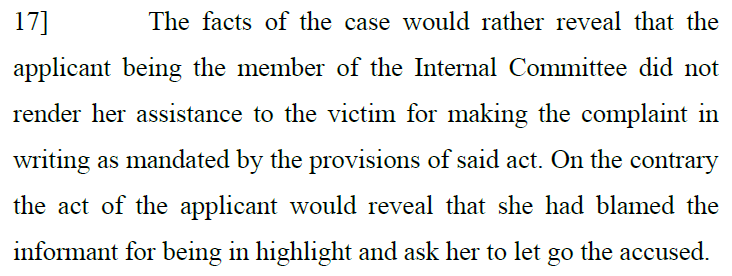
The decision was made on the grounds of her negligence in addressing the grave complaints, even though she was a member of the Prevention of Sexual Harassment (POSH) Committee. She was bound by her position to extend help, but instead, she resorted to blaming the victim and pushed her to spare the accused.
Meanwhile, the court had also dismissed bail pleas of accused Asif Ansari, Raza Memon, Tausif Attar and Shahrukh Qureshi.
The informant’s ordeal, continuous torment and Chanani’s flagrant indifference, victim-blaming
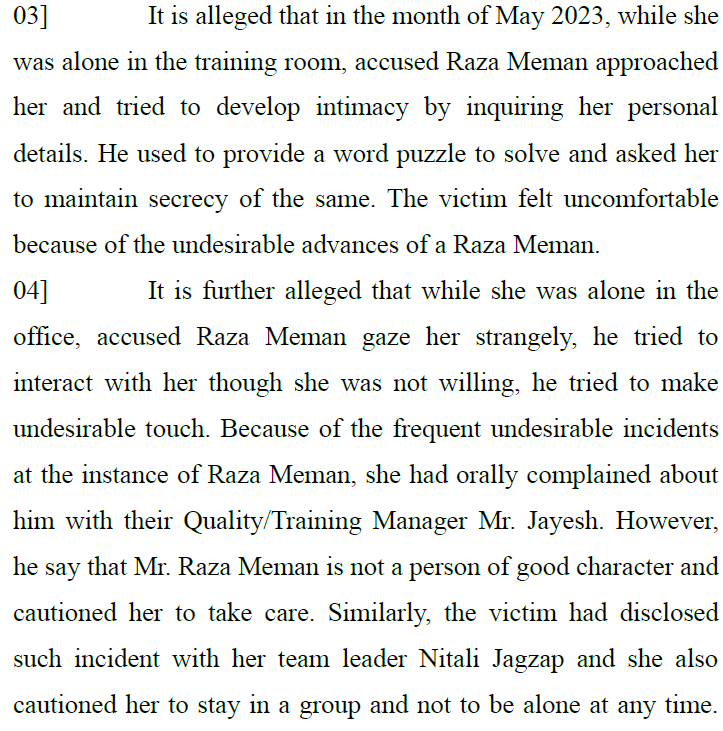
Chainani served as site supervisor of the victim (informant) who worked as an associate under the team leader Raza Meman. He contacted the woman in May 2023 while she was by herself in the training area and attempted to establish intimacy by asking her personal information. He would present her a word puzzle to solve and ask her to keep it a secret. The unwanted advances made her feel uneasy. He “gazed her strangely,” sought to engage with her against her will and made inappropriate physical contact when she was alone in the office.
The victim orally informed the quality and training manager, who warned her to be careful and stated that Memon was not a person of good character. She likewise alerted another team leader Nitali Jagzap who advised her to never be alone and always remain in a group.
Meman learnt about the same and purposefully linked her name with a male coworker Abhishekh and disparaged her by claiming that the two were having an affair. The victim tied the knot in last November. She used to nap at the office after lunch. The perpetrator further embarrassed her by enquiring about private aspects of her marriage and life at the time. Afterwards, she requested him to grant her a leave of absence in February to spend with her spouse in Goa.
However, he probed into whether she indulged in alcohol and was planning to celebrate her honeymoon there. She felt assaulted by the way he stared at her from head to toe and his actions “amounted to sexual harassment.” Additionally, it was laid out that Meman managed her work in a manner that led to a significant strain with the intention of harassing her.
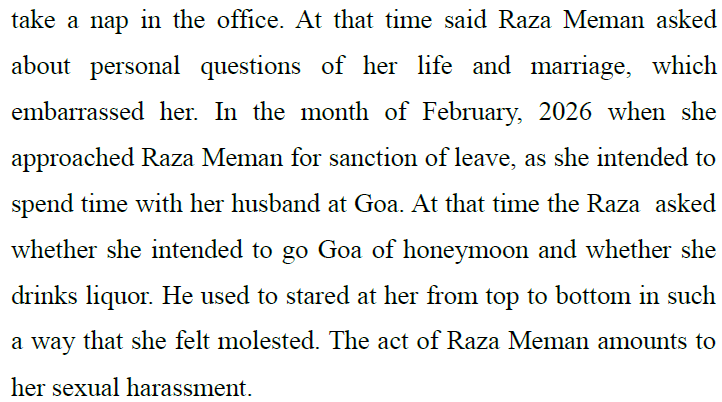
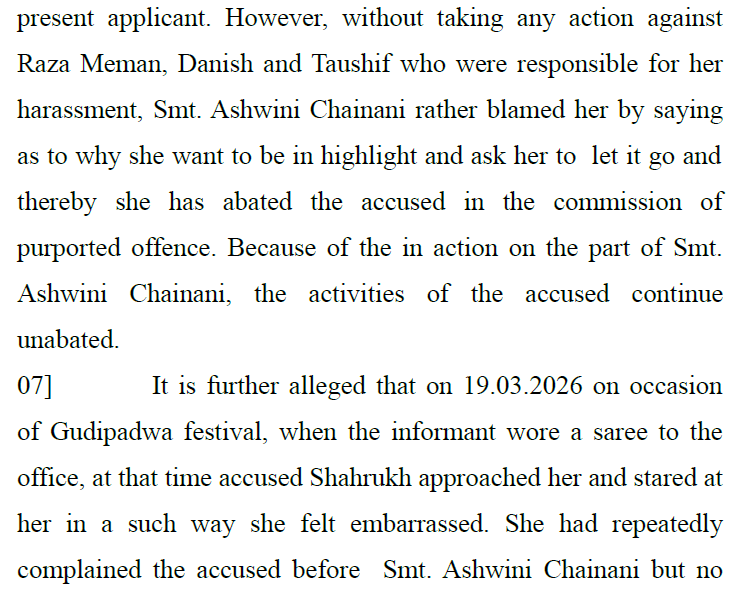
Her frustration prompted her to report the ordeal to the office head Chainani who preferred to partake in victim blaming instead of confronting the offenders. “However, without taking any action against Raza Meman, Danish and Taushif who were responsible for her harassment, Ashwini Chainani rather blamed her by saying as to why she wants to be in highlight and ask her to let it go,” the order read. It added that as a result she abated them concerning the crime and their objectionable behaviour persisted due to her conduct.
On 19th March (Gudipadwa), the woman was wearing a saree (sari) to work when Shahrukh came up to her and looked at her with an expression that left her ashamed. She had often protested about him before Chainani. However, the latter did nothing which only emboldened him.
The court points to facts to eliminate Chainani’s weak arguments
It was contended that the applicant had been drawn into the matter on the pretext that, as the head (delivery partner) she had failed to react appropriately to the oral complaints made to her, consequently aiding and abetting the violations. The submission insisted “discrimination” and asserted that she was “operating and posted at the Pune office of TCS and the day-to-day work at a Nashik office was not under her direct supervision.” Hence, she was oblivious about the instances and “did not received any report or complaint of sexual harassment.”
It was also alleged that she has been assisting in the inquiry and her son’s wedding is scheduled for 26th June. However, the state of Maharashtra pointed out that Chainani “failed to take timely cognisance of the oral complaints of sexual harassment made by the informant against co-accused and as a result the activities of the co-accused continue unbridled. The investigation is in progress and in the event of release of applicant on bail the prosecution apprehends influencing witnesses and to tamper with the prosecution evidence.”
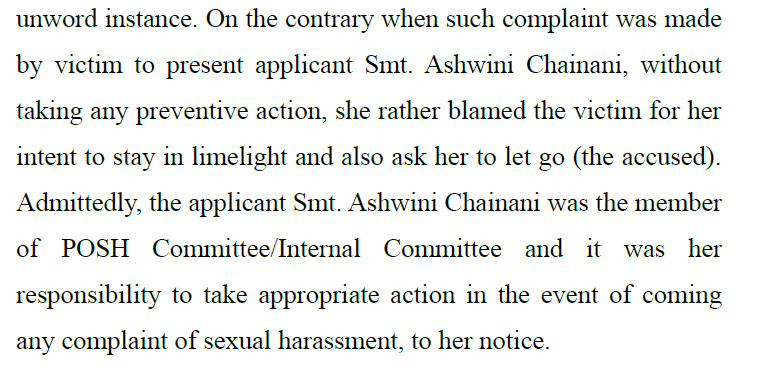
Chanini also voiced dissatisfaction at the lack of action taken against Jayesh and Jagzap. Nevertheless, the court emphasised that a comparison cannot be made as the duo “not only not cautioned the informant about the immoral character of the accused Meman but also advised her to stay in a group to avoid any unword instance.”
On the other hand, when the victim lodged a report to Chainani, she accused her of wanting to remain in the spotlight and urged her to let go the accused instead of taking any precautionary step. The latter “admittedly” was member of the “POSH Committee (Internal Committee), and it was her responsibility to take appropriate action in the event of coming any complaint of sexual harassment, to her notice.”
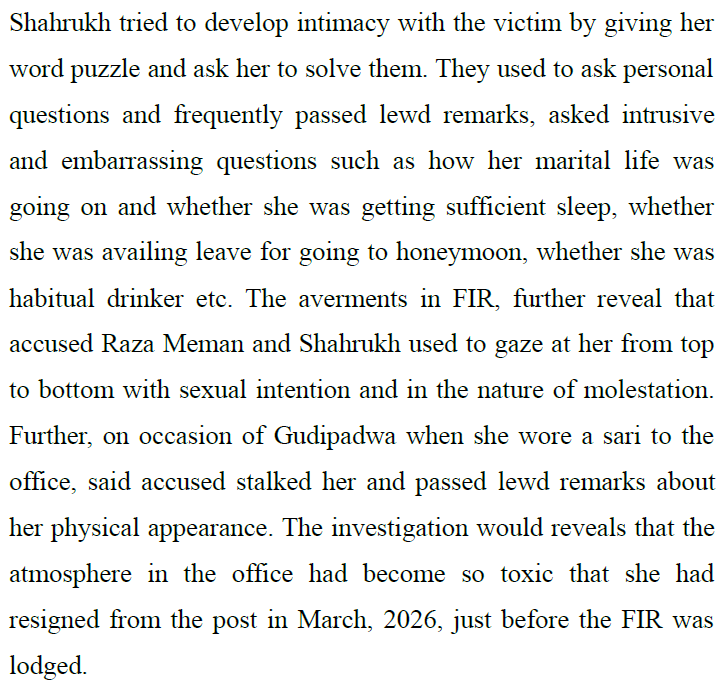
The court noted the gravity of the situation by restating the offences perpetrated by the accused, which included their endeavours to cultivate intimacy. “They used to ask personal questions and frequently passed lewd remarks, asked intrusive and embarrassing questions such as how her marital life was going on and whether she was getting sufficient sleep, whether she was availing leave for going to honeymoon, whether she was habitual drinker etc.,” it mentioned.
The allegations in the FIR (First Information Report) illustrated that Shahrukh and Meman molested her by staring at her from head to toe with a sexual motive. They even stalked her and uttered crude comments about her beauty when she wore a saree on Gudipadwa. According to the probe, she resigned from the position in March 2026, shortly before the official complaint was registered owing to the toxic atmosphere of the office.
The court pronounced, “Thus, it would be evident that the applicant despite being a member of POSH Committee (Internal Committee) demonstrated insensitivity to the oral complaints lodged by the victim and thereby not only she has shielded the accused but also abetted them to continue with their acts of sexual harassment.”
Chainani waited for the crisis to materialise rather than taking proper action against the co-accused. Her apathy and silence enabled their deeds. “She turned a blind eye and a deaf ear to what was happening in front of her. Despite lodging first FIR on 25 March, she did not visit the T.C.S. office at Nashik, nor took appropriate steps to check unbridled activities of the co-accused,” the judge observed.
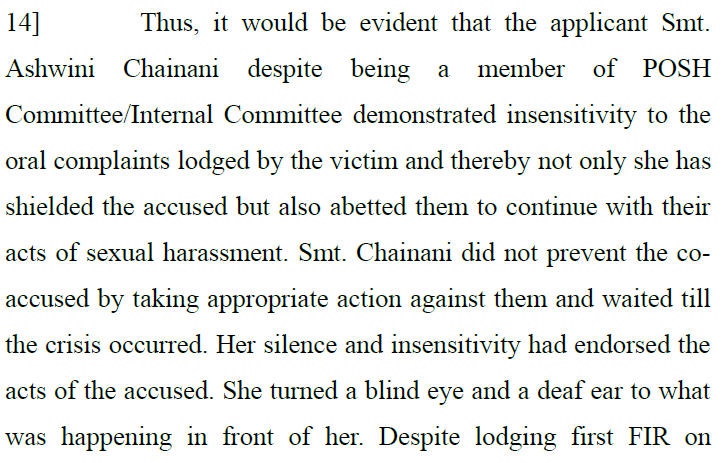
He stated that the victim cannot be held accountable for the holdup in posting the complaint because she instantly informed Chainani of the circumstances.
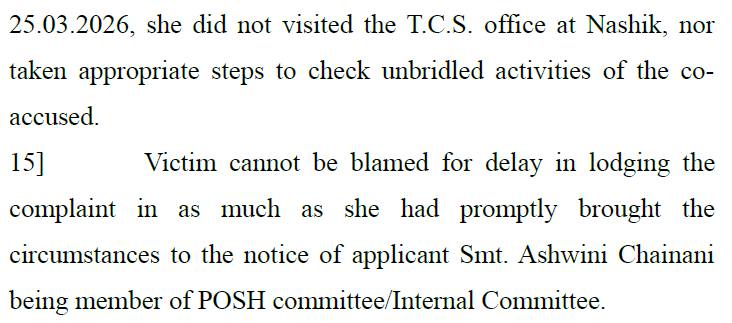
The reasons for the delay in the complaint are justified
The court also stated that section 9 of “The sexual harassment of women at work place (Prevention, prohibition and redressal) Act, 2013 which prescribes that where such complaint cannot be made in writing, the Presiding Officer or any member of the Internal Committee etc. as the case may be, shall render all reasonable assistance to the women for making the complaint in writing,” against the discussion in relation to the lack of a written complaint, terming it as an “after thought” of the victim.
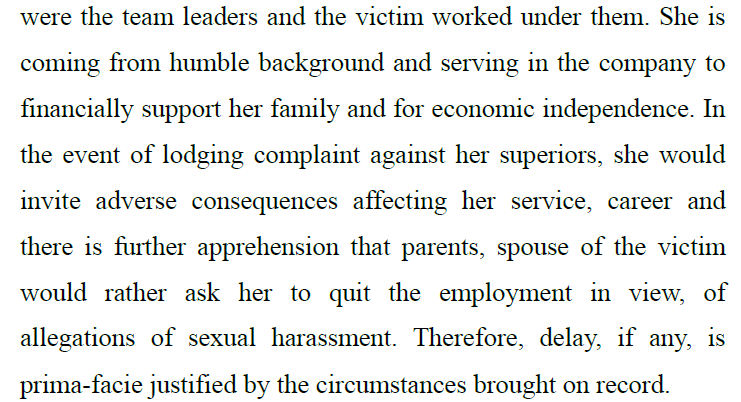
The judge outlined, “It can be seen that the complaint of sexual harassment has to be routed through the accused persons who were the team leaders and the victim worked under them. She is coming from humble background and serving in the company to financially support her family and for economic independence.”
The court acknowledged that she would face negative repercussions that would impact her career and service in the light of a complaint against her bosses. There is also concern that the victim’s spouse and parents might prefer that she resign from her job due to charges of sexual harassment. As a result, each postponement is primarily justified by the conditions documented in the case.
It was brought to the court’s attention that Chainani was not cooperating with the investigating officer. Hence, the personnel arrested her on short notice, citing explanations after considering the possibility of flight risk. Chainani even referred to a past verdict involving a principal to maintain that her actions do not amount to abetment.
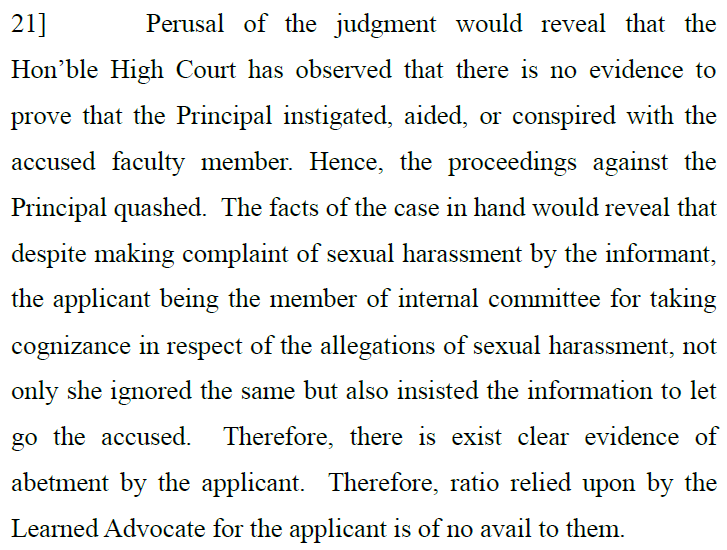
However, the court ruled that there was insufficient proof that the principal encouraged, assisted or colluded with the accused faculty member. Thus, the proceedings were junked.
“The facts of the case in hand would reveal that despite making complaint of sexual harassment by the informant, the applicant being the member of internal committee for taking cognizance in respect of the allegations of sexual harassment, not only she ignored the same but also insisted the information to let go the accused. Therefore, there exists clear evidence of abetment by the applicant,” it declared.
“The investigation in the matter is at the nascent stage. Considering the influential nature of the applicant and co-accused there is every likelihood of influencing witnesses and tampering with the prosecution evidence in the event of release on bail. Hence, the application deserves to be rejected,” the judge concluded.
When NCW flagged toxic work culture and “zero POSH compliance” in its report
On 11th May, the National Commission for Women (NCW) conveyed that the Maharashtra government had received a comprehensive report from its fact-finding committee, which was established to look into the matter. According to the body, the examination uncovered a “deeply disturbing and toxic workplace environment” which revolved around systematic bullying, sexual harassment, misuse of authority and constant anti-Hindu statements made against female employees.
It strongly disapproved of the Nashik office’s application of the POSH Act and pointed out that Pune and Nashik shared a common Internal Committee, which is an infraction of the law. Moreover, no IC members had ever visited or assessed the Nashik unit for enforcement of these guidelines.
The committee expressed that the office did not have any signs, boards or posters detailing POSH conformity. Similarly, there was no visible content alerting staff to the consequences of breaking these rules and no board with the contact details and names of IC members. The report also noted the absence of employee awareness drives and IC member induction programs. According to the committee, there was “zero compliance” with the POSH Act.
The latest judgment has also confirmed the extremely compromised system of the firm and how the individuals who had to ensure the safety of the vulnerable Hindu women turned out to be its prominent violators.