
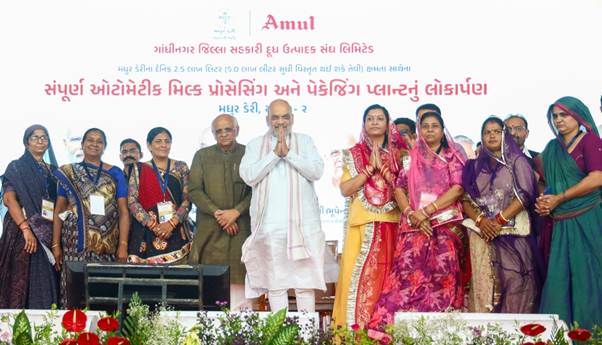

Amit Shah Inaugurates Modern Madhur Dairy Plant, Boosts Cooperative Dairy Vision in Gujarat
Madhur Dairy received a major boost as Union Home and Cooperation Minister Amit Shah inaugurated its state-of-the-art automated milk processing and packaging facility at Dashela in Gujarat’s Gandhinagar district. The inauguration was held in the presence of Gujarat Chief Minister Bhupendrabhai Patel and several other dignitaries.
The newly developed Madhur Dairy Unit-2, constructed at an estimated cost of ₹128 crore over 15 acres of land, currently has a milk processing capacity of 2.5 lakh litres per day, which is expected to increase to 5 lakh litres daily in the coming years. The project is aimed at strengthening rural livelihoods and increasing the earnings of milk-producing families, particularly women associated with the cooperative dairy sector.
Addressing the gathering, Amit Shah described the project as more than just an industrial expansion, calling it a significant step towards empowering lakhs of rural dairy farmers through the cooperative movement. He said the profits generated through the dairy model would directly benefit milk producers and strengthen village economies across the region.
Tracing the growth journey of Madhur Dairy, Shah noted that the institution began operations in 1971 with milk collection of just 6,000 litres and a turnover of ₹7,000. Over the decades, it has evolved into a major cooperative dairy institution with an annual turnover of approximately ₹628 crore and an extensive milk collection and distribution network. He described Madhur Dairy as a successful example of India’s cooperative development model.
The Union Minister also highlighted the Centre’s “White Revolution 2.0” initiative launched under the leadership of Prime Minister Narendra Modi, which aims to significantly increase India’s milk production over the next decade. He stated that leading cooperative dairies such as Amul, Banas Dairy, and Mehsana Dairy are adopting modern technologies to improve dairy productivity and ensure direct economic benefits for livestock farmers.
Shah further said that cooperative dairy institutions are increasingly focusing on value-added nutritional products including protein shakes, probiotic curd, and high-protein beverages. According to him, the strength of the cooperative system lies in ensuring that the benefits generated from these products reach farmers directly.
Highlighting the role of women in the dairy sector, Shah said nearly 36 lakh women are currently involved in milk production of around 3 crore litres per day, with nearly ₹200 crore being transferred daily into their bank accounts through the cooperative dairy network. He termed this movement a major example of women empowerment and rural self-reliance.
The Union Minister also spoke about technological innovation in the sector, mentioning Amul’s AI-powered digital assistant “Sarlaben,” launched during the AI Summit by Prime Minister Narendra Modi. The platform is designed to provide accessible technological support to rural women and livestock rearers.
He added that the adoption of circular economy principles in the dairy sector is expected to increase dairy incomes by nearly 20 percent in the future. The Government, he said, remains committed to modernising the cooperative dairy ecosystem through technology, innovation, and sustainable development initiatives.