
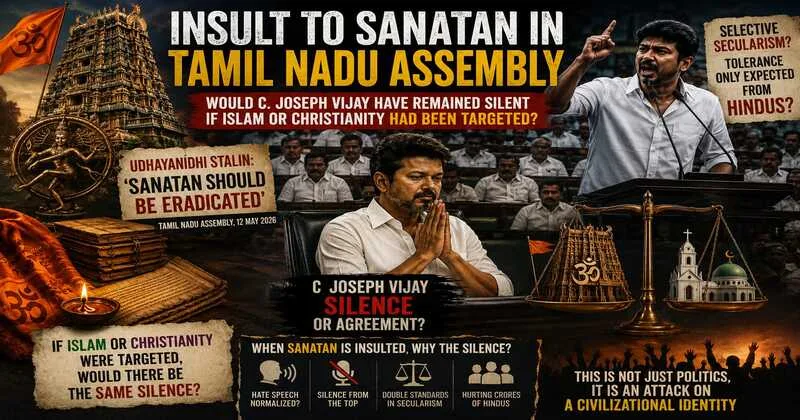
What unfolded in the Tamil Nadu Legislative Assembly on 12 May 2026 was not merely a political controversy. For many Indians, it represented a deeper civilisational and ideological conflict surrounding the place of Sanatan Dharma in modern Indian politics. The renewed remarks by DMK leader regarding the need to “eradicate Sanatan” reignited a debate that first erupted in 2023. Yet this time, the larger controversy was not only about the statement itself, but about the silence of the Chief Minister .
As the remarks were made in the Assembly, Vijay reportedly remained seated quietly, watching without publicly objecting or distancing his government from the statement. For critics, that silence became symbolic. They argue that when a constitutional office-holder chooses not to respond to remarks perceived as offensive toward the faith of millions, the silence itself acquires political meaning.
The central question being raised is straightforward: if a similar statement had been made against Islam or Christianity, would the political establishment, media, and civil society have reacted with the same restraint? Would such comments have been dismissed as “political expression” or “ideological criticism”? Or would there have been immediate outrage, condemnations, and demands for accountability?
This debate has intensified because the controversy is not occurring in isolation. In 2023, Udhayanidhi Stalin had compared Sanatan Dharma to diseases such as dengue, malaria, and COVID-19, arguing that it should not merely be opposed but “eliminated.” Those remarks had already triggered nationwide criticism. Supporters of the DMK defended the comments within the framework of social justice and opposition to caste hierarchy, while critics viewed them as an attack on Hindu civilizational identity itself.
The present controversy, therefore, reflects a broader ideological divide in Indian politics. Critics argue that attacks on Hindu symbols, temples, traditions, and Sanatan practices are frequently packaged as “progressive politics,” “rationalism,” or “social reform,” while equivalent language directed toward other religions would be considered unacceptable and intolerant. According to this viewpoint, India’s secular discourse has increasingly become selective, placing the burden of tolerance disproportionately upon Hindu society.
Tamil Nadu’s Dravidian political tradition has long maintained a confrontational relationship with aspects of Hindu religious symbolism, especially those associated with caste structures and Brahminical dominance. However, what concerns many observers today is the normalisation of language calling for the destruction or eradication of Sanatan itself. In that context, the conduct of Chief Minister C. Joseph Vijay has become central to the discussion.
Vijay had entered politics projecting himself as a symbol of “new politics” in Tamil Nadu — one that promised inclusivity, unity, and respect across communities. During his political campaign, he frequently emphasised harmony and a fresh political beginning beyond old ideological hostilities. Critics now argue that his silence during the Assembly controversy appears inconsistent with those promises.
In politics, silence can often become more consequential than speech. Supporters of the Chief Minister describe his conduct as parliamentary restraint or political decorum. Opponents, however, see it as tacit approval. That is why social media and political discussions are increasingly centred not only on what Udhayanidhi Stalin said, but also on why the Chief Minister did not publicly respond.
The controversy has also revived a larger national conversation about the meaning of hate speech and secularism in India. Many commentators argue that strong reactions emerge swiftly when remarks target minority religions, yet statements directed at Sanatan or Hindu traditions are often contextualised as ideological criticism or social commentary. For critics, this reveals a double standard within sections of politics, media, and intellectual discourse.
For millions of Hindus, “Sanatan” is not merely a theological term. It represents a civilizational continuity stretching back thousands of years and forms an essential part of India’s cultural identity. Therefore, calls for its eradication are interpreted not simply as political rhetoric but as attacks on a broader civilizational framework.
The scenes from the Tamil Nadu Assembly are therefore likely to remain politically significant. They symbolise more than a controversy over words. For many observers, they represent a clash between competing visions of secularism, identity, and cultural legitimacy in India.
Ultimately, the debate today is no longer confined to Udhayanidhi Stalin’s remarks alone. It is increasingly focused on whether Tamil Nadu’s new political leadership will genuinely uphold equal respect for all faiths, or whether criticism directed specifically at Sanatan traditions will continue to be treated differently within the framework of Indian secular politics.