
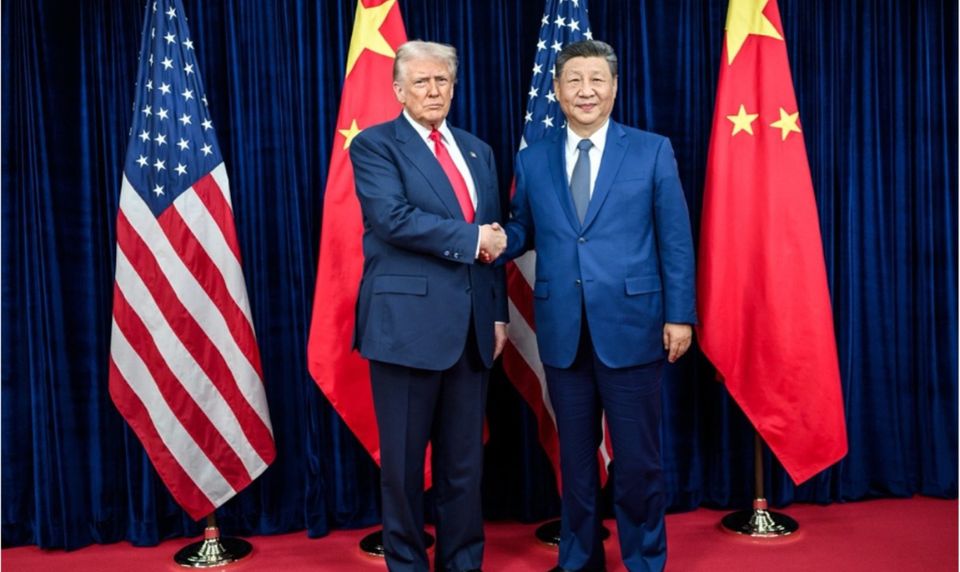
The recent visit of US President Trump to China wasn’t a mere diplomatic discourse between heads of states of two global powers but rather a strategic balancing act between Global North and Global South. The US is a strong supporter of the Global North and fighting for the survival of its unipolarity while China is sponsoring Global South and promoting multipolarity and multilateralism. So, it’s quite exciting to witness pleasant and friendly face-to-face diplomatic appearances of Trump and Xi Jinping while circumventing the underlying huge strategic challenges.
Presently, the US is fighting for its consistent global unipolar domination, striving to retain its position as the sole superpower despite overwhelming challenges from an emerging multipolar world order. On the other hand, China is vehemently promoting a “multipolar world order,” framing it as a necessary shift away from US and Global North’s hegemony towards a more democratic, equitable system where power is distributed among multiple centers. China proposes this new vision of economic prosperity not merely as a power tool but as a commitment to “cooperation and growth” for just and equal global governance.
While confronted with multi-dimensional geostrategic rifts and economic wranglings, it appeared that both sides are making serious efforts to establish workable mechanisms to manage the simmering differences constructively to avoid further deterioration of the relationship and move towards mutual non-flagrant posture. During the US President’s recent visit, Chinese President Xi Jinping accompanied him as a friendly and intimate posture for touring Beijing’s historic Temple of Heaven. Nonetheless, the visit not only featured smiles and polite exchanges but was a skillfully choreographed event that was coined for projecting coziness and frank intimacy at a much tense time in US-China tense relationship. For the first time, both heads of states, eminent global powers, displayed a surprisingly warm and “friendly rapport” hinting for more cordial diplomatic relationships.
Though both Trump and Xi Jinping obviously exhibited a lot of optimism and friendly overtures but the atmosphere of the Xi-Trump summit was quite carefully managed and articulated to suit national interests and keep the world guessing about real outcomes in the future. In accordance with traditional diplomatic norms, the Xi-Trump discourse reflected a true high-stakes power move scenario, where both leaders opted to show an impression of strength while fostering a personal friendly connection. The friendly sentiments and cooperative demeanor were aimed to set a positive environment for sensitive and challenging trade negotiations and to establish meaningful constructive strategic and stable relationships and mechanisms. While US President Trump called, “it’s an honor to be your friend,” and stated their relationship was “better than ever before.” Chinese President Xi Jinping suggested that the US be “partners, not rivals. However, despite the friendly overtures, both leaders sought to be seen as firm and steady as well as diplomatically disciplined to their state’s strategic objectives.
The analysts believe that the recent US President’s visit to China was characterized by a deliberate diplomatic effort to address high-stakes economic and geopolitical challenges with a desire for de-escalation in bilateral relationships. While Trump’s visit is seen as a significant strategic maneuvering to manage mutual rivalry, the optimistic expectations remain still elusive for resetting course towards much warmer and cordial relationship, with a focus for ceasing of enhanced hostilities.
In the global arena, US and China relationships face multiple geopolitical, geoeconomic, and technological competitions between the two global powers and the largest economies. The power tussles involve the potential of high-stake disputes over trade, technology (artificial intelligence), and territorial issues like Taiwan, holding perils for destabilizing the regional and global stability and harmony.
Chinese President Xi Jinping reiterated firm resolve for “One China” policy and his remarks, “Taiwan independence and cross-strait peace are as irreconcilable as fire and water” clearly announced Chinese mindset while emphasizing that this is the most important strategic issue while hinting use of military prong to achieve unification.
On the other hand, President Trump is caught in a double paradox, as the US is currently engaged in high-stakes talks to manage its rivalry with China and create some sort of strategic stability, while the US is officially bound to provide Taiwan with weapons and larms.
Apart from obvious flashpoint as Taiwan, the two competing global powers are also navigating crushing economic challenges, including trade, tariffs, and technological competition, with both leaders seeking to earn economic benefits to normalize a stable strategic relationships. The current unambiguous strategic outlook of mutual relationship is viewed as a significant “Thucydides Trap” scenario, where rapidly rising China threatens to displace an established hegemon, the US while increasing risks of accidental armed clash sends shivers to the world.
The visit also provided an opportunity for diplomatic discourse on contentious issues like the US clash with Iran, opening of the Strait of Hormuz for free commercial shipping of oil trade and potential Chinese oil purchases from the US to reduce its dependence on the Middle East.
In the face of tremendous and unprecedented geopolitical and geo-economic challenges, both countries have shown unflinching resolve for diplomatic engagements to lead to defuse tensions and de-escalation of simmering disputes. The US president’s recent visit of China and consequent face-to-face diplomatic discussions will surely create an amicable atmosphere for more predictable peaceful and healthy relationships, promising a much more stable and prosperous future for the global community.
Article by Brig. Hamid Rashid (R)
This story has been reported by PakTribune. All rights reserved.