
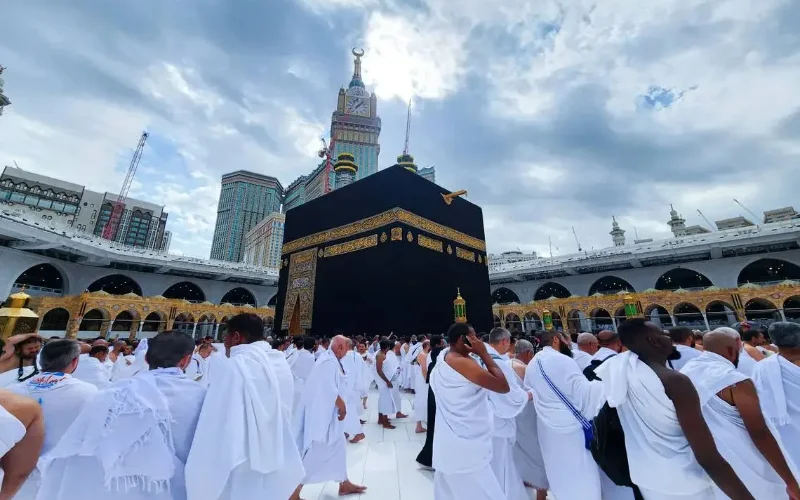
As in previous years, millions of Muslims have gathered in Makkah to perform Hajj, the annual Islamic pilgrimage and one of the five pillars of Islam.
Hajj is considered the final and fifth fundamental pillar of Islam and is obligatory once in a lifetime for every Muslim who is physically and financially able to undertake the journey.
According to the Permanent Committee for Scholarly Research and Fatwa in Egypt, the obligation of Hajj for Muslims was established in the 9th year of the Islamic calendar following a divine command.
Each year, pilgrims from around the world travel to Saudi Arabia to perform the sacred rituals, marking one of the largest annual religious gatherings globally.
Historical references note that the first major organized Hajj after the establishment of early Islamic governance took place under the leadership of Hazrat Abu Bakr Siddique (RA), when around 300 Muslims performed the pilgrimage.
The Prophet Muhammad (PUBH) himself performed the Farewell Pilgrimage in 10 AH, a landmark event in Islamic history that established the framework of Hajj rituals followed to this day.
According to compiled historical estimates, global participation in Hajj has shown steady growth from 1947 to 2026, reflecting improvements in travel infrastructure and Saudi Arabia’s expanding capacity to host pilgrims.
In 1947, following the establishment of Pakistan, around 5,000 Pakistani pilgrims performed Hajj in the first year, while total global participation stood at approximately 150,000 pilgrims.
During the early decades, most pilgrims came from Saudi Arabia and nearby Arab countries due to limited international travel facilities and logistical constraints.
From 1947 to 1955, an estimated 1.57 million Muslims performed Hajj, with numbers rising significantly in subsequent years as air travel and transport systems developed.
By the late 1960s, cumulative participation had reached more than 14 million pilgrims, reflecting steady annual increases.
In the 1970s, annual pilgrim numbers continued to rise, reaching around 1.2 million in 1970 and increasing further in later years as infrastructure expanded.
Between 1947 and 1980, total Hajj participation is estimated at more than 34 million pilgrims, according to historical compiled data.
The 1980s and 1990s saw further growth, with annual figures reaching 2.5 million in 1981 and around 3 million by the mid-1990s.
More recent data shows that around 1.85 million Muslims performed Hajj in 2024, while 1.67 million completed the pilgrimage in 2025. Around 1.7 million are expected to perform Hajj in 2026.
Overall, compiled estimates suggest that approximately 140.45 million Muslims performed Hajj between 1947 and 2026.
Islam remains a global faith followed by billions, and Hajj continues to be performed annually and is expected to remain a central religious obligation for Muslims worldwide.