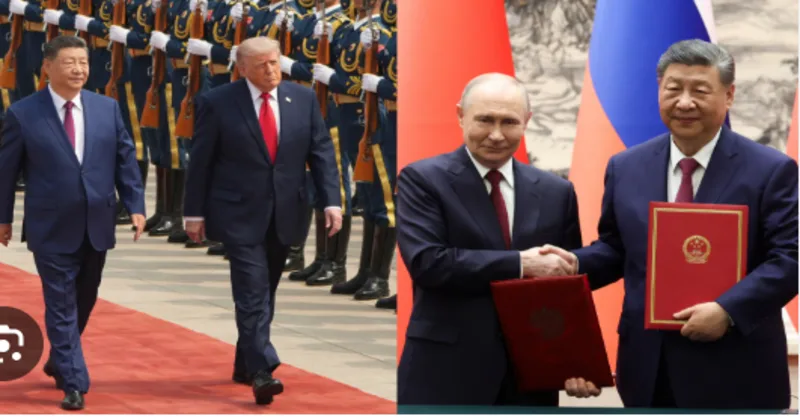
In a game of football, two sides play for a duration of 90 minutes. Each side tries to score a goal till the last minute. The match may be engrossing but the fans are most disappointed when it ends in a goalless draw. Two high profile visits to China in the month of May, in the backdrop of West Asia crisis, ended without achieving much tangible results. The first was the visit of President Donald Trump to China, which was quickly followed by the visit of President Putin to China. In some ways, the world was expecting a lot for the good of the global community from these two back-to-back high-profile visits. Unfortunately, both the visits (or matches) ended without any results (as goalless draw), much to the disappointment of the global community.
President Donald Trump undertook a three-day visit to China from May 13-15. Besides the heavyweights of his administration, the US delegation had the likes of Elon Musk, Tim Cook, Jesen Huang and more than 20 other American CEOs and business leaders. This was the first US Presidential visit in nine years and Chinese President Xi Jinping provided the visit all the feel-good optics. As the lone superpower, the US President was quite confident that the visit would further cement his supremacy over the world affairs. As the second rank economy, China is catching up with the US fast. The US imbroglio in the West Asia conflict provided China a great opportunity to score victory over a weakened America.
While the US made some good moves through the sale of 200 Boeing aircrafts, the Chinese side agreed to such proposals but did not commit any major economic breakthrough in writing. Mr. Trump had an ace up his sleeve in the form of tariffs but he chose not to play this card. In short, all the financial heft of the mighty US companies accompanying Mr. Trump failed to score a goal. Chinese President Xi Jinping tried to moderate the intense match by saying that the US and China should be partners and not rivals. Yet the three-day match(visit) continued, with each side trying to achieve something good for their country.
The US had kept the issue of Iran’s control over the Strait of Hormuz as a major turning point in the visit. Trump had hoped that the continued support of Iran by China in the West Asia conflict would make Jinping uncomfortable. Mr. Trump also sought some assurance from Jinping that hereafter China would not supply military hardware to Iran. In typical Chinese way of playing games, Jinping quietly heard the American side and chose to ignore or commit anything. China had hoped to get some major breakthrough in the American policy over Taiwan. In fact, Chinese President called Taiwan the most sensitive issue in the China-US relations. By now the three-day match(visit) was nearing end and thus Mr. Trump managed to wriggle out without any further friction over Taiwan.
As is the norm these days, both the US and China called the visit most successful (victory) from their perspective, though technically it was a goalless draw. The visit was high on optics and symbolism. It provided the global audience with all the thrills associated in a close match, full of moves and countermoves. Alas, neither side formally announced any major trade breakthrough or significant business deals. As a result, the next round of match (visit) has been announced in September when President Xi Jinping visits White House in the autumn. Hopefully, both the sides can then play a better game for the good of the global community.
The visit of Russian President Vladimir Putin to China from May 19-20 was more of a friendly match. Both the communist countries share close relations as a counter to the US hegemony. Putin’s visit had lavish ceremonies in China and personal rapport between Xi Jinping and Putin was amply visible. In the backdrop of recent setbacks in Russia-Ukraine war and continued economic strain, Putin sought to deepen economic and military cooperation with China. Though the talks reaffirmed a ‘no limits partnership’ and produced over 40 cooperation agreements, the visit of Mr. Putin failed to achieve the victory goal through ‘Power of Siberia 2’ gas pipeline deal with China.
The long-delayed Power of Siberia 2 (POS-2) project, a proposed 2600 km natural gas pipeline that would carry Russian gas from western Siberia through Mongolia to China is crucial to revive the Russian economy. Russia has lost gas supply to the European countries after sanctions were imposed after the Russia- Ukraine war in February 2022. China is taking its time to decide about this ambitious project, possibly because of a complex relationship it shares with Mongolia. Thus, it would be fair to call the visit of Mr. Putin to China another goalless draw. Here too, the match was interesting and the global community was looking for a breakthrough in the West Asia conflict. But both the sides played the match as per their mutual benefits.
Contrast the above two visits with the highly successful five nation visit of PM Modi to UAE, Netherlands, Sweden, Norway and Italy from 15-21 May. This visit was a major diplomatic victory for India which secured approximately $40 billion worth of investments in India. Key outcomes from this visit upgrade our strategic partnership with focus on trade, energy supply, green energy, defence and emerging technology. Norway bestowed PM Modi Grand Cross of the Royal Norwegian Order of Merit. Sweden conferred its highest honour Royal Order of the Polar Star upon PM Modi. With two ‘man of the match’ awards, the visit of PM Modi is a great case study of astute diplomacy in a highly competitive world.