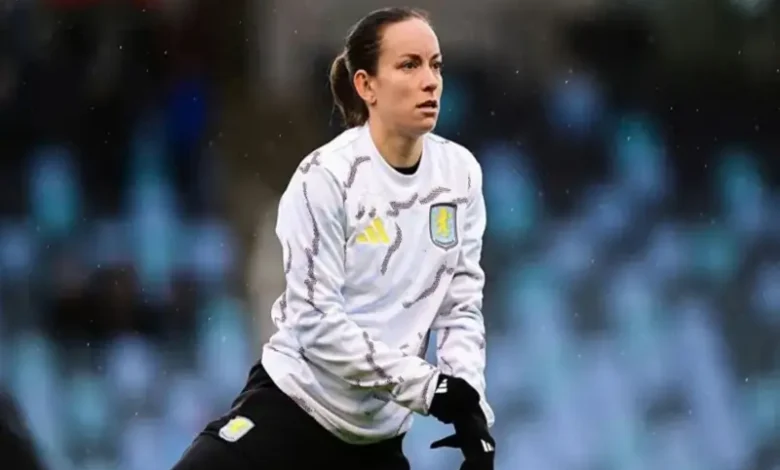
Aston Villa midfielder Lucy Staniforth has confirmed she will retire from professional football at the end of the current season, saying the decision came with complete clarity and emotional peace rather than hesitation.
The 33-year-old, who has enjoyed a career spanning nearly two decades across England’s top clubs and international football, admitted she feels ready to move into the next chapter of her life after battling recurring injuries and years of physical and mental challenges in the game.
Staniforth began her journey at Sunderland in 2008 as a teenager and went on to represent seven different clubs in the Women’s Super League era, making her one of the most experienced and well-travelled midfielders in the competition.
Alongside her club career, she also earned 17 caps for England between 2018 and 2025, contributing to the national setup during an important period of growth for the women’s game.
Her career highlights include reaching FA Cup finals with Sunderland in 2009 and Bristol Academy in 2013, as well as featuring prominently for Aston Villa. Where she made over 50 appearances and helped the club achieve a fifth-place WSL finish in the 2022–23 season.
Her journey has not been without setbacks. Staniforth endured serious injury struggles, including back-to-back anterior cruciate ligament (ACL) injuries in 2014, which kept her sidelined for almost three seasons and significantly shaped the trajectory of her playing career.
Reflecting on her decision to retire, she said there was no internal conflict about stepping away from the game:
“To me, it’s really exciting. It’s not something I’ve wrestled with, but it’s definitely been a thought in the back of my mind as I’ve been getting on,” Staniforth told BBC Sport.
“I’m really comfortable with the decision. It’s been really cool to take the football lens off and be excited for me, as a person, moving into the big, wide world.
Staniforth described her relationship with football as both rewarding and demanding, acknowledging the emotional and psychological pressures that came with a professional career.
“Football has ultimately been my life. It’s made me who I am and it’s all I’ve known. It’s huge and I’ve loved it. I’ve also hated it at times because it’s really hard!
“I’m excited now because I’m not ‘Lucy the footballer’ anymore. It might be hard to come to terms with down the line, but at the moment, it just excites me.”
Looking ahead, the midfielder says she wants to focus on personal growth and eventually contribute to improving structures within women’s football.
With a master’s degree in football directorship already completed and a growing interest in governance and player welfare, she hopes to work in areas such as facilities, travel demands, and overall player support systems.
“That’s the space that I’m going look to go into. I’ve got so much experience and I was playing for various different clubs,” added Staniforth, who also had spells at Liverpool, Sunderland again, Birmingham and Manchester United before joining Villa in 2023.
“Access to facilities, the difficulties of playing international football and travelling, then match loading I think those things are some key areas in women’s football.
“It needs playing experience to be able to guide people in the right direction. I’m definitely steering down that route for now. But in the future, who knows?”
Staniforth also reflected on how far the women’s game has come since her early days, describing a journey from modest beginnings to playing on the biggest stages in football.
“It’s pretty crazy. The kit was hanging off us, we were raising money to afford to get to games, but we had the best time,” she recalled.
“Being able to play at Wembley for England never crossed my mind, but now it’s a regular thing. It’s unbelievable.”
As Staniforth prepares to step away from the pitch, she leaves behind a career defined not only by resilience and longevity but also by her contribution to the growth of women’s football in England.
Her departure marks the end of an era for a player who witnessed and helped shape the transformation of the women’s game from grassroots struggles to a professional, globally followed sport.
While she closes the chapter on her playing days, Staniforth now begins a new journey one driven by purpose beyond the pitch, but still deeply rooted in the game she has lived and breathed for nearly 17 years.
A career built on grit, growth, and quiet determination now gives way to a future still connected to football but on her own terms.