Human Rights Commission of Pakistan 2025 Report Flags Killings, Enforced Disappearances, Lack of Freedom, Rule of Law

In the year gone by, whatever little democratic space existed in Pakistan, it retreated further into a shell as executive became more powerful. Pakistan’s human rights situation deteriorated sharply in 2025, with gap between constitutional protections and realities widening further. A case in point is the 17 years’ imprisonment awarded to human rights lawyer Iman Mazari and her husband for social media posts.
Mazari’s mother was a minister in Federal Cabinet of Pakistan led by incarcerated former Prime Minister Imran Khan. Her conviction and subsequent imprisonment has been widely condemned by human rights organisations like Amnesty International, besides UN experts.
Ever expanding powers of the executive, virtually unfettered now, and controversial legal amendments giving unbridled powers to the Army have been flagged as serious challenges. Restrictions on free speech have curtailed dissent and emaciated judiciary has lost whatever independence it had, according to the HRCP report.
Enforced disappearances and increased fake police encounters highlighted how serious the situation has become. All vulnerable groups, including women, minorities, children and transgender persons, faced widespread violence and discrimination. Although some legislative progress was made, the report concluded that these gains were overshadowed by systemic governance failures.
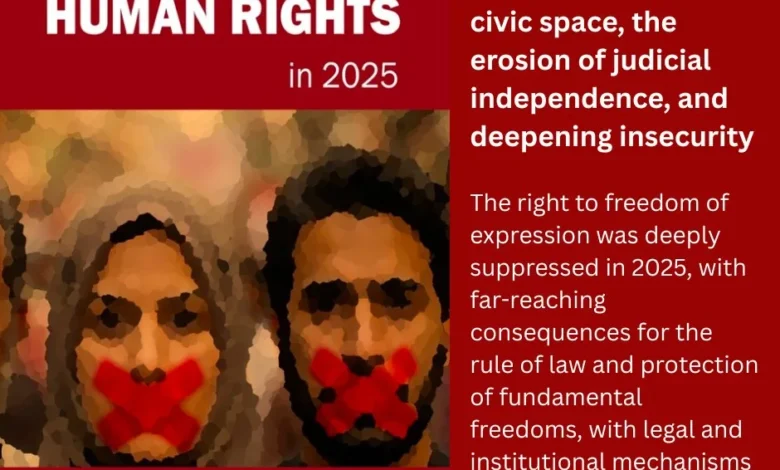
The HRCP annual report for 2025 launched on May 4 pointed out to a shrinkage of civic space, while raising concerns over the deep suppression of the right to freedom throughout Pakistan.
The report titled “State of Human Rights in 2025” was launched in Islamabad, where Chairperson Asad Iqbal Butt, former chairperson Hina Jilani, co-chair Munizae Jahangir, vice-chair Nasreen Azhar and secretary-general Harris Khalique.
🔴 Freedom of expression, rule of law under stress: HRCP launches 2025 report
4 May 2026, Islamabad. The Human Rights Commission of Pakistan (HRCP)’s annual report, State of Human Rights in 2025, documents a year marked by a severe contraction of civic space, the erosion of… pic.twitter.com/CCF9fBke7l
— Human Rights Commission of Pakistan (@HRCP87) May 4, 2026
Munizae Jahangir is the daughter of late Asma Jahangir, a human rights lawyer of Pakistan who won worldwide acclaim.
Munizae had, at one time, worked for Indian TV channel NDTV and visited India as part of a delegation of South Asian Free Media Association (SAFMA) journalists, according to a report of voicenet.pk.
“It is the responsibility of the government to ensure the fundamental human rights guaranteed by our Constitution,” said Munizae. “Laws that erode these rights should not be utilized—such as the Anti-Terrorism Act or the PECA Act. These laws have not only been used to victimize journalists, but legal amendments in Balochistan have also granted institutions the power to detain any person for up to three months without presenting them before a magistrate.” This was a direct violation of the Constitution and the UN Charter ratified by Pakistan, she added.
No Right to Freedom of Expression
The HRCP noted that the right to freedom of expression, particularly to question authority and demand accountability, was deeply suppressed in 2025, with the rule of law and the protection of fundamental freedoms being compromised seriously. Many journalists have been targeted in different manners, including some like Matiullah Jan losing their jobs due to pressure from the authorities.
It also raised concerns over the increasing use of legal and institutional mechanisms to curb dissent, highlighting amendments to the Prevention of Electronic Crimes Act, alongside the use of sedition and anti-terrorism laws.
All this led to the widespread targeting of journalists, political workers, activists, and lawyers. Among the political workers targeted most blatantly are the workers of Pakistan Tehreek Insaf (PTI) who have been booked on flimsiest of charges and imprisoned.
“Reports of intimidation, enforced disappearances, and restrictions on movement contributed to a climate of fear and self-censorship, limiting public discourse and obscuring human rights violations,” said the HRCP report.
The amendments to the Anti-Terrorism Act 1997 at the federal and in Balochistan now allowed law enforcement agencies to detain any person for up to three months without charge or judicial oversight.
Detentions Without Judicial Trials
It may be pointed out that this tactic of keeping activists in jail for three months was used, repeatedly, to imprison Baloch human rights activist Dr Mahrang Baloch and her Baloch Yekjehti Committee (BYC) activists. This basically has translated into undermining fundamental rights of liberty, due process and promoted arbitrary detentions.
For good measure, the HRCP report highlighted “marked deterioration in judicial independence”, particularly following the passage of the 27th Constitutional Amendment, which reconfigured judicial appointments and expanded executive influence. Even the Supreme Court is now, in a way, reduced to the status of a handmaiden of the executive, and lost its teeth.
Key court decisions clearly showed that the democratic space had shrunk considerably, raising serious concerns about the military trials of civilians. These military trials of civilians protesting for the restoration of their rights have been one of the most worrying feature of Prime Minister Shehbaz Sharif’s tenure.
In disturbed Khyber-Pakhtunkhwa and Balochistan provinces, the security forces have become a law unto themselves killing civilians on mere suspicion often with zero evidence. “Enforced disappearances, extrajudicial killings, and collective punishments persisted,” it added.
UN Experts Flag Alarm Over Convictions
A couple of days earlier, five United Nations (UN) experts had expressed alarm over the conviction of lawyers Imaan Zainab Mazari-Hazir and her husband, Hadi Ali Chatta.
Last month, an Islamabad sessions court had sentence them to a total of 17 years in prison due to some social media posts.
UN special rapporteurs Margaret Satterthwaite, Ben Saul, Mary Lawlor, Irene Khan and Gina Romero noted that the two were convicted on multiple criminal charges, which resulted in lengthy prison sentences “for simply exercising rights guaranteed by international human rights law”.
The joint statement added that “lawyers, like other individuals, are entitled to freedom of expression. The exercise of this right should never be conflated with criminal conduct, especially not terrorism”. The UN statement flagged the vague definition of terrorism-related offences under Pakistan’s counter-terrorism framework.