
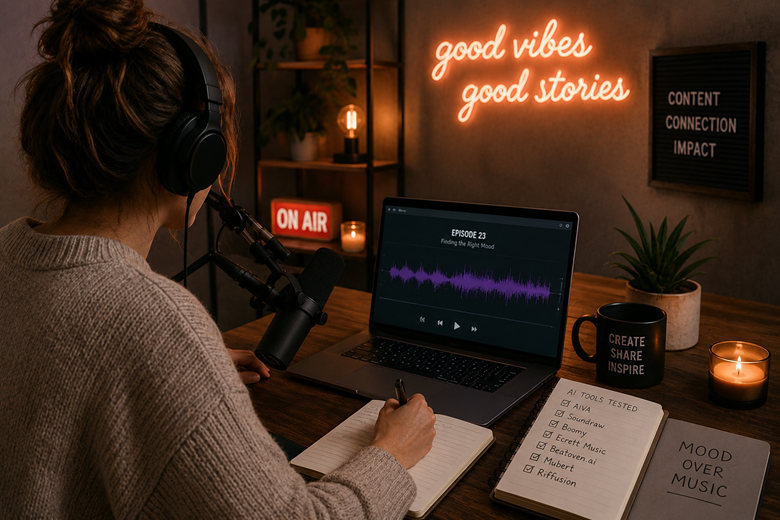
I produce a narrative history podcast that relies heavily on atmosphere, serial-type, and for months I’d been getting together all the elements of loops from royalty-free music and putting it all together, but nothing quite seemed to fit the emotion of an episode. If no recording of any kind could be found in the library, it would have been followed by a plucky ukulele—since that was the scene of a tense archival recording. Interested to see if any AI Music Generator could give a rather standard story dictation instead of generating a genre tag. In two weeks, I gave the same story beats to seven plates and not only compared platforms for their style on a polished level, but also based on how the music sounded in relation to the story I was trying to tell.
This was one test with a single episode – a forgotten polar expedition. I plotted four emotional moments: The rescue decision – the highs of leaving without abandoning our mission; The feeling of being hemmed in by a cold, penetrative snowstorm; The sudden silence of the scene, as if evidence had never existed; The highs of the scene ending, with the idea that we were doing our duty. For each beat (I covered the most important ones in one sentence, which was never over 20 words) I asked for a 90-second segment. Platforms that I did test were ToMusic AI, Suno, Udio, Soundraw, Mubert, Beatoven and AIVA. So I wanted to find out which would be able to influence music more than just embellish it and tell a story with it.
The first round of generations was revealing in a way I did not expect. Several platforms produced tracks that sounded beautiful in isolation but completely ignored the emotional prompt when I lined them up with the script. Suno gave me a sweeping orchestral piece for the “creeping dread” scene that sounded more like a heroic victory lap. Soundraw’s output was clean and well-produced, but the mood tags felt cosmetic; asking for “eerie” often returned something mildly melancholic at best. Mubert’s tracks were short and loopable, which might work for a retail store but not for a story that needs to breathe and change. Beatoven and AIVA both offered compositional depth, but the process of getting them to follow a tight narrative cue was slow and required musical vocabulary that a storyteller might not have.
What started to matter was not just sonic fidelity but directorial control. Could the tool understand that “dread” and “sadness” are different? Could it hold tension without resolving too soon? I found myself returning to the AI Music Maker on ToMusic AI because its custom mode let me pair a mood word with a tempo, an instrument, and a simple structural hint, and the results felt less random. On the “eerie stillness” beat, I asked for a slow, sparse soundscape with bowed metal textures and no percussion, and the output held a cold, suspended tension that actually made me uncomfortable in the right way. It was not the best individual track I heard all week; Suno produced a single piece of music so gorgeous I saved it for my own listening. But across four story beats, ToMusic AI was the only tool that stayed on narrative target without me having to fight it.
To make sense of the scattered impressions, I scored each tool on dimensions that mattered for narrative music: emotional accuracy, sound quality, generation consistency, prompt flexibility, and interface speed. The table below reflects two weeks of daily storytelling tests.
| Platform | Emotional Accuracy | Sound Quality | Generation Consistency | Prompt Flexibility | Interface Speed | Overall Score |
| ToMusic AI | 8.7 | 8.0 | 9.0 | 8.8 | 9.0 | 8.7 |
| Suno | 6.5 | 9.3 | 7.0 | 7.5 | 6.5 | 7.4 |
| Udio | 7.5 | 9.0 | 7.5 | 9.2 | 6.5 | 7.9 |
| Soundraw | 5.5 | 7.5 | 8.0 | 6.0 | 8.0 | 7.0 |
| Mubert | 4.5 | 6.5 | 6.0 | 5.0 | 8.5 | 6.1 |
| Beatoven | 7.0 | 8.2 | 7.0 | 7.0 | 6.0 | 7.0 |
| AIVA | 6.5 | 8.0 | 7.5 | 6.5 | 7.0 | 7.1 |
Udio’s prompt flexibility was the highest because it allowed very granular parameter tweaking, but that power came at a time cost that pulled down its interface speed. Suno’s sound quality was routinely the best, yet its emotional accuracy suffered from a tendency to default to a cinematic grandeur that flattened subtle feelings. ToMusic AI did not win any single column by a landslide, but its combination of emotional accuracy and generation consistency made it the only tool I would trust to underscore an entire episode without hearing something jarring.
How an AI Tool Learns to Follow a Story, or Fails
When you produce narrative audio, you stop caring about how a track sounds out of context. The only thing that matters is whether the music makes the scene feel more true. That means the AI needs to handle negative space, dynamic restraint, and specific instrumental textures.
The Polar Expedition Test, Beat by Beat
I logged every generation for the four-story beats and noted where each tool broke character. The most common failure mode was the “triumph leak,” where a tool inserted an uplifting chord progression into a moment that needed dread or stillness.
When the Ice Closes In: Dread Versus Drama
For the second beat, I wanted the sound of isolation and slow panic. I used prompts like “creeping dread, distant low brass, no drums, cold wind texture.” ToMusic AI gave me something with a low, rumbling drone and sporadic metallic pings that felt genuinely desolate. Udio produced an intricate sound design piece that was even more texturally interesting, but took twelve minutes of tweaking. Suno ignored the “no drums” instruction entirely and delivered a percussive action cue. Soundraw offered a minor-key piano loop that was more sad than tense. This pattern repeated across beats; the tools that won on pure listening pleasure often lost on narrative specificity.
The generation flow I settled into on ToMusic AI followed a repeatable four-step logic that suited a writer’s brain more than a producer’s.
- I selected the custom mode so I could attach lyrics or scene notes and give emotional direction alongside tempo and instrument choices.
- I wrote a scene prompt as if explaining the feeling to a composer: the emotion, the instrumentation, and a quick note on what not to do.
- I chose from the multiple AI music models based on which one had previously handled sparse, atmospheric cues better in my tests.
- I generated the track, listened while reading the script excerpt, and either saved it to the Music Library or adjusted the prompt immediately and tried again.
This workflow felt like directing a musician who could not ask questions but who followed instructions literally, which is exactly what narrative scoring needs.
Why Storytellers Need a Different Kind of Tool
The AI music conversation tends to revolve around songs with vocals, hooks, and verses. But the growing market of independent podcasters, audiobook producers, and video essayists needs something closer to a scoring assistant. The tools that dominate vocal pop and rock are not necessarily the best at holding silence, at underscoring dialogue, or at creating a ten-minute ambient bed that does not distract.
I found that ToMusic AI’s simple mode worked well for quick atmospheric pieces, while the custom mode gave me enough control to avoid the generic “hopeful corporate” sound that plagues so much AI-generated background music. The platform’s site indicates royalty-free terms for commercial use, which matters a great deal when an episode might air with sponsorship. I could not find that clarity on every competitor’s free tier, and with Mubert, the watermarking made the free output unusable for any public project.
The Weak Spots I Have to Mention
ToMusic AI isn’t the lighting rod that will be built into a dedicated movie scoring application. It does not include tempo maps, nor Hit Points, so if you need to play hit points at a visual cut, or if you want the music to start at a certain line of text, you’ll be cutting in post-production in an audio workstation. The Music Library doesn’t auto-tag moods or scenes, so if you need to be really disciplined at your own naming system, you can do it. While the Music Library is clean, it does not auto-tag by mood or scene, so if you are a stickler for your own naming system, that’s fine.
I also observed that at times music would be very quiet with a seemingly un-redrawable background, low-level algorithmic hiss. The storytellers who will benefit most from this will be those who can articulate an emotion well and who do not require “locked synchronisation. When you’re a narrative podcaster, a video essayist or an indie game writer playing out a scene, the increased speed and emotional impact will be as if it was a real add-on to your grunts and groans. As long as you, a film composer, were locked into a picture you’re not going to get much better than a typical digital audio workstation and maybe even be required to have a human musician.
What Actually Changed in My Workflow
Following the two-week test of my own, I re-recorded the polar expedition episode with tracks from AI only in my ToMusic program and sent a handful of trusted ears the new audio. And after the two week test with my own audio, I reworked the polar expedition episode to be all AI and just sent it to a few safe ears. No one said they had heard it beforehand, but two of them commented on how the music was “very well done for an indie record” for the sound design.
Technical attributes are not important; the storyteller’s goal is to keep the audience in your world. But, I’ve retained Udio for just sound play around, and possibly utilise Suno whenever I need a single song for a closing credits dance. However, it was the tool that was on the typewriter, taking notes while I articulated a feeling that was the one who heard the most. In the field of writing as a narrative, the ability to let go of one’s own emotional thoughts and stick to a lead without forcing it to express an emotion is above and beyond increasing the sample rate.