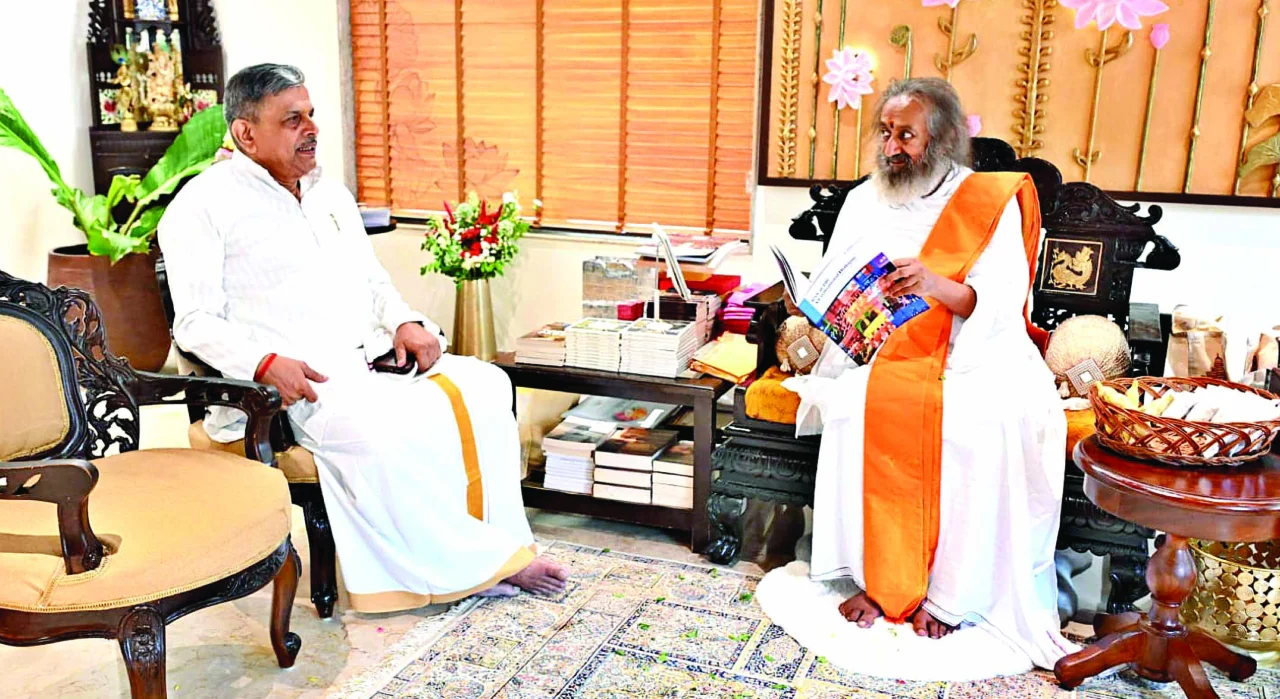
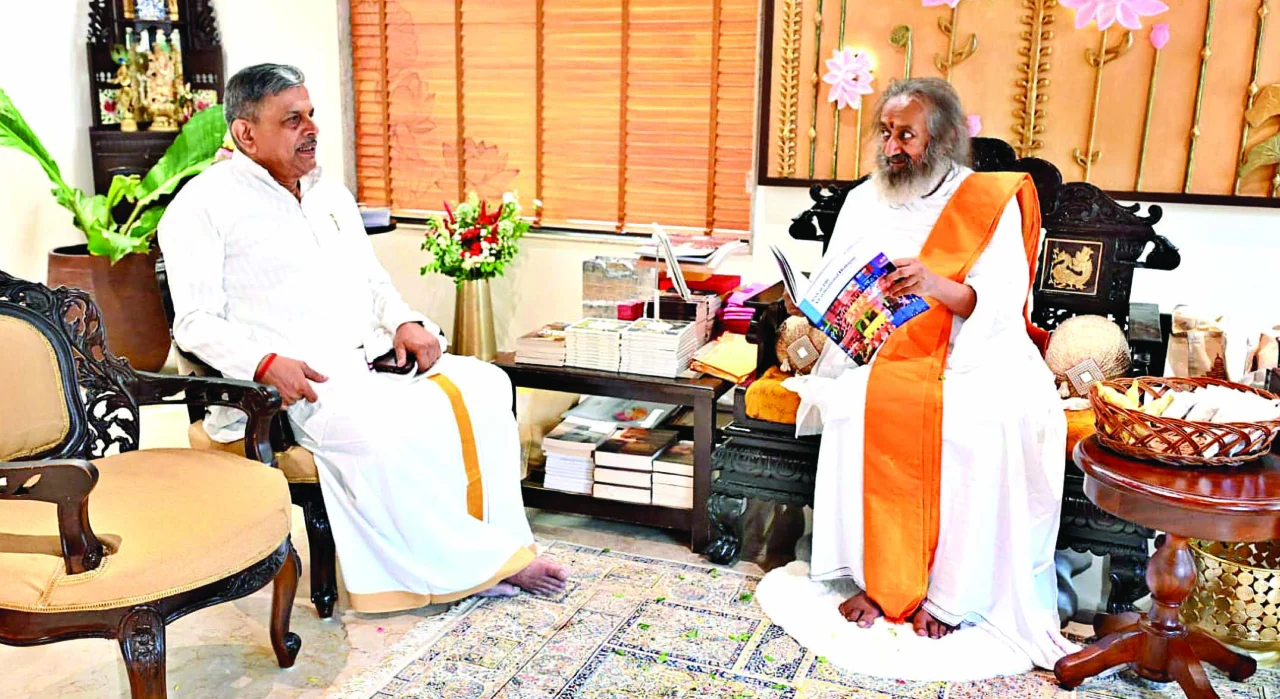
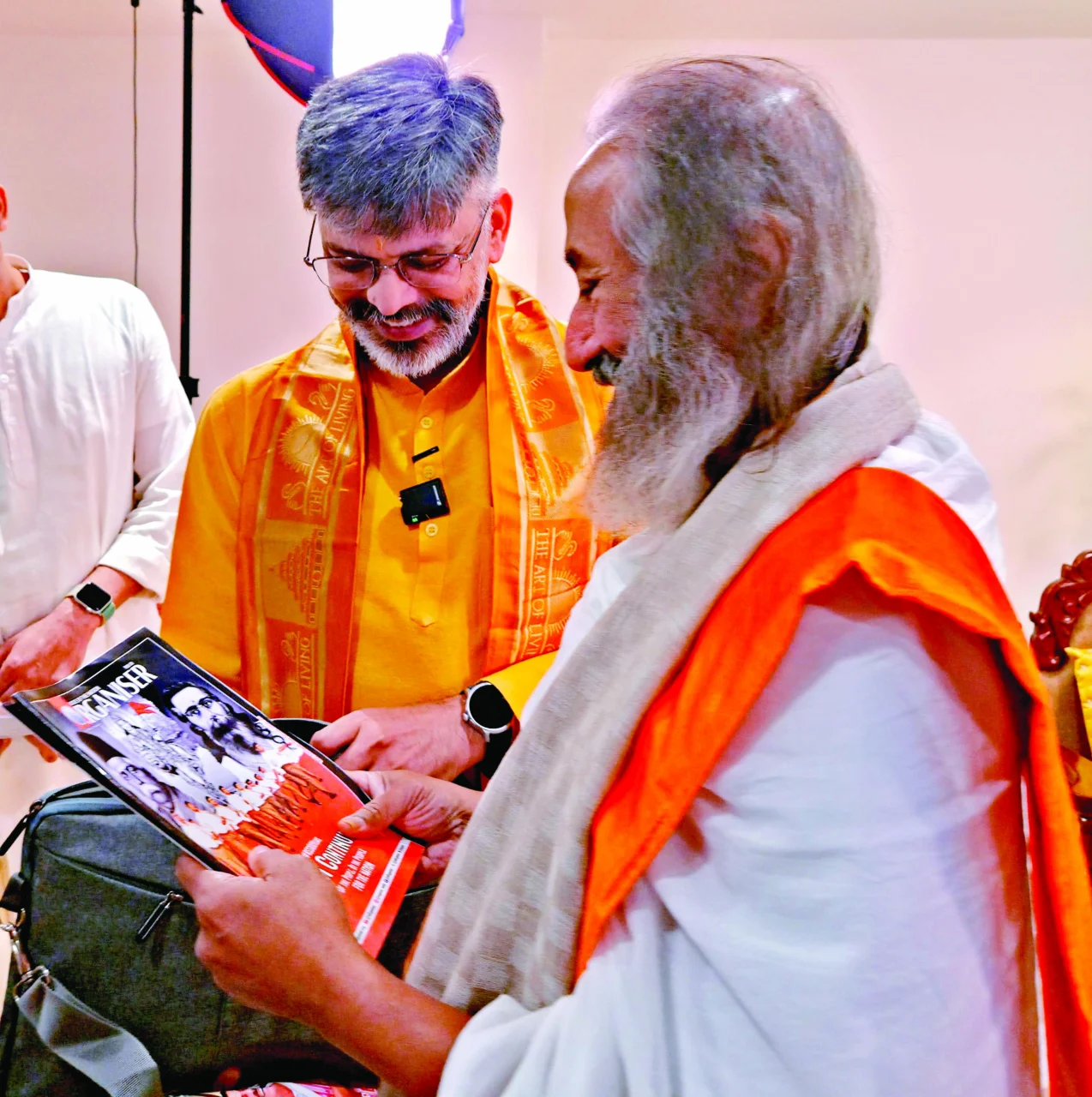
On the occasion of the 45th Foundation Day of The Art of Living Foundation and the 70th birthday celebrations of its founder, Gurudev Sri Sri Ravi Shankar, Organiser Editor Prafulla Ketkar spoke to him at the International Centre of The Art of Living in Bengaluru. From the journey of the movement to education reforms and the future role of spiritual movements in a conflict-ridden world, Sri Sri reflected on everything in this extensive conversation. Excerpts:
First of all, best wishes for your 70th birthday. As the Prime Minister Narendra Modi said, we would be very keen to celebrate your centenary as well. Congratulations also on the 45th foundation year of this great movement called The Art of Living. This has been a very long journey. Since 1981-82, you have built this brick by brick – from spirituality to education, social service and conflict management. When you reflect, how do you see this journey?
We are all here with a definite mission. Nature has designed, God has designed for everyone to play a role, and we just put our 100 per cent and play our role, that’s it. No role is big, and no role is small; every role is equally important.
You know, in a zigzag puzzle, every part, every piece is essential. In the same way in life, we all have our jobs to do and our roles to play and we just play. For this, I have only one formula – clarity in mind, purity in heart and sincerity in action. That’s it.
But despite having this clarity, the initial phase must have had many challenges.
Without challenges, nothing big can happen. When we started this, there were challenges. Some traditional people opposed us because they thought this was something new.
Then there were atheist and Communist narratives. They were scared because I looked like a swami or sadhu. So they opposed anything that had chanting in it or appeared to be religious.
“Science & spirituality were never at loggerheads in Indian knowledge tradition”
Not just in India, but also outside India, there was a lot of opposition. But with all this, we steered our vehicle and overcame those challenges. Every challenge actually became advantageous for us.
Every time we faced a crisis, it only confirmed our age-old saying ‘Satyamev Jayate.’ That is what I can say.
Since childhood you have had a spiritual inclination, eight to ten days of meditation and deep experiences. What was trigger point where you felt something like Art of Living had to emerge?
In my life there was no such turning point. Usually people say up to one point life was one way and then after some disappointment, job disappointment, relationship disappointment or something else, life changes. Nothing like that happened to me.
From my very childhood I somehow knew what was going to happen. It just kept unfolding. So in that sense there was no huge turning point.
So the The Art of Living you were already practicing, you just unfolded it.
Yes, unfolding. In 1981-82 I took ten days of silence. During that time Sudarshan Kriya came.
At that time also I was teaching my first basic course because people wanted to come, listen and have some experience. In my first batch in Shimoga there were eight doctors and then twenty or thirty other people. By word of mouth it spread.
Today after 45 years, The Art of Living is present in 188 countries and Sudarshan Kriya has become globally recognised. How do you feel about this?
We have many meditations and around 67 different programmes for all age groups. It is not just Sudarshan Kriya. We have meditation programmes, intuition programmes, corporate programmes and many others. All these programmes emerged according to the needs of the time.
The knowledge is based on Yoga, Vedanta and lived experience. That is what has really taken off.
I always say Sanatan is not only puratan (ancient), it is also nitya-nutan (ever-new). That integration and adaptability is the unique feature of Sanatan Dharma.
You have worked extensively on education as well. One major challenge today, especially after the arrival of artificial intelligence and technology, is the growing divide people perceive between spirituality and science. The Western prism often sees them as opposites. Along with that, India is still struggling with the colonial influence in education and the challenge of decolonising the mind. How do you see this?
In the world there are broadly two streams of thought — the oriental and the occidental.
The occidental says first believe and then one day you may get an experience. Science does not work with that paradigm. Science says first experience and then believe. Experiment, proof and observation come first.
And interestingly, Eastern philosophy also follows the same principle. Oriental philosophy says don’t believe just because I say so. Experiment. Experience. Then accept.
That is why spirituality and science were never at loggerheads in India. They complement each other.
In our philosophy also, the first darshanas deal with logic and material reality. Only later come Yoga and Vedanta. This is the beauty of Eastern philosophy.
Here scientists were honoured and questioning was encouraged. There is even a Prashna Upanishad entirely devoted to asking questions.
Even Shri Krishna in the Bhagavad Gita says — think over it first, don’t accept it merely because I am saying it.
Science loves this approach because it is the same spirit — questioning, experimenting and experiencing.
Not just that, we have a huge wealth of Vedic wisdom which you cannot find elsewhere. We never saw life in compartments. We saw life holistically. That is why our Vedas included Gandharva Veda, Ayurveda, architecture, music, food, archery — every aspect of human life. This is why Indian civilisation never clashed with science.
You have taken spirituality to the masses in a very joyful way. How would you explain this to the younger generation today, whose attention span is shrinking because of technology, social media and instant gratification?
When we started bhajan clubbing years ago, young people all over the country connected immediately. Chanting, dancing and music made spirituality more joyful and juicy.
“Conflicts arise because of lack of communication, lack of trust and lack of spirituality”
Young people love experience and energy. If spirituality is presented vibrantly, they embrace it.
After the National Education Policy (NEP) 2020, there has been an attempt to integrate Indian Knowledge Systems (IKS) into education. At the same time, artificial intelligence is rapidly expanding. How do you see this balance?
Artificial Intelligence should be welcomed. It is not counterproductive for education. In fact, AI challenges human beings to become more original and creative. That is important. We need to strengthen our own universities and local institutions more than depending only on foreign brands. We should think global but also think local. Both are necessary. India is progressing very well. There is still a lot of scope for improvement and I am sure it will happen.
You mentioned the Prashna Upanishad. In the age of AI, a new buzzword has emerged — prompts. Earlier students sat before the Guru, reflected deeply and asked questions. Now people ask prompts to AI bots like ChatGPT. How do you see this shift?
It is not just words or intellectual knowledge that bring transformation. Communication is much deeper. It is a transfer of energy. It is a feeling level communication which brings revolution in human life.
Transformation cannot happen merely through information or intellectual understanding. There is a higher level of knowledge and that cannot be challenged or replaced. That will continue.
Today the world is witnessing multiple geopolitical conflicts and tensions. How do you see the role of movements like The Art of Living in addressing these conflicts?
Conflicts arise because of lack of communication or breakdown of communication. Breakdown of communication happens because of lack of trust. And lack of trust ultimately comes from lack of spirituality. So we need to bring all these things together. People who are peacemakers and mediators have a huge role today. They should not take sides so that they can speak to both sides, bring them together and establish trust.
Stress is one of the main causes behind conflict. If a person becomes free from stress and develops a broader vision, conflicts can be resolved.
You have personally worked on many conflict resolution efforts. What was the real challenge there and how did you address it?
Any conflict resolution comes with many challenges. We can go on talking about it — it is a huge subject by itself. It needs sincerity and skill, both.
Where do you see the future of The Art of Living movement in the coming decades?
This is something very valuable for mankind and it will continue helping people all over the world. It is already doing so.