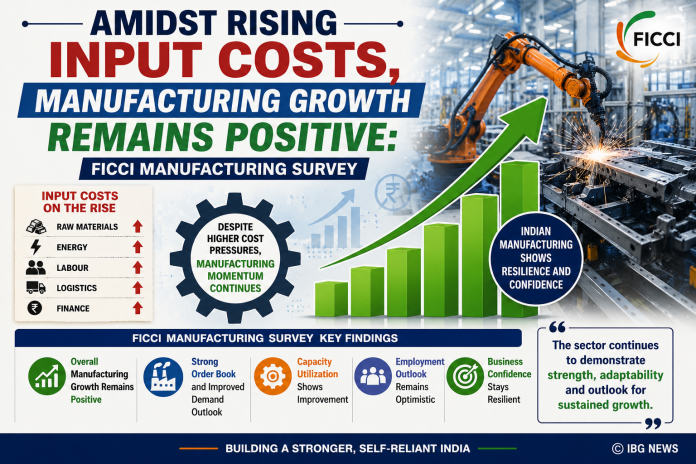

Amidst Rising Input Costs, Manufacturing Growth Remains Positive: FICCI Manufacturing Survey
Exports and Investment Outlook Remains Steady: FICCI Survey
NEW DELHI, 06 May 2026: Amidst rising input costs, FICCI‘s latest Manufacturing Survey shows a positive growth sentiment for Indian manufacturing in Q-4 of 2025-26. Responses based on expectations of both large and MSME manufacturers, reflect the overall positive sentiments and strong domestic fundamentals for manufacturing growth.
Source: FICCI survey
The survey continued to reflect sustained growth and increasing optimism for India’s manufacturing sector in Q-4. In comparison to Q3 FY 2025-26, when 91% of respondents reported higher or same production levels, approximately 93% of respondents reported either higher or same production levels in Q4 FY 2025-26. This optimism was also evident in domestic demand, as 89% of respondents anticipated higher or same orders in Q4 FY 2026 compared to the previous quarter.
This survey is the 69th edition which assessed the performance and sentiments for Q4 January-March 2025-26 of manufacturers for eight major sectors namely, Automotive & Auto Components, Capital Goods, Chemicals, Fertilizers & Pharmaceuticals, Electronics & Electricals, Machine Tools, Metal & Metal Products, Textiles, Apparels & Technical Textiles and Miscellaneous. Responses have been drawn from manufacturing units from both large and SME segments with a combined annual turnover of over Rs. 8 lakh crores.
Capacity Addition & Utilization
- The only impact seen was in the capacity utilization which saw a little dip vis-à-vis previous quarter. The existing average capacity utilization in manufacturing is close to 72%, which reflects a little lower utilization vis-à-vis previous survey. However, the future investment outlook is steady for the next six months.
- Challenges faced by respondents in expanding capacities include current geopolitical situation (tariffs, trade restrictions, economic uncertainty), operational issues (labour availability, raw material shortages, regulatory challenges).
- The table below gives average capacity utilization for various sub-sectors of manufacturing:
Table: Current Average Capacity Utilization levels as reported in survey (%)
| Sector | Average capacity utilization (%) |
| Automotive & Auto Components | 75.7 |
| Capital Goods | 69 |
| Chemicals, Fertilizers & Pharmaceuticals | 75 |
| Electronics & Electricals | 68 |
| Machine Tools | 70 |
| Metal & Metal Products | 76 |
| Miscellaneous | 65 |
| Textiles, Apparels & Technical Textiles | 76.4 |
| Grand Total | 72 (approx.) |
Inventories
- In Q3 2025-26, around 89% of the respondents reported higher or same level of inventory and for Q-4 2025-26, around 86% of the respondents are expecting higher or same level of inventory.
Exports
- In exports, about 74% of respondents reported higher or same level of exports in Q3 FY 2025-26 and in Q4 2025-26 around 80% of the respondents expect their exports to be higher or same as compared to previous year’s similar quarters.
Hiring
- 41% of the respondents are looking at hiring an additional workforce in the next three months as compared to 38% in the last quarter.
Interest Rate
- The average interest rate paid by the manufacturers has been reported to be 8.85%. A little over 86% of respondents reported sufficient availability of funds from banks for working capital or long-term capital.
Sectoral Growth
- Based on expectations, the likely sectoral growth range is shown below:
Table: Growth Expectations for Q-4 FY 2025-26*
| Sector | Growth Expectation |
| Capital Goods | Moderate |
| Chemicals, Fertilizers & Pharmaceuticals | Strong to Moderate |
| Electronics & Electricals | Moderate |
| Machine Tools | Moderate to Low |
| Metal & Metal Products | Moderate |
| Miscellaneous | Moderate |
| Textiles, Apparels & Technical Textiles | Moderate |
| Automotive & Auto Components | Moderate |
* Very Strong >20%; Strong 10-20%; Moderate 5-10%; Low < 5%; Source: FICCI Survey
Production Cost
- Production costs for manufacturers in this quarter seem to remain on higher side. Nearly 70% of respondents reported an increase in the cost of production as a percentage of sales, as against 57% in the previous quarter, indicating that costs pressures were higher in this quarter.
- The increase in cost of production compared to last year is mainly due to higher raw material costs, currency depreciation, and increased logistics, power, and utility costs.
Workforce Availability
- Most sectors though are not facing shortage of labor at factories as around 79% respondents mentioned that they do not have any issues with workforce availability, the remaining 21% feel that there is still lack of skilled workforce available in their sector and there is a need to step up efforts both at government and Industry level.