
Think about the last time your power went out for a day. The first worry, almost always, is the food.
Now imagine an entire community — farmers, families, children — living on the Deccan plateau 3,500 years ago, with a harvest that had to last the whole year. No refrigerator, no sealed tin and no cold chain. Just grain, heat, humidity, insects, and the pressing, daily question: how do we make this last?
The answer, it turns out, was right beneath their feet.
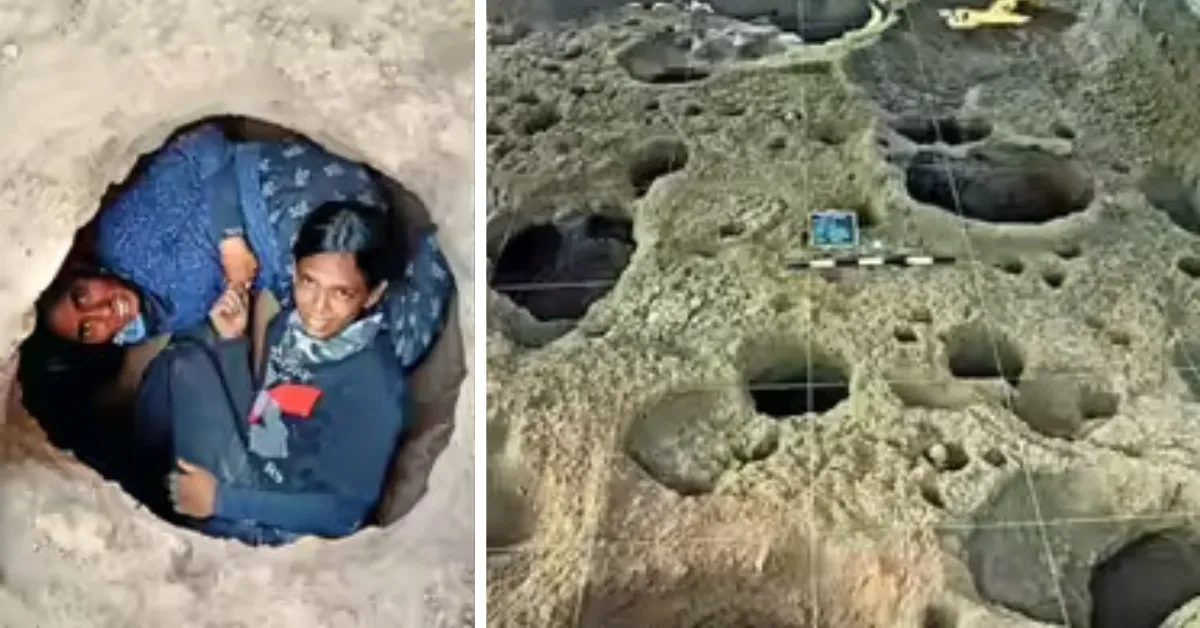
Archaeologists from Tamil University have recently unearthed a series of Neolithic-era pit houses at Molapalayam, a site near Coimbatore on the foothills of the Western Ghats.
Dating back approximately 3,500 years, these underground chambers — dug by an agro-pastoral community that once thrived here — are offering a stunning window into how ancient Indians kept food fresh, safe, and preserved long before the modern world had any equivalent technology.
The underground kitchen cabinet
The pits uncovered at Molapalayam weren’t just storage bins. They were, in many ways, the nerve centre of an ancient household.
Archaeologists found that some pits contained grinding stones — suggesting they doubled as kitchens. Others appear to have been used as shelters during natural disasters, large enough to hold a person.
And crucially, many were used to store foodgrain: the community’s most vital resource, the difference between a good year and a catastrophic one.
/filters:format(webp)/english-betterindia/media/media_files/2026/05/22/3-2026-05-22-17-42-51.png)
Two sides of some of these pits were lined with sturdy walls. The excavators also found skeletal remains of two infants buried near the structures — a detail both heartbreaking and illuminating. These pits weren’t just utility rooms tucked away from daily life.
They were built inside homes, woven into the architecture of living, suggesting how central food preservation was to the rhythm of everyday existence.
Archaeologist V Selvakumar from the Tamil University department of maritime archaeology, who has studied parallel Neolithic pit house sites like Paiyampalli in Tirupattur district — excavated as far back as the 1960s — confirmed the pattern.
Underground pit houses were not an anomaly. They were a regional tradition, repeated across Tamil Nadu’s Neolithic landscape.
Why underground? The science is brilliant
Here is the part that should make every modern reader pause: this wasn’t superstition or accident. It was applied science.
Below a certain depth, the earth maintains a temperature that is far more stable — and significantly cooler — than the surface above.
In Tamil Nadu, where summer temperatures can cross 40°C and humidity levels can ruin a season’s harvest in days, this subterranean consistency was transformative.
/filters:format(webp)/english-betterindia/media/media_files/2026/05/22/2-2026-05-22-17-44-25.png)
Grain stored underground was shielded from heat spikes, protected from moisture fluctuations, and kept safe from the insects and rodents that plagued above-ground storage.
The pits were further engineered for longevity.
Research by scholars at Gandhigram Rural University, documenting Tamil Nadu’s living indigenous storage traditions, found that farmers prepared the interiors of such structures with a carefully made poultice of tank bed silt, rice bran, and paddy straw — all materials that absorbed excess moisture. Inner walls were coated with cow dung slurry, a natural antiseptic.
Outer surfaces were periodically washed with lime. Openings were sealed with stone slabs, woven mats, or bark covers that allowed just enough airflow to prevent fermentation while blocking pests.
The structures even had outlet holes at the base, so grain could be drawn out gradually without exposing the entire store to the elements each time.
This was not a workaround. It was a system.
A living tradition that almost disappeared
What makes the Molapalayam excavation so powerful is the thread it draws between the deep past and the very recent present.
As late as the 20th century, Tamil Nadu’s farmers were still using variations of the same logic. Storage structures called kulumai, kudhir, and kodambae — large cylindrical mud bins, sealed and plastered using the same organic materials their Neolithic ancestors used — were commonplace across villages in districts like Coimbatore, Salem, Erode, and Dindigul.
Studies estimate that up to 70% of India’s food grain was historically preserved using indigenous storage systems like these.
Then came the Green Revolution, chemical preservatives, industrial warehouses, and the assumption that older meant inferior. Many of these traditions quietly vanished within a generation.
The pit houses of Molapalayam are a reminder of what was lost — and what understood heat, humidity, and harvest in ways that a thermostat still cannot fully replicate.
What ancient wisdom has to offer today
There is a reason this discovery arrives at exactly the right moment.
India loses millions of tonnes of food grain to improper storage every single year. Cold chain infrastructure is expensive, energy-intensive, and still deeply uneven across rural areas.
As climate change intensifies heat events and disrupts monsoon patterns, the pressure on food storage will only grow.
The answer the Molapalayam community arrived at 3,500 years ago — use the earth itself, work with natural temperature gradients, seal with organic materials, draw grain out slowly — is now being studied seriously by food scientists and sustainability researchers looking for low-cost, low-energy preservation models.
The people who built those pit houses near the Western Ghats did not have laboratories. They had observation, patience, and a deep respect for the land they lived on. And for millennia, it was enough.
Perhaps it still has something to say.
Sources:
‘Found near Kovai: Pit houses that stored grain, protected people 3,500 years ago‘: by Ragu Raman for The Times of India.
‘Indigenous grain storage structures of South Tamil Nadu’: by M Sundaramari, S Ganesh, GS Kannan, M Seethalakshmi & K Gopalsamy for Indian Journal of Traditional Knowledge, Published April 2011.
‘Understanding Storage Pits: An Ethno-Archaeological Study of Underground Grain Storage in Coastal Odisha, India’: by Asian Perspectives: The Journal of Archaeology for Asia and the Pacific, Published 2021.