The Somnath temple, located on the Gujarat coast, occupies a singular place in India’s civilisational consciousness. Repeatedly destroyed and rebuilt over centuries, beginning with Mahmud of Ghazni’s attack in 1025 CE, Somnath came to symbolise both historical trauma and resilience. For many Indians, its reconstruction after Independence was not merely an act of religious revival, but a statement of national self-respect following centuries of subjugation.
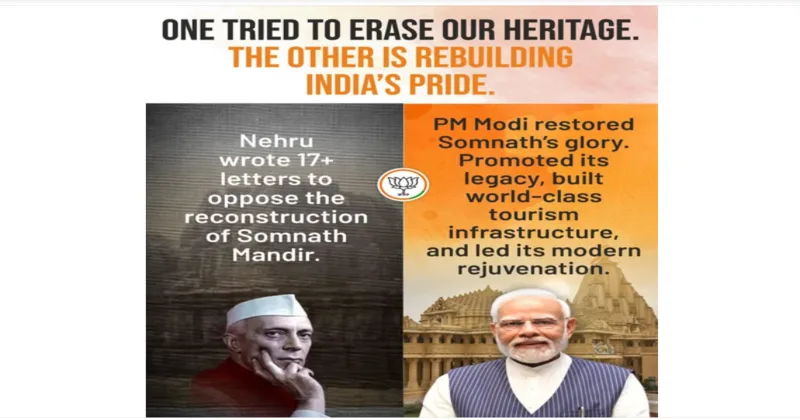
Yet, archival evidence now being foregrounded by the Bharatiya Janata Party (BJP) suggests that India’s first Prime Minister, Jawaharlal Nehru, viewed the rebuilding of Somnath not as a civilisational correction but as a political and diplomatic liability. According to the BJP, Nehru wrote at least 17 letters between 1950 and 1951 expressing discomfort, opposition, or attempts to distance the Indian state from the temple’s reconstruction and consecration.
The issue has returned to public discourse during Somnath Swabhiman Parv, marking one thousand years since the first attack on the shrine.
BJP flags ‘Sustained Opposition’ by Nehru
BJP spokesperson and Rajya Sabha MP Sudhanshu Trivedi had alleged that Nehru’s correspondence reveals “blind appeasement” and a tendency to downplay Hindu civilisational assertions while being overly sensitive to external, especially Pakistani, reactions.
The party has released copies and summaries of letters written by Nehru to cabinet colleagues, chief ministers, foreign diplomats, and even Pakistan’s Prime Minister, Liaquat Ali Khan. According to the BJP, taken together, these letters demonstrate not neutrality but active resistance to the Somnath project.
“This was not a single disagreement or momentary hesitation,” Trivedi argued. “It was a consistent pattern of discomfort with Hindu civilisational revival.”
अतीत में सोमनाथ को मोहम्मद गजनी और खिलजी ने लूटा लेकिन आजाद भारत में भगवान् सोमनाथ से सबसे अधिक नफरत पंडित नेहरू को थी।
इसकी सबसे बड़ी बानगी देखिये कि पंडित नेहरू ने 21 अप्रैल 1951 को पाकिस्तान के प्रधानमंत्री लियाकत अली खान को “प्रिय नवाबजादा” कहकर संबोधित करते हुए पत्र लिखा और… pic.twitter.com/J34QlGmFy8
— Dr. Sudhanshu Trivedi (@SudhanshuTrived) January 7, 2026
Letter to Pakistan PM: Diplomatic Anxiety Over Somnath
One of the most controversial letters cited is dated April 21, 1951, addressed to Pakistan’s Prime Minister Liaquat Ali Khan. In this communication, Nehru reportedly dismissed the narrative surrounding Somnath’s historical gates and reassured Pakistan that no such reconstruction or symbolism was taking place.
The BJP argues that instead of firmly asserting India’s sovereign right to restore a historical monument, Nehru chose to allay Pakistan’s concerns. Addressing Liaquat Ali Khan as “Dear Nawabzada,” Nehru sought to neutralise any impression that India was reclaiming Hindu historical memory in a politically assertive way.
Many say this reflected a prioritisation of external perception over internal confidence at a formative moment for the Indian Republic.
Attempts to Minimise Publicity and Symbolism
Several letters show Nehru urging restraint in how the Somnath reconstruction was presented to the public. In correspondence with the Ministry of Information and Broadcasting on April 28, 1951, he described the consecration ceremony as “pompous” and expressed concern that it could damage India’s international image.
Nehru also reportedly conveyed his unhappiness over President Rajendra Prasad’s decision to attend the inauguration. Rather than viewing the President’s presence as a unifying national gesture, Nehru feared it would blur the lines between religion and state.
The BJP contends that this amounted to an effort to deliberately lower the visibility of an event that had widespread public support.
Letters to Chief Ministers: ‘Revivalism’ and ‘Bad Optics’
Nehru wrote multiple letters to Chief Ministers in May and August 1951, reiterating that the Government of India should not be associated with the Somnath ceremonies. He reportedly characterised the reconstruction as “revivalist” and argued that it created a “bad impression abroad.”
In these letters, Nehru acknowledged that many of his colleagues and large sections of the public supported the project. However, he maintained that secularism required the state to distance itself from what he saw as overt religious symbolism.
The BJP argues that this interpretation of secularism effectively delegitimised Hindu expressions of historical restoration while ignoring the emotional and cultural dimensions of Somnath.
Economic Arguments Against Reconstruction
In a letter dated July 20, 1950, addressed to K M Munshi, who was spearheading the Somnath reconstruction, Nehru questioned the timing of rebuilding the temple given India’s economic hardships, housing shortages, and post-Partition challenges.
While acknowledging the country’s difficulties, critics argue that Nehru reduced a centuries-old symbol of resilience to a purely economic calculation. Supporters of the reconstruction counter that Somnath was funded largely through public donations and not at the expense of welfare programmes.
Opposition to Cabinet and Presidential Participation
Multiple letters reveal Nehru’s unease with senior constitutional figures associating with the temple inauguration. In correspondence with Vice President S Radhakrishnan and Home Minister C Rajagopalachari, Nehru admitted he had tried to discourage cabinet ministers from attending the ceremony.
In a letter to President Rajendra Prasad dated March 2, 1951, Nehru candidly wrote that he “did not like” the President’s involvement. He suggested postponement and warned of national and international repercussions.
Despite these objections, President Prasad went ahead and inaugurated the temple, famously asserting that a secular state does not mean hostility to faith.
All 17 letters by Nehru
1. April 21, 1951 – Letter to Liaquat Ali Khan, Prime Minister of Pakistan: In one of the most controversial letters, Nehru wrote directly to Pakistan’s Prime Minister Liaquat Ali Khan, addressing him as “Dear Nawabzada.” In this letter, Nehru dismissed narratives surrounding the recovery of Somnath’s gates as “completely false” and reassured Pakistan that “nothing of the sort” was happening with regard to the temple’s reconstruction.
2. April 28, 1951 – Letter to R.R. Diwakar, Minister of Information and Broadcasting: Nehru instructed the Information and Broadcasting Ministry to tone down coverage of the Somnath consecration. He described the ceremony as “pompous” and stated that it was injuring India’s image internationally. He also expressed his unhappiness with President Rajendra Prasad’s decision to attend the ceremony, revealing clear discomfort with high constitutional participation.
3. May 2, 1951 – Letters to Chief Ministers: Nehru wrote twice to Chief Ministers, explicitly distancing the Government of India from the Somnath ceremony. While acknowledging the strong public sentiment and participation of Congress colleagues, he insisted that secularism required non-association. Hindu civilisational revival, in his view, had to be restrained to avoid political risk.
4. August 1, 1951 – Letter to Chief Ministers: In this follow-up letter, Nehru blamed the “pomp and ceremony” of the Somnath inauguration for creating a “very bad impression abroad.” He argued that the event weakened India’s secular credentials. Notably, he placed the burden of explanation on Hindu expression rather than challenging hostile foreign interpretations.
5. July 20, 1950 – Letter to K.M. Munshi: Addressed to K.M. Munshi, the principal force behind the reconstruction, Nehru questioned why the Somnath Temple should be rebuilt at a time when India faced housing shortages and economic difficulties. He reduced a civilisational symbol to an economic liability, ignoring its historical and emotional significance.
6. June 13, 1951 – Letter to Vice President Dr. S. Radhakrishnan: Nehru described the Somnath inauguration as unnecessary “fuss” and admitted that he had tried to prevent Cabinet Ministers from associating with it, underscoring active opposition rather than passive neutrality.
7. April 17, 1951 – Letter to K.M. Panikkar, Ambassador to China: In this letter, Nehru admitted that he had tried to “tone down the effects” of the President’s visit to Somnath, revealing a deliberate attempt to reduce the visibility and symbolism of the event.
8. April 21, 1951 – Letter to U.N. Dhebar, Chief Minister of Saurashtra: Nehru objected to the use of public funds for the Somnath ceremony and argued that temples were not a government matter. Critics note the selective application of this principle, especially given state involvement in other religious structures at the time.
9. April 22, 1951 – Letter to Digvijaysinghji, Jam Saheb of Nawanagar: Nehru expressed anxiety over Somnath trustees contacting foreign missions for sacred river water and soil. He feared this would create a false impression of government involvement and prioritised concerns over Pakistan’s reaction.
10. April 24, 1951 – Second Letter to Digvijaysinghji: Here, Nehru openly criticised the Somnath inauguration as “revivalism” and warned of “bad consequences nationally and internationally,” framing the event as a threat rather than a restoration.
11. April 17, 1951 – Letter to Secretary-General and Foreign Secretary, MEA: Nehru directed embassies not to assist the Somnath Trust in any way, including requests for sacred water. He acknowledged conveying his displeasure to both the President and K.M. Munshi.
12. May 9, 1951 – Letter to S. Dutt, Secretary, MEA: Just days before the consecration, Nehru reiterated that any association of the Government of India with Somnath was “most unfortunate,” maintaining opposition until the very end.
13. March 19, 1951 – Letter to Khub Chand, High Commissioner to Pakistan: Nehru disapproved of Indus water being sent for the ceremony and insisted there be “no publicity under any circumstances,” prioritising avoidance of Pakistani criticism over transparency.
14. March 2, 1951 – Letter to President Rajendra Prasad: Nehru bluntly stated that he “did not like” the President associating with the Somnath inauguration and suggested delaying or scaling down the event.
15. March 11, 1951 – Letter to C. Rajagopalachari, Home Minister: He reiterated opposition to the President’s participation, expressing preference that the Head of State stay away from the ceremony.
16. April 17, 1951 – Letter to C. Rajagopalachari: Nehru admitted that he was “very much troubled” by the Somnath Temple, a candid acknowledgment of his unease.
17. April 24, 1951 – Letter to Mridula Sarabhai: Nehru again stated that the Somnath issue was “giving him much trouble,” revealing persistent discomfort with Hindu civilisational restoration.
Foreign Policy Concerns and Embassy Instructions
Nehru’s discomfort extended beyond domestic politics into foreign diplomacy. Letters to officials in the Ministry of External Affairs instructed Indian embassies not to assist the Somnath Trust in obtaining sacred water or soil from rivers abroad for the consecration ceremony.
In communications with ambassadors and high commissioners, including those posted in Pakistan and China, Nehru insisted that such requests should receive no attention and no publicity. He feared that symbolic acts like using Indus water could provoke hostile commentary from Pakistan.
According to many, this demonstrated a willingness to suppress cultural expression to avoid diplomatic friction.
Selective Secularism? BJP’s core charge
A recurring BJP argument is that Nehru invoked secularism selectively. While he objected strongly to public funds or official association with Somnath, critics point out that state involvement with other religious institutions and events did not provoke similar resistance.
In letters to leaders in the Saurashtra government and to Digvijaysinhji, the Jam Saheb of Nawanagar, Nehru objected to even symbolic government participation, warning that it could create a misleading impression internationally.
The BJP frames this as evidence that Hindu civilisational restoration was treated differently from other forms of religious expression.
The BJP’s release of 17 letters is intended to establish continuity, not coincidence. From early 1950 through mid-1951, Nehru repeatedly expressed anxiety, frustration, and opposition regarding Somnath.
In letters to Congress leader Mridula Sarabhai, Nehru admitted that the Somnath issue was “troubling” him deeply. In correspondence with C Rajagopalachari, he confessed being “very much disturbed” by the developments.
According to BJP leaders, this sustained engagement shows that Somnath was not a peripheral issue for Nehru, but one that sharply exposed ideological fault lines within the early Indian leadership.
Nehru vs Munshi vs Rajendra Prasad
The Somnath debate also reflected deeper ideological differences within India’s founding leadership. K M Munshi viewed the reconstruction as an act of cultural self-restoration. Rajendra Prasad saw no contradiction between secularism and participation in a civilisational event.
Nehru, by contrast, feared that visible Hindu symbolism could undermine India’s secular identity and complicate relations with Pakistan and the Muslim world.
These differences were never fully resolved, but Somnath became their most visible expression.
The renewed focus on Nehru’s letters comes at a time when questions of historical memory, temple restoration, and the meaning of secularism dominate India’s political discourse.
For the BJP, Somnath represents an early example of what it calls Congress’s ideological discomfort with Hindu identity. For Congress supporters, Nehru’s stance is defended as an attempt to safeguard a fragile, plural nation at a sensitive historical moment.
Either way, the letters ensure that Somnath is no longer just a temple of the past, but a prism through which India continues to debate its civilisational future.
The Somnath temple’s reconstruction was completed despite opposition, and today it stands as a thriving centre of worship. Yet, the story of how it was rebuilt, and the resistance it faced from the highest levels of government, remains deeply instructive.
As India re-examines its post-Independence choices, Nehru’s letters offer a rare window into the anxieties, contradictions, and ideological battles of the era. Whether viewed as principled secularism or misplaced appeasement, they show one enduring truth, that the question of how India relates to its civilisational past is far from settled.