As buying cycles grow more complex and decision-makers more informed, the pressure on marketing leaders to demonstrate tangible business impact has intensified significantly. Alike B2C marketers, the rules of B2B marketing are also being rewritten. With 84% of Indian B2B CMOs reporting increased scrutiny around ROI, the question has shifted from whether brand investment is worthwhile to how it translates into business outcomes. At the center of this shift is the evolving role of the CMO, one that is moving away from brand stewardship and toward direct accountability for growth.
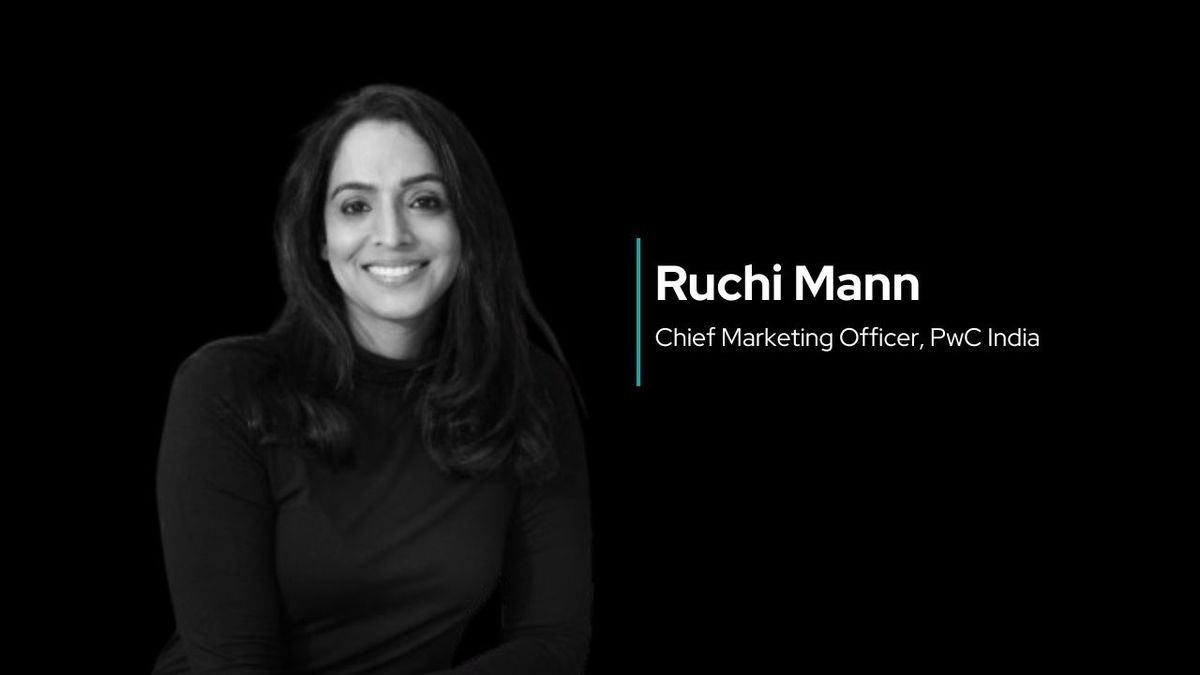
Ruchi Mann, Chief Marketing Officer at PwC India, argues that the pressure on ROI has not diminished brand-building but made it more accountable, with CMOs now expected to link reputation to pipeline quality, pricing power, and long-term conversion. For a firm like PwC, one of the Big Four professional services networks with a combined global revenue of over $55 billion, it is even more important to take accountability. When the product itself is trust, marketing cannot rely on visibility alone. Mann describes this as a shift from amplifying presence to curating meaning, where the goal is to be trusted for a few things that truly matter rather than to be seen everywhere.
In this interview, Mann also speaks to how AI is reshaping the CEO-CMO relationship, why in-person experiences are becoming more valuable in a digital-first world, and what will make B2B brands distinctive in the years ahead.
Edited Excerpts:
You’ve worked across internal communications, employer brand, corporate reputation, and now enterprise marketing. Which part of that journey has most shaped how you approach B2B marketing today?
The pivot from internal communications to enterprise marketing has been the most defining. It grounded me in a simple truth: reputation in B2B is built from the inside out. Today, I approach marketing less as standalone storytelling and more as proof-building, aligning what we say externally with what we actually deliver for clients, our people, and the market. That shift from narrative to credibility is what makes B2B marketing truly effective.
B2B marketing has traditionally been seen as rational, sales-led, and functional. Over the last few years, what have been the biggest shifts in how B2B brands build relevance and differentiation?
The biggest shift is that the divide between B2B and B2C has effectively disappeared. At the end of every decision is a human navigating risk, ambition, and accountability. What’s changed is how brands earn relevance, moving beyond functional superiority to building emotional credibility, demonstrating real-world impact, and showing up with a clear point of view. Differentiation today is less about what you sell, and more about what you stand for and consistently deliver.
PwC sits in a category where trust is the product. What does marketing look like when credibility, not visibility, is the real differentiator?
When credibility is the differentiator, marketing shifts from amplifying presence to curating meaning. It is less about being visible everywhere and more about being trusted for a few things that truly matter. At PwC, this is grounded in what we stand for: building trust in society and solving important problems. It means investing in depth over breadth, bringing rigorous thinking, independence and integrity to every conversation, and helping clients navigate complexity with clarity and confidence. We build a clear point of view, demonstrate measurable impact, and show up where it counts.
Visibility may get attention, but sustained credibility shaped by trust, relevance and real outcomes is what earns consideration and long-term relevance.
For a firm like PwC, who is the real audience for marketing today? How has PwC’s marketing playbook changed in the last few years?
The core audience has consistently been the C-suite, but what’s changed is the context in which they engage. Today’s leaders are more informed, more time-constrained, and navigating far more complex decisions.
Our playbook has evolved accordingly, from linear, campaign-led approaches to always on, insight-driven engagement. This includes a sharper focus on high-value content, a deliberate shift towards immersive, experience-led formats, and expanding our base of evangelists by activating both clients and our own people as credible voices.
Whether it’s adapting to AI-led discovery or the fragmentation of attention, the shift has been towards showing up with sharper, more relevant interventions across the decision journey.
How would you define the role of a B2B CMO in 2026? What has changed the most in what marketing leaders are expected to own today?
The role of a B2B CMO today is far more integrated with the business than ever before. It is no longer about stewarding brands or demand in isolation, but about shaping growth alongside the business and owning a clear stake in outcomes.
What has changed most is the expectation to have real skin in the game, working closely with other functions, influencing revenue, and making decisions, not just narratives. While many organisations, including ours, are still in the early stages of this journey, the delivery expectations are far clearer than before and we need to deliver.
Ultimately, marketing succeeds when it operates as a business function, not a support function.
Reports suggest 84% of Indian B2B CMOs are under more pressure to prove ROI today. Has that changed how CMOs justify brand-building internally?
Yes, the pressure on ROI has not diminished brand-building; it has made it more accountable.
CMOs are moving from justifying brands to making them measurable, linking reputation to pipeline quality, pricing power, and long-term conversion. The conversation is no longer “why brand?” but “what is brand delivering for the business, and how do we prove it?” The most effective CMOs are not diluting brand for short-term gains. They are ensuring it is tightly connected to outcomes and remains a core driver of growth.
What should B2B marketers stop borrowing from B2C, and what should they adopt more seriously?
B2B marketers should stop borrowing surface-level consumer tactics that sometimes prioritise noise over nuance. Virality, constant visibility, and trend-chasing rarely translate into trust or consideration in complex buying cycles.
What they should adopt more seriously is the discipline of human insight and experience design from B2C, understanding motivations, reducing friction, and building memorable, consistent journeys.
The opportunity is not to make B2B “look like” B2C, but to make it feel as intuitive and human, while staying anchored in expertise and credibility.
In-person events continue to rank among the strongest drivers of B2B conversion. In a digital-first world, why are physical experiences becoming more valuable in B2B marketing?
In a digital-first world, in-person experiences create what digital often cannot: depth, trust, and memorability.
B2B decisions are high-stakes and collective, and physical environments allow you to demonstrate capability, not just describe it. They enable real conversations, faster trust building, and a more tangible sense of partnership.
As digital expands reach, physical experiences are becoming the differentiator that converts intent into conviction.
Search and discovery in B2B are changing fast, from AI-led discovery to zero-click journeys and vernacular search. How should marketers rethink visibility in that environment?
Visibility now is not about being “everywhere.” It is about being the most retrievable, trusted answer wherever discovery happens.
• Design for AI-led discovery, not just SEO. Make your expertise easy for machines to understand and cite: clear POV pages, structured FAQs, schema, and author credibility. You want to show up as the source, not just a link.
• Win the zero-click moment. Assume the user may not visit your site. So, your content must deliver value in-snippet, in-platform, and in-summary, with distinct proof points and clear “why us” signals that travel.
• Shift from keywords to intent clusters. Buyers are searching with problems, not services. Build around decision intents like “how to de-risk,” “how to comply,” “how to fund,” “how to transform,” and own those narratives end-to-end.
• Build authority, not volume. In a world of infinite content, trust concentrates. It is better to be known for a few high-conviction themes where you can lead with evidence, than to publish broadly and blend in.
• Go vernacular with relevance, not translation. Local language search is often about practicality and context. Create regional, industry-specific guidance that reflects how India does business, not generic global playbooks.
In short, rethink visibility as discoverability plus credibility.
Has AI changed what CEOs now expect from CMOs? How is it reshaping the CEO CMO relationship?
Yes, AI has materially changed what CEOs expect from CMOs.
They now expect marketing to operate closer to the business core, bringing sharper intelligence on customers, faster signal on what’s working, and a clearer line to revenue. The bar has moved from creativity to decision-making impact.
It has also made the CEO-CMO relationship more strategic. CMOs are increasingly partners in shaping growth, not just enabling it- using AI to inform where to play, how to differentiate, and how to scale relevance with precision.
As AI makes content easier to produce and harder to differentiate, what will make B2B brands truly distinctive over the next five years?
As AI scales content, distinctiveness will come from what cannot be replicated.
• First, proprietary thinking backed by real proof, not generic narratives.
• Second, consistency between what you say and what you deliver.
• Third, strong signals of trust through expertise, outcomes, and experience.
The advantage will not be who creates more, but who is believed more and chosen faster.