
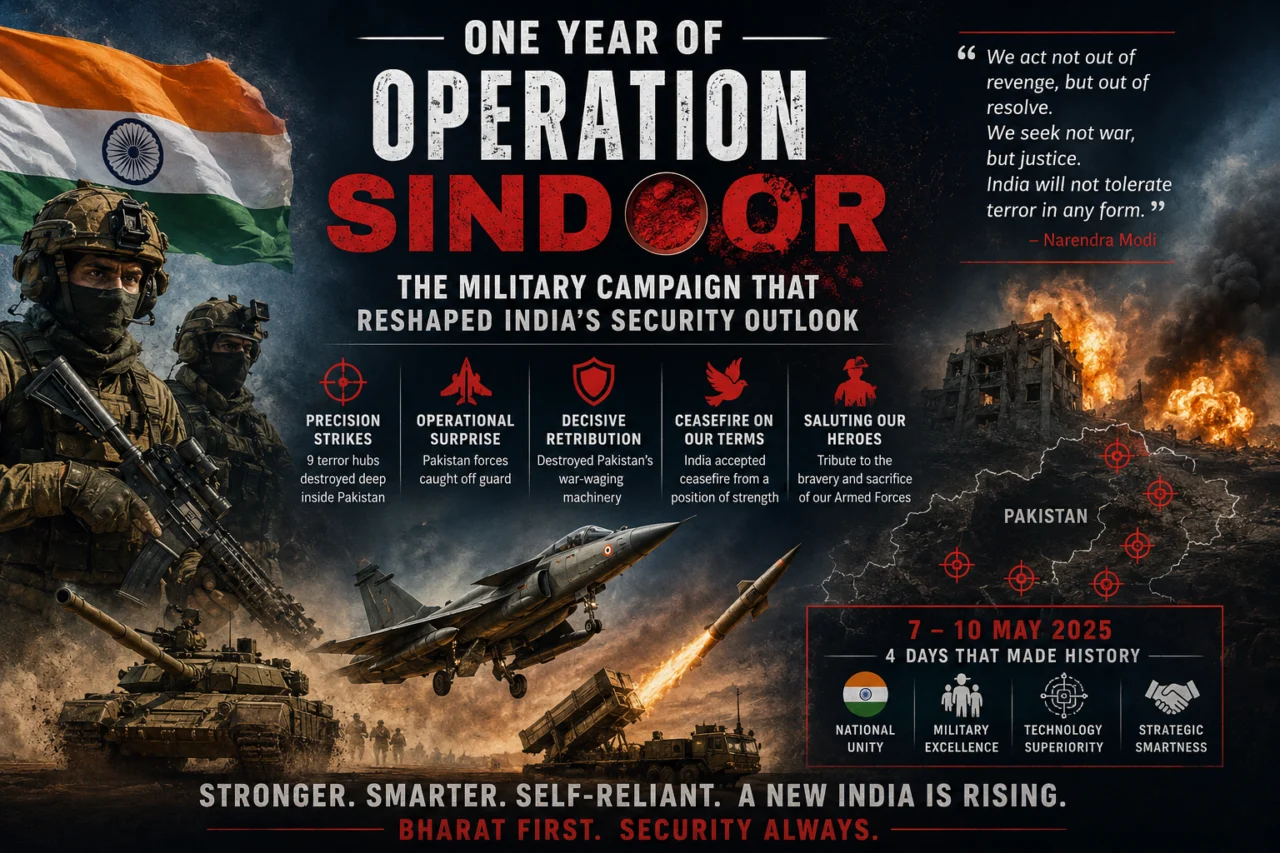
On the first anniversary of Operation Sindoor, I begin by paying my homage to the Fallen Heroes and salute the valour of the Indian Armed Forces. Looking back, Operation Sindoor stands out as the most important transformative milestone for the Indian Armed Forces and even for the national leadership. The last one year has seen continuation of Russia-Ukraine War (now more than four years old), Israel-Hamas conflict (now more than 2 ½ years), 12-day war between the US & Israel with Iran in June last year and the ongoing conflict in West Asia since 28 February. In such a conflict driven world, India’s success against Pakistan in less than four days in Operation Sindoor (May7, 2025-May 10, 2025) is a testimony of India’s strategic smartness.
It is believed that a military always fights a war as per the last one fought by it. This axiom suggests that the military leadership often relies on outdated strategies of the past wars and generally fails to adopt the new technology and tactics. To some extent, this is true of Indian military leadership too. In our case, the most of the military planning and conduct is based on the Indo-Pakistan war of December 1971, which is considered the greatest success of our armed forces in the last century. It was only after operations in Kargil (Operation Vijay) in the year 1999 that Indian Armed Forces seriously carried out the much necessary reforms in military affairs. Even then, the first decade of this century saw slow progress in defence reforms and not much urgency.
Mr. Manohar Parrikar as the Defence Minister from November 2014 to March 2017 under Modi 1.0 government accelerated military modernisation, policy reforms and ‘Make in India’ push. Under Mr. Rajnath Singh as the Raksha Mantri under Modi 2.0 government from the year 2019 and once again under Modi 3.0 government from the year 2024 has given the defence reforms necessary continuity and urgency. Appointment of the CDS from 1 January 2020 onwards has also played a key role in ushering jointness and integration between the Army, Navy and Air Force. Uri cross-border surgical strike in September 2016 and Balakot airstrike in February 2019 indicated the offensive intent of Modi government against terrorism. But Pakistan needed a completely different approach to defeat it decisively.
Two conflicts changed the mindset of Indian military leadership. First was Russia-Ukraine war which commenced in February 2022 and still continues after more than four years. Russia-Ukraine war presented a case study on the conventional war as also gave a clear demonstration of non-kinetic warfare with missiles, drones and air power. The second war was Israel- Hamas conflict which is ongoing since October 7, 2023. The decisive response of Israel towards cross-border terrorism from Hamas, Hezbollah and Houthi certainly influenced our military thinking. India for long had suffered from the cross-border terrorism sponsored by Pakistan. Galwan clashes with China in Eastern Ladakh in June 2020 once again made our armed forces to review their operational doctrine. Backed by PM Modi, Indian Armed Forces continued on the path of force modernisation and organisational restructuring with a degree of urgency never seen before.
Then Pahalgam terror attack happened on April 22, 2025. This dastardly terror attack shook the conscience of the nation like never before because Hindu tourists were selectively killed after identifying their religion. Even Jammu & Kashmir witnessed massive protests against the terror attack. The opposition parties also gave full support to Modi government. In short, India was now ready for a decisive response against Pakistan, the sponsor of Pahalgam terror attack. But a military action against Pakistan always carried a self-imposed restriction of Pakistan’s use of tactical nuclear weapons against India. A confident, militarily superior and resolute India thought otherwise this time around. Indian leadership therefore clearly laid down the political and military objectives of war. It was evident from the numerous meetings between the PM, RM, NSA, CDS and the Service Chiefs.
India punished Pakistan decisively during the Operation Sindoor from 7-10 May last year. Though Pakistan was expecting retribution from India, yet the armed forces achieved operational surprise and caught Pakistani forces off guard. To begin with, India destroyed the nine terror hubs deep inside Pakistan with precision strikes. When Pakistan attempted to escalate the conflict, India destroyed the entire war waging machinery of Pakistan. During my military career, I have served on the Pakistan border and Line of Control many times. But the type of retribution inflicted by the Indian armed forces during Operation Sindoor remains unparalleled. So severe was Indian offensive that Pakistan pleaded for ceasefire, which India accepted on own terms, from a position of strength. It is the moral ascendency of a victorious India that the ceasefire with Pakistan has held on for one year. Operation Sindoor in many ways has thus heralded the era of India’s strategic smartness.
For India, it has become clear that any conflict with Pakistan gives it the direct support of China, thus making two-front war a strategic reality. Importantly, India has now embarked on serious modernisation of the armed forces through the indigenous route. Various weapon platforms made in our country are finding acceptance of the armed forces. The military leadership of India has gained special strategic confidence and is looking ahead with self-assurance. This was evident in another detailed media interaction of the military authorities on 7 May at Jaipur. Even in a pure democratic setup of India, Indian armed forces are getting the operational freedom never experienced before. India also demonstrated the necessary strategic smartness to cease the operations on 10 May last year having achieved all the political and military objectives. India has proved to the world that a victory is not necessarily measured in remaining involved in conflict for a longer duration. India has demonstrated that strategic decisiveness and operational smartness is the way to achieve swift victory. US-Iran leadership may well take note of India’s outstanding victory in Operation Sindoor.