Prime Minister Narendra Modi is set to visit the iconic Somnath Temple in Gujarat on 11th May to mark the 75th anniversary of the restored Hindu temple’s inauguration by President Rajendra Prasad in 1951. PM Modi will participate in various religious, administrative and cultural events in Gir Somnath and Vadodara. Ahead of the visit, the Prime Minister, who hails from Gujarat, penned an opinion piece reflecting on the Somnath Temple as the eternal first Jyotirlinga and a profound symbol of Bharat’s civilisational spirit.
In the op-ed titled, “Somnath and Bharat’s unconquerable spirit!” published on 8th May, PM Modi discussed the civilisational continuity, the Somnath Mandir symbolises, noting that ever since the first Islamic attack a thousand years ago, Somnath has endured many assaults but always risen again with dignity and strength.
“Somnath gives us a civilisational message. The vast sea before it evokes timelessness. The waves tell us…that no matter how fierce the storms are or how turbulent the tides are, one can always rise again with dignity and strength. The waves return to the shore, as though reminding every generation that the spirit of the people can never be subdued for long,” the Prime Minister wrote.
From Lakulisha and Soma Sarman, Chakravarti Maharaja Dharasena IV of Vallabhi, Bhima Deva, Jayapala and Anandapala, Raja Bhoja, Karna Deva and Siddharaja Jayasimha, Bhava Brihaspati, Kumarapala Solanki and the Pashupata Acharyas, Vishaladeva Vaghela and Tripurantaka, Mahipaladeva and Ra Khangar, Punyashlok Ahilyabai Holkar, the Gaekwads of Baroda, to Veer Hamirji Gohil and Veer Vegdaji Bhil, PM Modi acknowledged and hailed the role played by these people in protecting the honour of Somnath Temple.
Prime Minister Modi rightly equates a pradakshina (circumambulation) of Prabhasa or Somnath with one of the entire earth, and celebrates the unbroken continuity of the Sanatan civilisation whose divine flame could never be extinguished, even in the face of consistent Islamic invasions and upheavals.
The Prime Minister also recalled the great contribution of Independent India’s first Home Minister, Sardar Vallabhbhai Patel, in reviving the dilapidated ruins of the Somnath Temple into a grand and glorious abode of Mahadev.
“In the 1940s, when the spirit of freedom swept across India and the foundations of a new republic were being laid under the leadership of towering figures like Sardar Patel, one thing continued to trouble him deeply…the condition of Somnath. On 13th November 1947, during Diwali time, he stood next to the dilapidated ruins of the temple with sea-water in his hands and said, “On this auspicious day of the (Gujarati) New Year, we have decided that Somnath should be reconstructed. You, people of Saurashtra, should do your best. This is a holy task in which all should participate.” On one clarion call of Sardar Patel, it was not only the people of Gujarat but also the people of the whole of India that responded enthusiastically,” PM Modi’s op-ed reads.
As PM Modi reminisces about the civilisational continuity, blows inflicted and consistent fightbacks by Hindus over the centuries, it is essential to remember how Islamic invaders destroyed the Somnath Temple.
Somnath Temple, the holy abode of Someshwara Mahadev and the many Islamic attacks it faced
The Somnath Mandir is a majestic temple situated near Prabhas Patan of Veraval in Gujarat. It is one of Lord Shiva’s twelve sacred Jyotirlingas and finds mention in Chapter 13 of the Shiv Purana. Somnath is also described as Triveni Sangam, much like the one in Prayagraj, due to the meeting of the Kapila, Hiran and Saraswati rivers.
For Muslims, especially the Islamic invaders in the medieval era, destroying the temples and idols of the Kafirs was upheld as their “religious duty”. While many Hindu temples were desecrated and destroyed during the Islamic invasions, Somnath in Gujarat and Jagannath Temple in Puri, Odisha, faced the maximum attacks, with each being invaded 17 and 18 times.
The first attack on the Somnath Temple came in 725 CE from an Arab named Junayd ibn Abd ar-Rahman al-Murri, also known as Al-Junayd during the Umayyad Caliphate. Junayd was appointed the governor of Sindh in 723. He invaded Gujarat and Rajasthan and ravaged, looted and destroyed the Somnath Mandir in 725.
It was only in 815 CE that Nagabhata II, a Gurjar Pratihar monarch, visited the ruins of the Somnath Temple and rebuilt the temple using red stones.
The Islamic antagonism towards Hindus was perfectly embodied by Mahmud of Ghazni, who led 17 invasions on the Somnath Temple and desecrated the idols. In 1025, he plundered the holy idol of Somnath during his sixteenth expedition to India. “Somnath” is Sanskrit for “moon master.” Mahmud of Ghazni is said to have sworn to wage an annual Jihad against the country of Kafirs. Ghazni overthrew Hindu king Jayapala, defeated his successors Anandpala (in 1008) and Trilochanpala (in 1013).
In 1011, Mahmud of Ghazni attacked Thaneshwar and destroyed idols. He burned the temples in Mathura during 1018–1019, and the idols were taken to Ghazni. His Jihadi fanaticism also devoured Mathura, Kannauj and the many temples on the way. However, Ghazni’s Somnath invasion became an unforgettable chapter in Bharat’s history, reflecting both the obsession and abhorrence Muslims harbour for Hindus, and the resilience of the Hindu civilisation to rise every time and continue the fight until the ultimate victory, no matter how long it takes.
Despite heavy losses and fierce opposition, the Jihadi army of Mahmud of Ghazni demolished the sacred temple. The defenceless guardians of the Somnath Temple fought bravely till the end. Thousands sacrificed their lives. Mahmud Ghazni fought a battle against the Hindus comprising the temple guards, Brahmins and locals defending the temple; the battle resulted in over 50,000 deaths.
After the slaughter, Mahmud entered the temple’s sanctum sanctorum, dismantled the Shivalinga and stole all the riches, which totalled over 20,000,000 Dirhams.
The cruel ruler of the Ghaznavid Empire earned the disgraceful moniker ‘Butshikan’ or idol breaker due to his Jihad against Hindu temples.
Historical records state that Ghazni smashed and broke the Lord Somnath idol into four pieces during his 16th invasion of the Somnath Temple. Mahmud of Ghazni entered the temple after defeating the temple’s guardians and saw the magnificent idol of Lord Somnath there. He took his mace and attacked with such vigour that the Lord Somnath idol, which was reportedly five yards long, was shattered into pieces after he became enraged upon seeing the idol.
After the protectors of the Somnath temple were defeated, it is stated in Tariki-e-Alfi, a historical work compiled by a committee formed by Akbar, that Brahmins offered Mahmud of Ghazni an unheard-of amount of wealth in exchange for leaving the ling of Somnath undamaged. Mahmud, in response, said that after he died, he would rather love to be known in the presence of Allah as Butshikan (the destroyer of idols) rather than ButParast (the devotee of idols). He rejected the Brahmins’ offer and demolished the Somnath idol.
The fragments of the Somnath idol were buried inside the Jama Masjid in Ghazni and beneath the entrance to the Sultan’s palace, according to Al-Beruni, an Islamic scholar active during the reign of Mahmud of Ghazni. This was done so that people would step on them while visiting the mosque and the palace and continue to humiliate the idol worshippers.
The Islamic jihadi attacks on the Somnath Temple did not end with Mahmud Ghazni’s campaign. Somnath Mandir endured many more assaults from Islamic barbarians over the centuries. Besides the continued expeditions of Mahmud Ghazni, the attack ordered by the Delhi Sultanate king, Allauddin Khilji, is an important episode in the history of the continuous cycle of destruction and rebuilding of the Somnath Temple.
In 1299, Allauddin Khilji’s Delhi Sultanate army, led by commander Ulugh Khan, heavily damaged the Somnath Temple and looted its riches. The attack came during the Gujarat conquest against the Vaghela king Karna. The Rajput Prince Biram Dev of Jalore led a Hindu army that intercepted and defeated Ulugh Khan and the Delhi Sultanate forces returning with the Shivling from Somnath, and the plundered wealth.
As Allauddin Khilji’s illegitimate daughter Firoza fell in love with Biram Dev, Khilji asked him to convert to Islam. However, the Kshatriya prince blatantly refused. Enraged by this, Khilji deployed his army to Jalore. Biram Dev and his father, Kanhadadev, led the army that fought bravely; however, they were defeated and killed. Khilji’s forces destroyed many temples and ruined the Jalore Fort. The Jihadis, however, could not find the Shivling or the stolen goods from the Somnath Mandir.
Another major attack on the Somnath Temple was by Muzaffar Shah I, often called Zafar Khan, who was the monarch of the Gujarat Sultanate from 1407 to 1411. He was a Khatri or Tank Rajput before conversion to Islam. Zafar Khan went to Somnath in 1395 AD, when he destroyed the temple, constructed a Jumma mosque, spread Islam and set up a thana in the city of Somnath Patan, alias Deva Patan.
Similarly, Mahmud Begada desecrated Somnath in 1451 AD, and the Portuguese Christian fanatics also attacked the Somnath Mandir and took away its riches in 1546 AD.
Despite the continued attacks and destruction, the Somnath Temple was always rebuilt and restored to its glory by the Hindus.
The last destruction of the Somnath Temple transpired in 1665 AD under Mughal tyrant Aurangzeb. As he found that Hindus reconstruct the temples that Muslim Jihadis would destroy, Aurangzeb mandated that any Hindu temples, including the Somnath, that were rebuilt shall be razed. The intention was to prevent Hindus from resuming worship in these temples.
The Somnath Mandir was vandalised by local Muslims of Prabhas and some of Aurangzeb’s troops under his orders. Initially, Hindus outnumbered and drove out Aurangzeb’s forces. However, a larger army returned, and the temple was demolished, and the treasury was plundered.
Islamic invaders destroyed Somnath Temple, Jawaharlal Nehru opposed the temple’s reconstruction: Hatred of the enemies and the treachery of our ‘own’
After centuries of attacks, destruction, and systematic loot of the Somnath Mandir, it was assumed that at least after independence in 1947, the Hindu temple would be restored to its original glory by the government of our own. However, the first Prime Minister of an independent India, Jawaharlal Nehru, made it clear with his stance in this matter that Gora Sahebs were replaced by the Bhoora Sahebs, both indifferent to the plight and sentiments of the common people, particularly Hindus.
From the British Colonial Raj to Congress Raj, the blatant snubbing of Hindu rights continued in both pre- and post-independent India. This blatant disdain for Hindus was reflected in the conduct of Jawaharlal Nehru, who was outspokenly against the reconstruction of the Somnath Temple.
On 13th November 1947, Sardar Patel reached Junagarh to a roaring welcome from the state’s citizens. Patel promised to restore the Somnath Mandir. When he returned to Delhi, a cabinet meeting decided to reconstruct the temple and determine that the state would cover the costs.
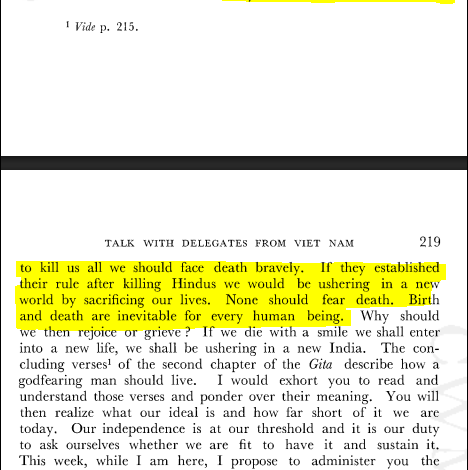
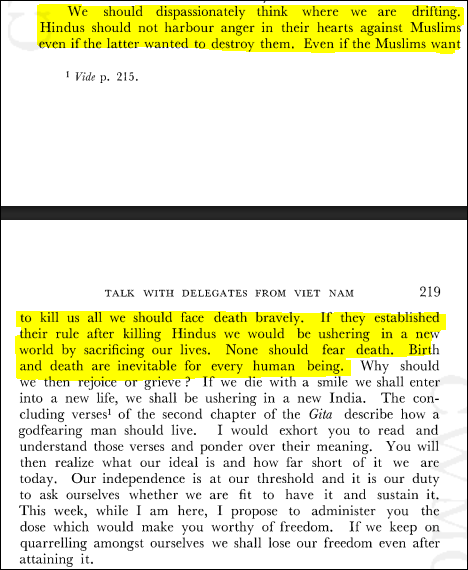
However, Mohandas Karamchand Gandhi, who once said that “Hindus should not harbour anger in their hearts against Muslims even if the latter wanted to destroy them”, said that it is the people who should cover the expenses of temple restoration. This led to the decision being overturned. Gandhi was killed in 1948, and Sardar Patel passed away in 1950.
Kanhaiyalal Maneklal (KM) Munshi, the cabinet minister at the time, became chairman of the trust’s advisory committee, which was tasked with restoring the temple. While Munshi was overseeing the restoration of the Somnath Temple, Jawaharlal Nehru was feeling a disgraceful unease (read heartburn).
In a clear declaration of his stance on the Somnath Mandir revival issue, Nehru told Munshi, “I don’t like your trying to restore Somnath. It is Hindu Revivalism.”
Between 1950 and 1951, Jawaharlal Nehru wrote a series of letters in which he expressed opposition to the reconstruction and consecration of the Somnath Temple. Nehru wrote around 17 letters to various officials, including Cabinet ministers, chief ministers, the President, the Vice President, and even to the Prime Minister of Pakistan, making his deep contempt for the Hindu community’s quest for reclamation of its destroyed temples known. He described the idea of restoring the Somnath Temple as ‘Hindu revivalism’.
Nehru had objected to President Rajendra Prasad’s decision to attend the Somnath Temple consecration ceremony. On 2nd March 1951, Prime Minister Jawaharlal Nehru ‘confessed’ that he was against the idea of President Rajendra Prasad associating himself with the grand opening ceremony of the Somnath Temple. He urged Prasad not to preside over the ceremony.
“…I confess that I do not like the idea of your associating yourself with a spectacular opening of the Somnath temple. This is not merely visiting a temple, which can certainly be done by you or anyone else, but rather participating in a significant function which unfortunately has a number of implications. Personally, I thought that this was no time to lay stress on large-scale building operations at Somnath. This could have been done gradually and perhaps more effectively later. However, this has been done. I feel that it would be better if you did not preside over this function,” Nehru wrote.
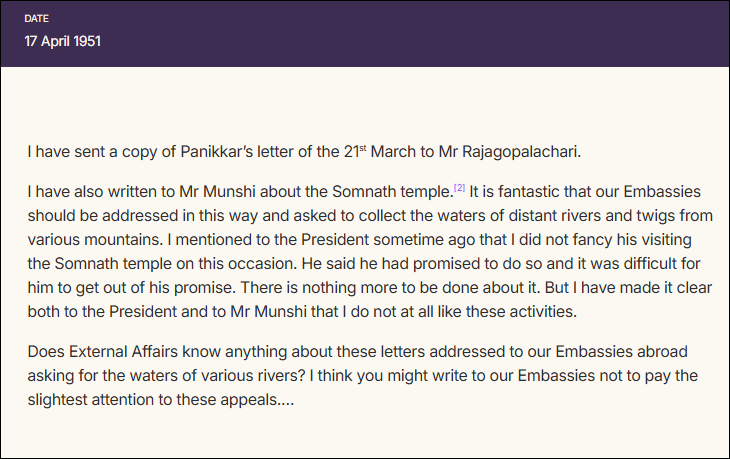
PM Nehru, ‘secular’ icon of the Islamo-leftist cabal to this day, had also written a note to the then Secretary-General and Foreign Secretary, in which he said that he did not like the idea of collecting waters of various rivers and twigs from mountains for the Somnath consecration ceremony. He also expressed his disappointment over then-President Rajendra Prasad visiting the Somnath Temple to attend the Pran Pratishtha ceremony.
“I have also written to Mr Munshi about the Somnath temple. It is fantastic that our Embassies should be addressed in this way and asked to collect the waters of distant rivers and twigs from various mountains. I mentioned to the President sometime ago that I did not fancy his visiting the Somnath temple on this occasion. He said he had promised to do so and it was difficult for him to get out of his promise. There is nothing more to be done about it. But I have made it clear both to the President and to Mr Munshi that I do not at all like these activities,” PM Nehru wrote in the note dated 17th April 1951.
Not only this, but PM Nehru also asked the Ministry of External Affairs official to write to Indian embassies abroad not to heed requests to fetch waters from various rivers for the relevant purpose.
PM Nehru was also ‘distressed’ over the association of the Indian and Saurashtra governments with the Somnath Temple consecration ceremony. “I have been much distressed at the association of the Government of India with the ceremony that is taking place at Somnath. I wrote to the Jam Saheb and to the Government of Saurashtra about it. I find now that in fact some Ministries of the Government of India, including our Ministry, had been consulted and in fact they encouraged various steps that were taken. I am afraid we can do nothing further in the matter now. But I think all this association is most unfortunate,” Nehru wrote in a note to MEA Secretary S Dutt on 9th May 1951.
Nehru also wrote a letter to Navanagar Jam Saheb, Maharaja Digvijaysinhji Jadeja, expressing worry over the Islamic nation Pakistan accusing India of not being secular over government involvement in the Somnath Temple consecration. This overwhelming concern over what the Pakistani government would think about India came hardly five years after Pakistan came into existence, after the slaughter of Hindus, Sikhs, Buddhists and other Kafir communities.
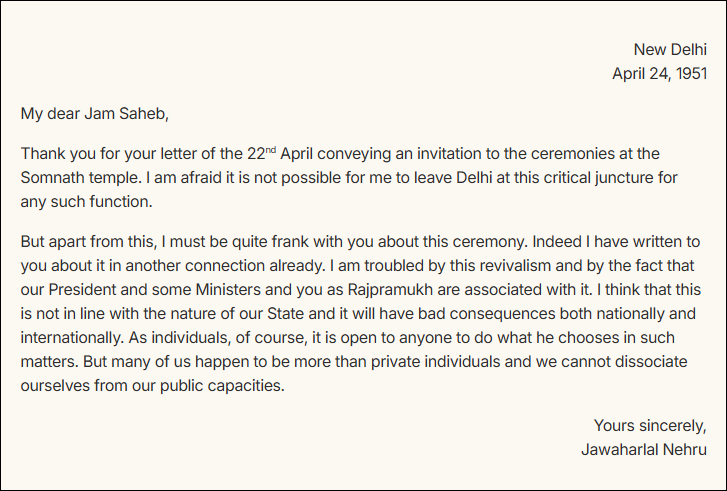
Not only this, Nehru even declined Navanagar Jam Saheb’s invitation to the Somnath Temple consecration ceremony, calling the event ‘Hindu revivalism’
The letter dated 24th April 1951 reads, “Thank you for your letter of the 22nd April conveying an invitation to the ceremonies at the Somnath temple. I am afraid it is not possible for me to leave Delhi at this critical juncture for any such function. But apart from this, I must be quite frank with you about this ceremony. Indeed I have written to you about it in another connection already. I am troubled by this revivalism and by the fact that our President and some Ministers and you as Rajpramukh are associated with it. I think that this is not in line with the nature of our State and it will have bad consequences both nationally and internationally. As individuals, of course, it is open to anyone to do what he chooses in such matters. But many of us happen to be more than private individuals, and we cannot dissociate ourselves from our public capacities.”
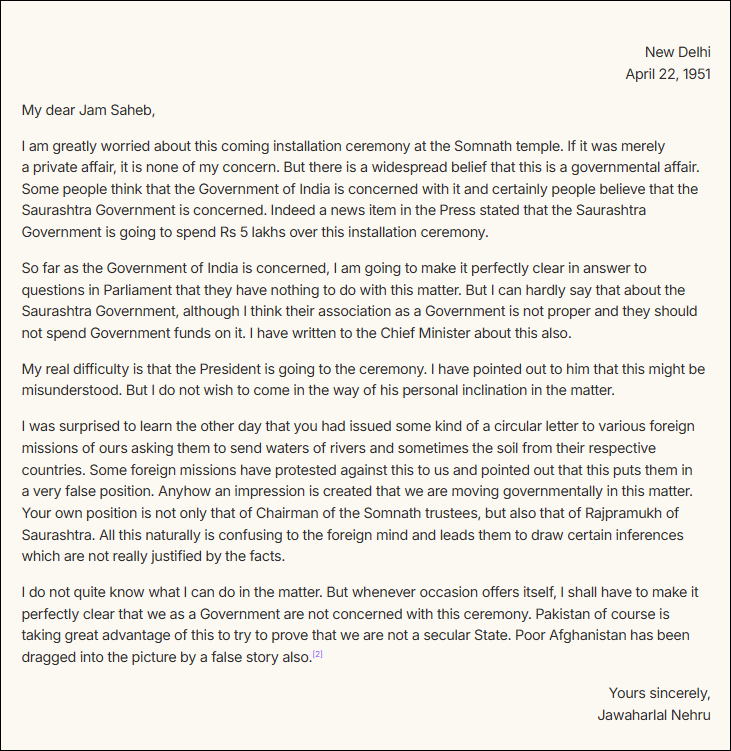
In one of the letters, Nehru told Home Minister C Rajagopalachari that the President should not go to the Somnath consecration ceremony. However, President Prasad rejected Nehru’s suggestion and attended the ceremony at the Somnath Temple.
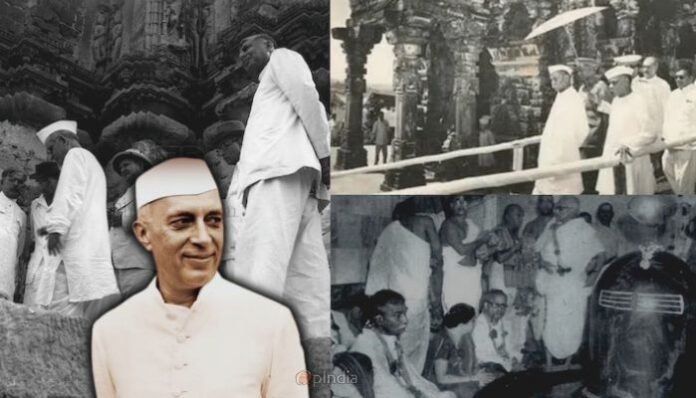
While Congress carried forward Nehru’s opprobrious legacy of neglecting and suppressing Hindus and their historical grievances as ‘revivalism’ and ‘intimidation’ of minorities, the PM Modi-led BJP government changed the script. The Modi government carried forward Sardar Patel’s legacy. It ensured that, from Somnath to the Ram Mandir in Ayodhya to the Kashi Vishwanath Mandir in Varanasi, Hindu glory is not suppressed to appear ‘secular’ and appease Muslims.