Where do we come from?
Where are we heading?
The last place you’d expect to be reminded of these existential realities is in a park.
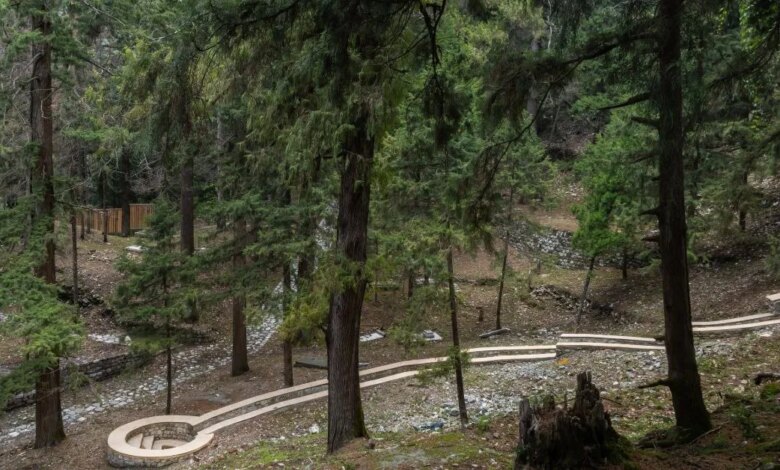
But brace yourself for it at the Sensorium Memorial Park in Uttarakhand. As architect Monik Shah (32), Co-Founder of the firm ‘Compartment S4’, which designed the public park, explains, the map ensures that visitors enter and exit at the same point. “It almost mimics the circle of life,” he says. In fact, there’s even an installation at the end of the trail that is an ode to the philosophical concept.
“The larger philosophy is that one needs to trace the same route they did growing up, as they do while they are growing old, which is why the visitor walks the same length while entering as they do while exiting,” Monik explains.
But even while the park is a public space, it demands a certain degree of respect and reverence. The reason for this lies in the British-era cemetery that the park is built around, with over 200 graves dating back to the 1850s.
/filters:format(webp)/english-betterindia/media/media_files/2026/04/17/sensorium-park-2026-04-17-11-16-00.jpg)
Pine trees cocoon it, and within this peaceful envelope, Monik’s team was briefed to create an accessible site. Monik explains, “We wanted to honour the site’s ecological and historical significance through minimal yet impactful interventions.”
Stepping away from the rush
When the project first commenced in 2024, the team did not know for sure the total number of graves because of all the overgrowth. “While there is no way of ascertaining, a few historians told us that the graves date back to World War I and the floods that took place in Nainital in the 1800s,” Monik shares.
/filters:format(webp)/english-betterindia/media/media_files/2026/04/17/sensorium-park-1-2026-04-17-11-18-45.jpg)
Given the busy route the site lies on — the route between Bhimtal and Nainital — the Uttarakhand government was certain that the site would be flocked with tourists in large numbers. “While we were keen on this, we also wanted the site to be respected. We were keen that the tourists experience a sense of calm and respect while navigating through the space,” he adds, reasoning that the idea of creating a sensorium stemmed from the ecology of the site.
/filters:format(webp)/english-betterindia/media/media_files/2026/04/17/sensorium-park-2-2026-04-17-11-21-08.jpg)
“It’s a large pine forest, seven kilometres from Nainital, located on a busy traffic route, but as soon as one enters the park, one feels secluded from the outside chaos. So our thought process was, firstly, to pay respect to the dead, and secondly, to celebrate the gift of life once you’re inside the park. When you’re amidst those pine trees, it allows time and space for reflection,” Monik shares.
Experiencing with your senses
Once you start the walk around the park, pause at the signages. They carry messages and information that will enrich your visit. A sculptural extension at the gate pays homage to the dead. This is also the spot where the natural stone trail begins, winding through the forest, with installations along the way.
/filters:format(webp)/english-betterindia/media/media_files/2026/04/17/sensorium-park-3-2026-04-17-11-23-48.jpg)
Monik shares, “The entire site is experienced as a gradual sensory journey rather than as a space organised around a single focal point.” Movement through Sensorium Park begins with a subtle transition at the entrance, where the outside world gives way to a quieter and more introspective landscape. You’ll come across a sequence of small, dispersed interventions that engage the five senses.
These include a mirror cabin, a human-scale bamboo wind chime positioned in a way that it is activated only by natural wind, allowing its sound to merge with the rustling of the trees. Instead of introducing an artificial acoustic element, the installation amplifies what already exists within the landscape.
/filters:format(webp)/english-betterindia/media/media_files/2026/04/17/sensorium-park-4-2026-04-17-11-28-03.jpg)
Other installations rely on tactile engagement — textured stone surfaces, timber elements, and the existing bark of the trees become part of the experience, encouraging visitors to slow down and engage with the site physically.
The journey also engages the senses of smell and taste in subtle ways.
The use of deodar wood introduces a natural fragrance that reinforces the forest environment, while a small garden of edible fruit and berry trees activates the sense of taste in a restrained manner.
A place to sit, breathe, and reflect
Sharing that the park celebrates the use of materials like stone and wood, the team says the focus was on adhering to sustainable choices. While the ecology of the land was not upset in any way, Monik says they had to spend a considerable amount of time clearing the land of overgrowth and building the retaining walls.
According to the team, this design allows the park to go beyond its physical form, creating an immersive experience where visitors move through the landscape while also engaging with memory, presence, and the passage of time.
/filters:format(webp)/english-betterindia/media/media_files/2026/04/17/sensorium-park-5-2026-04-17-11-29-21.jpg)
“By embracing this approach, the design blends cultural sensitivity, minimalism, and environmental sustainability, respecting the sentiment attached to this site of memory. The park does not announce its presence but instead creates a space for quiet contemplation,” Monik reasons.
It’s a space that allows you to pause, to breathe, and to remember that while you’re on your way through the circle of life, sometimes, taking a moment to sit on a park bench is always worthwhile.
All pictures courtesy Compartment S4