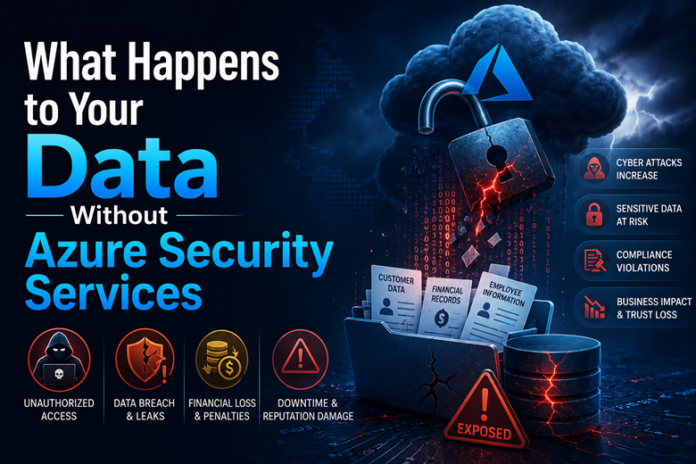

Every business today depends on data. Customer records, financial transactions, internal documents, employee information, all of it sitting somewhere in a digital environment. And as more companies move their work to the cloud, keeping that data safe has quietly become one of the biggest concerns on the table for business owners and IT teams. The problem is, a lot of organizations assume that being on Microsoft Azure is enough. That the platform just handles it.
It doesn’t. Without the right protective layers in place, particularly Azure security services, that assumption tends to fall apart in ways that are both serious and expensive. Here’s what actually happens when a cloud environment runs without proper security coverage, and why it matters no matter how big or small your organization is.
Your Data Becomes Easy to Access for the Wrong People
Weak Access Controls Open the Door
Take away proper security controls, and manage who can access what turns into a guessing game. Without strong identity protection and multi-factor authentication, getting into a system doesn’t require much. A stolen password. A phishing email that one distracted employee clicks on. An old account that was never closed when someone left the company. Any of those can hand an attacker a direct path to sensitive business data.
Here’s the thing about attackers: they rarely go looking for dramatic ways in. They look for quiet gaps. A forgotten admin account that nobody thought to disable. A storage container that someone left open by accident. An API that skipped the authentication step. When nothing is actively scanning for these kinds of issues, they can go unnoticed for months.
No Monitoring Means No Early Warning
A cloud environment without centralized monitoring is basically running blind. There’s no alert when someone logs in at 3am from a country your team has never touched. Nobody catches it when one user account suddenly starts pulling down ten times its usual amount of data. Those are exactly the signals that, spotted early, can stop an attack in its tracks.
Security logs get generated automatically in cloud environments, that part is fine. If you’re not using the right tools to monitor and act on logs in real time, they don’t really serve much purpose. They just sit there, and by the time someone reviews them manually, the damage is often already done.
Data Breaches Become More Likely and More Costly
The Full Cost of a Breach Is Often Underestimated
When a breach hits, the obvious stuff comes first. Stolen customer records, exposed financial information, systems going offline. But the real cost goes much further than that. If your business handles personal or financial data, regulatory fines come into the picture fast. Then there are the investigation and recovery costs. Then there’s the hit to your reputation, which can be the toughest part to fix. Once trust is lost, it takes time to earn it back.
Without proper threat detection and a plan for responding, organizations are slower to even realize something has gone wrong. And every hour that passes during a breach usually means more data exposed and more harm done.
Data Can Leak Without Any Obvious Incident
Not every damaging exposure comes with a dramatic attack. Some of the worst ones happen quietly. A storage permission set up the wrong way can leave internal files open to anyone on the internet, no alert fired, no warning given. Without tools that keep checking settings and flagging problems, that exposure just sits there, sometimes for weeks or months, until someone stumbles across it who had no business finding it.
Encryption is another thing that often gets overlooked. When data isn’t encrypted in storage or during transfer, anyone who intercepts it or finds their way into the wrong folder can read it straight away. No extra effort needed on their end.
Staying Compliant Becomes a Serious Challenge
Regulations Do Not Make Exceptions for Poor Configuration
Different industries come with different rulebooks. GDPR, HIPAA, PCI-DSS, or any number of local data protection laws that carry just as much weight. The expectations across all of them are pretty consistent though. Sensitive data needs to be locked down. Audit logs need to be kept. And when a breach happens, it has to be reported within a set timeframe. No exceptions.
When those controls aren’t there, meeting these requirements becomes a real struggle. And audits will find the gaps, that’s the whole point of them, whether they’re internal or external. When those gaps do surface, the consequences can hit hard: fines, certifications on the line, or whole parts of the business grinding to a halt until things get properly sorted.
Without Audit Trails, Accountability Disappears
An audit trail is just a record of who accessed what, when, and from where. Simple concept, but it matters more than most people realize, for compliance reporting, for internal accountability, for piecing together exactly what happened during an incident. When security isn’t set up properly, those trails end up patchy or gone entirely.
That’s a real problem the moment something goes wrong. Without a clear record, the most basic questions become almost impossible to answer. What data was affected? When exactly did it happen? Who needs to be told? Good questions with no good answers, because the logs were never there to begin with.
Day-to-Day Operations Face Real Disruption
Malware Spreads Further When Nothing Stops It
Without active threat detection, malicious software gets a much easier run once it finds its way in. Ransomware is the clearest example. It’s designed to move fast, spreading across a network and encrypting files before anyone figures out what’s happening. With no automated defenses watching for that kind of lateral movement, a large chunk of data and systems can be locked up before a single person responds.
Recovering from a ransomware attack is rarely quick or easy. It can be expensive, take a long time, and even then there’s no guarantee all your data will come back. Paying the ransom might feel like the only option, but it’s still a gamble rather than a real fix. In the meantime, the business may be left struggling to function for weeks.
Downtime Has a Real Business Cost
Security incidents don’t just go away on their own. Systems go offline. Data has to be restored from backups. Teams end up doing everything by hand while things slowly get back to normal. For a business that can’t afford to be down, even a few hours hurts, lost revenue, and customers who notice.
Getting ahead of it is always the smarter move. By the time the damage is done, the cost of fixing it, in time, money, and stress, is always higher than what it would have taken to protect things properly from day one.
Conclusion
Running a cloud environment without proper security coverage is a risk that shows up in very practical ways. Data gets exposed. Breaches go undetected. Compliance requirements get missed. Operations get disrupted. These outcomes aren’t guaranteed, but they’re much more likely if the right safeguards aren’t in place.
Every piece of data a business collects belongs to a real person who trusted them with it. That comes with a responsibility that goes well beyond the technical side of things. It’s a business obligation, and at its core, it’s about keeping trust intact. Recognizing the risks that come with weak or absent security is where the work of building something more solid and more dependable has to begin.