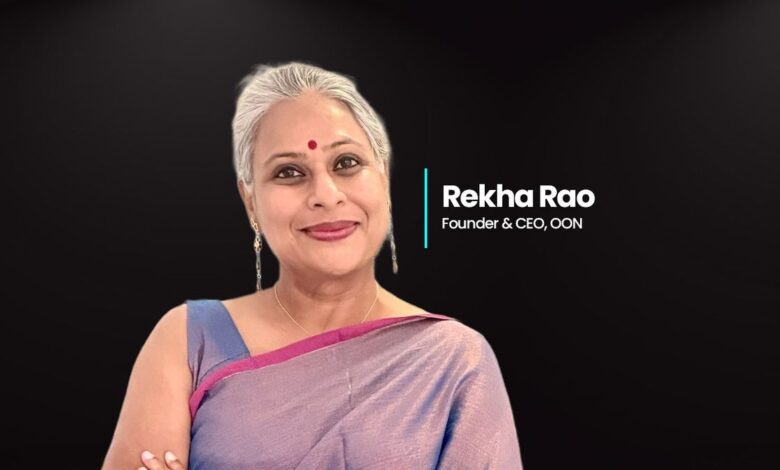
The advertising and marketing industry has long presented a paradox. Women today make up over 40% of the workforce in India, yet their presence steadily declines up the ladder, with only around 28-30% making it to senior roles. The sharpest drop occurs mid-career, where nearly half of working women exit between junior and middle management. In simple terms, while many women enter the industry, far fewer are able to stay, grow, or find structures that support them at senior levels.
It is against this backdrop that OON was founded by Rekha Rao. Built as a collective of senior, independent professionals, the model taps into a talent pool that has long existed but remained underutilised. At a time when brands are also re-evaluating the kind of expertise and consistency they expect from agency partners, OON brings together experience, flexibility, and a different way of structuring work.
A year into its journey, the model has revealed both its potential and the industry’s persistent gaps. The collective operates without traditional hierarchies, relying instead on a network of senior specialists who collaborate based on relevance and expertise. The result is a system that prioritises depth over scale, and accountability over constant availability.
In conversation with us, Rekha Rao, Founder & CEO – OON, reflects on the realities of building the organisation from the ground up, what the past year has revealed about collaboration and leadership, and why conversations around inclusion often fall short of actual change. She also speaks about the structural shifts still needed, both within agencies and in client relationships, for more women to build long, sustainable careers in the industry.
Edited Excerpts:
Q. You’ve spoken about seeing talented women drop off or struggle to re-enter the industry. How did this observation help turn into a business idea and the creation of OON? Could you walk us through the thinking that shaped its inception?
The “Broken rung” or the “leaky pipeline” pattern is a well-known fact in the media and communications industry. The drop-off typically accelerates around the 5–10 year mark—coinciding with common ages for marriage, childbirth, and intensified family responsibilities in the Indian context. More often than not, when this treasure of a talent wants to return to the industry, they seldom fit in again as they did before they left. The only option left is to pursue opportunities as independent service providers, often missing the big-ticket opportunities they once handled with ease.
On the other hand, more and more clients are struggling to find agencies that can guarantee expertise, experience, commitment, and continuity in the resources allocated to their businesses, leading to mismatched expectations and delivery. And this—ample talent with depth and breadth of expertise and experience, bridging what the clients find lacking in their current structures —was the sweet spot that formed the idea of OON.
Q. You’ve spent decades watching how women navigate the communications industry, stepping away, returning, or adapting in different ways. In this past year, what has surprised you most about how those patterns actually play out when you try to build a model around them?
It has been refreshing and delightful to watch how seamlessly work flows, even if the collaborating members barely knew each other in the past, or were in a shared office or workspace. The protean structure of OON helps us bring the best and the most relevant members of our talent pool together for the specific needs of a client, or for working on specific industry sectors.
For example, when we were pitching for a green energy client, the team consisted of a digital media expert, a journalist who has been covering the energy sector for over two and a half decades, a communications strategist, and a content expert. Similarly while working on a a GCC client, we had a team member who was heading communications for a large global tech company as the key content driver, and in another instance which was a pitch for an NGO, we had a lady who was not only someone who headed the communications office of global NGOs in India, but also has her own thriving grassroots NGO, as a key advisor.
We all work without the pressure of work overload and within timings that suit each individual’s convenience. Each takes up only as much as they know they can deliver, and once that commitment is in place, they are all extremely professional and high-level experts who deliver exactly what the client needs. And this is what is the most invigorating part of how we work in OON—that when women with experience are on a given task, they bond seamlessly, supporting each other, and delivering high-quality work that barely needs revisions or repeated interventions.
Q. The conversation around women in the workplace often centres on flexibility and empathy. But in your experience, what are the harder, less-discussed barriers that continue to shape women’s careers in this industry?
Flexibility and empathy are starting points or the bare minimum that an organisation can do to support women at work. However, pay attention to fix the following immediately:
-
Agency work culture is designed around constant availability—deadline-heavy, late nights, weekends, long meetings and calls etc. Caregiving is mostly shouldered by women in India, and by not paying heed to this truth, it is pushing many women towards exit rather than towards “leaning in.”
-
Limited or lack of on-site or subsidised childcare, weaker paternity leave uptake etc., mean the “second shift” at home falls disproportionately on women. Career breaks are penalised in evaluations, leaving women torn between work and home duties, often leading some of the most talented women to choose home over work.
-
The persistent “boys’ club” exists across industries. Informal mentoring, promotions, ‘capability analysis’, etc., often happen over after-work drinks or male-dominated socialising, where a majority of women are simply not invited, cannot be present due to their personal responsibilities, or feel uncomfortable.
-
Double standards and unconscious bias exists in how women often get labelled—temperamental, PMSing, Menopausal, bitchy, over-sensitive, difficult, touchy… But similar behaviours in men are called reserved, not in good mood, deep thinker, strong leadership or hard taskmaster!
-
Microaggressions (appearance comments, mother-sister slurs, questions in interviews about marriage/kids that men never face) erode confidence.
Inclusivity and equal-opportunity employment are more of a tokenism in most organisations. Corporate India is ruthless, and women constantly walk a tightrope to stay relevant and grow.
Q. A year into building OON, do you feel the industry is becoming more accommodating to women, or are alternative models like yours becoming necessary precisely because it isn’t? What has this year revealed to you about the difference between talking about inclusion and actually enabling it?
Not really. The fact that I have so many women professionals, and at that some very successful women identify with the purpose of OON, and so any independent women professionals reach out to me, I don’t think much has changed in a year. With Gen Z’s approach to work, where a lot of upward delegation tends to happen, things have only gotten more stressful in workplaces, with the seniors carrying the bulk of responsibility and delivery.
Alternatively, ‘work-at-your-pace’, ‘work-on-your-terms’ arrangements like OONs will grow with time. And the reason for that is inclusivity is good to be spoken about, but very few actually know that inclusivity is an attitude, which naturally translates into genuinely inclusive operational behaviour.
Q. After years in leadership roles within more traditional structures, what has this year required you to unlearn about managing people, work, and expectations? Has working with a collective of independent, senior women changed your understanding of control and accountability?
My biggest ‘unlearning’, or rather relief, was that I DO NOT NEED TO SUPERVISE ANYONE. My structure has extremely senior women who have been there and done that. They understand corporate nuances and language and bring their years of experience to the table, which requires little to no supervision. We work as partners, not in any hierarchy, with each giving space and respect to the other’s specialisation and expertise. It is a joy to work like this.
Q. You’ve previously highlighted the role clients play in shaping agency culture. In this past year, have you found that dynamic shifting at all? Is meaningful change for women in this industry possible without rethinking how client-agency relationships are structured?
With clients having dozens of options to choose from in a market like India, they constantly hold an unspoken sword on the neck of agencies for a lower price or more time and deliverables for less fee. One client (a large global FMCG health product firm) was sifting through some 52 agencies that had responded to their RFP. When we got to know of this, we took a call not to participate. For us at OON, it is about whether our knowledge, expertise, and experience truly fit the requirements and are valued or not. A client who can open a generic RFP definitely is not looking for appropriateness of experience. Nine out of ten times, their metric for choosing their partner will eventually be the price—how much for how much!.
Clients need to stop this commodification, and must choose who they wish to work with on basis of knowledge, proven capabilities, expertise and experience. If clients approach consulting agencies with a purely execution mindset, then honestly, they are the ones losing out. And agencies need to stand firm that they are not just ‘vendors’ as the Purchases teams would address them, but we are a consulting and knowledge-backed industry.
And therefore, you are right on point when you mention that meaningful change for women is not possible without rethinking how client-agency relationships are structured.
Q. One of your key insights has been that women who leave don’t disappear; they become independent consultants, but often undervalued. Do you think the industry has historically mistaken independent for less committed? Have you had to actively challenge that perception?
I don’t think the translation of independent is less committed. In fact, it is just the opposite. Independents are often very diligent, committed, passionate, and hardworking, as this is their bread and butter. Organisations may be apprehensive about the ability of an individual to take on scale, or that all eggs rest in just one person; at times, it could be the discomfort of dealing with women who work on their own terms of time and availability. Questioning the commitment of an independent professional or consultant would be foolish.
Q. You’ve spoken very openly about how factors like childcare, health, or even menopause can impact work rhythms. Do you think the industry is still uncomfortable acknowledging these realities in a serious, structural way? How can this change?
Although we are part of the communications industry, educating the world about many issues, we are the perfect example of the Japanese proverb—Todai moto kurashi, which means “It is darkest under the lamp.”
We talk, but the intense rhythm and pressure in the agency life often make it impossible to practice what we preach. I will not say it is because of the lack of intent across the board, but it definitely is the lack of time and the deprioritisation in the face of constant deadlines and agency crises that occur.
Q. There’s a long-standing stereotype that women don’t collaborate well with each other. Based on your experience, how inaccurate is this assumption, and what does it fundamentally misunderstand about how women actually work together?
At OON, we have blown away this stereotype to smithereens!! The women in the collective, many of whom barely know each other, have worked with each other in the past, have collaborated beautifully whenever the opportunity has come up. It is like various parts of an engine coming together to make a powerful vehicle, each different, yet, which fits with each other perfectly, and to support each other. Women are the strongest cheerleaders and advocates of one another. When given a truly equal space, women perform to deliver impact without being drawn into unnecessary politics or competition.
Q. Based on what you’ve learned this year, what needs to change, not just within OON, but in the larger industry, for more women to build long, sustainable careers?
Top management needs to make inclusivity and equality non-negotiable. Set and link their bonuses to diversity targets. Have regular inclusivity/ equality audits to gauge the organisation’s genuineness in driving the effort to keep women at work. Implement bias-resilient, data-driven evaluations over subjective “likability.” Design customised returnships to plug mid-career attrition. And of course, more independent flexi-structured setups like OON, which have no ceilings!
Q. What does success for OON look like at the end of year two?
2026 has started on a positive note in terms of the enquiries coming in. By the end of the year, measurement of success for us will be how many clients who have enquired, and have funded our idea path-breaking, actually show the courage to move away from traditional structures, into fluid, flexible, non-conformative structures like OON’s.
Q. As a Superwomen juror, if you could give one piece of advice to women in the industry who are still finding their voice or place in leadership, what would it be?
I would tell every woman out there—Do not compete with anyone except yourself. Set your benchmarks and goals based on what you think is valuable to you. Work because you love what you do, and to feel the sense of accomplishment for yourself, and not because you are performing to get validation from others. You are complete by yourself. You are your toughest competition.