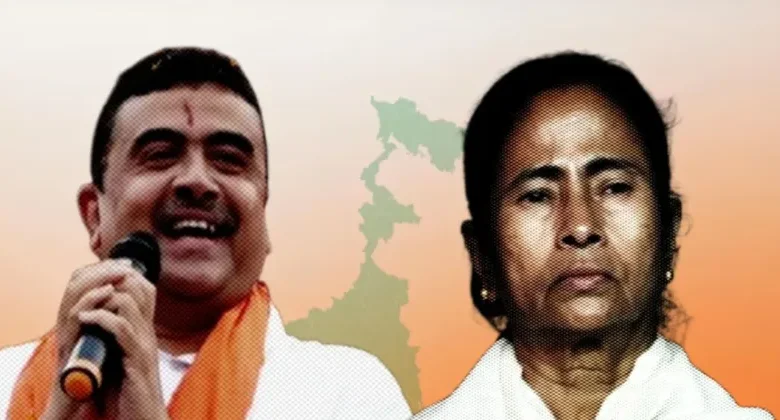
The battle for Bhabanipur, often called “Mini-India” due to its diverse population, was a heart-stopping thriller that mirrored the volatility of the state’s broader political landscape. The day began with Adhikari securing an early lead through postal ballots. As the morning progressed, Banerjee appeared to claw her way back, briefly overtaking Adhikari around the seventh round of counting.
At one point, the Chief Minister held a lead of over 19,000 votes, leading many TMC supporters to believe the bastion was secure. However, as the evening sun dipped over the Hooghly, the tide turned. By 6:30 PM, her lead had evaporated to a mere 2,900 votes. By 9:00 PM, Adhikari had surged ahead with an 11,000-vote cushion. When the final tally was verified, Suvendu Adhikari emerged victorious with a margin of 15,000 votes, completing a dual win as he also retained his influence in Nandigram.
How SIR cleaned the voter list
One of the most crucial factors in this defeat was the Special Intensive Revision (SIR) of electoral rolls. Ahead of the 2026 polls, between 47,000 and 51,000 names were deleted from Bhabanipur’s voter lists. The Election Commission maintained the deletions were necessary to remove duplicates and ineligible entries.
In a seat where winning margins had been steadily narrowing—from the landslide 2021 bypoll victory to a slimmer lead in the 2024 Lok Sabha elections—even a minor alteration in the voter pool was bound to be consequential. The SIR process effectively removed a significant chunk of the illegal electorate that had traditionally shielded Banerjee from anti-incumbency.
The Adhikari ‘Chakravyuh’: A Strategy of Social Arithmetic
The BJP did not leave Bhabanipur to chance. By fielding Suvendu Adhikari, the party turned the constituency into a “Chakravyuh” (an inescapable trap) for Banerjee. Backed by the symbolic presence of Union Home Minister Amit Shah during his nomination filing, Adhikari built his campaign on three pillars:
Booth-Level Social Arithmetic: Meticulous mapping of Bengali Hindu and Hindi-speaking communities.
Non-Muslim Consolidation: Ensuring a unified vote against the TMC’s perceived minority appeasement.
Personal Heft: Leveraging his reputation as the “giant killer” who had already defeated the CM once before.
By forcing Banerjee to fight for her life in her own backyard, the BJP successfully pinned her down, limiting her ability to campaign across the state while Adhikari projected a message of inevitable change.
The Shadow of RG Kar rape and murder case and governance fatigue
While the TMC relied heavily on its “welfare-first” model—highlighting schemes like Lakshmir Bhandar (monthly cash transfers for women), Kanyashree, and Swasthya Sathi—the results suggest that doles were no longer enough to mask deeper systemic issues.
The horrific RG Kar Medical College rape-murder case became a symbol of the state’s failure in women’s safety, severely denting Banerjee’s image among educated female voters. For many, the promise of a monthly stipend did not compensate for the lack of safety or the absence of job opportunities for their children.
This, combined with persistent allegations of “cut-money” culture, the “syndicate” system, and a general sense of 15-year governance fatigue, created a “fright” that was visible even during the campaign. Observers point to a pivotal moment when Banerjee walked off a stage in Bhabanipur after being disrupted by a nearby BJP rally, pleading with voters “if you can, vote for me”. To many, this was the first sign that the veteran politician knew her stronghold was crumbling.
For Mamata Banerjee, the loss in Bhabanipur is more than a seat lost; it is the end of an era of undisputed dominance in West Bengal. Her exit from the Bhabanipur stage mirrors her party’s exit from the state government.
For Suvendu Adhikari, the victory marks the completion of a personal mission. By defeating the Chief Minister in the seat she chose for her “rebirth” after Nandigram, he has cemented his status as the primary architect of the BJP’s rise in Bengal.