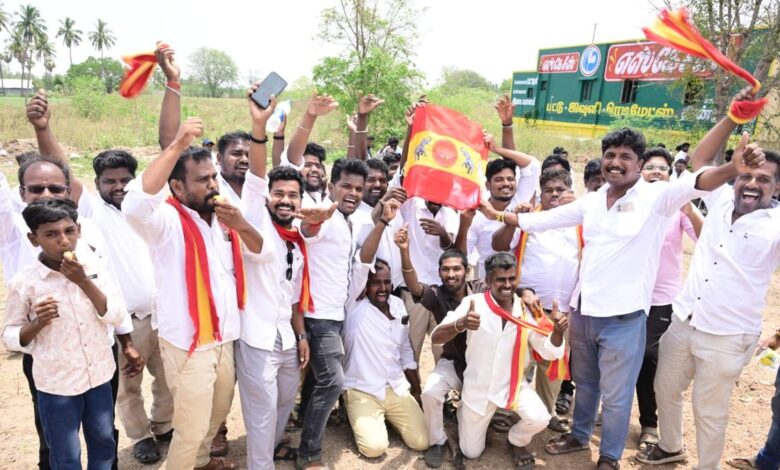
Chennai, May 4: Tamil Nadu’s political landscape is undergoing its most serious disruption in decades, as early trends from the Assembly election results indicate a decisive setback for the State’s traditional Dravidian heavyweights. The rise of C. Joseph Vijay and his Tamilaga Vettri Kazhagam (TVK) has pushed both the Dravida Munnetra Kazhagam and the All India Anna Dravida Munnetra Kazhagam into defensive positions, challenging a political order that has dominated for over five decades.
According to early counting data, TVK is leading in over 100 constituencies, inching close to the majority mark in the 234-member Assembly. The AIADMK is trailing in second place with around 65 seats, while the DMK has slipped to third with approximately 57 seats. The numbers alone signal more than a routine electoral swing—they point to a structural shift in voter behaviour.
At the centre of this disruption is a clear leadership crisis within the DMK. Chief Minister M. K. Stalin, who has held Kolathur since 2011, was trailing behind TVK’s V.S. Babu in early rounds of counting. “This is not just about one constituency. When a sitting Chief Minister struggles, it reflects a wider voter message,” said a senior political analyst based in Chennai.
The challenge extends across the DMK’s leadership bench. Deputy Chief Minister Udhayanidhi Stalin faced early setbacks in Chepauk-Thiruvallikeni, while senior ministers such as Duraimurugan in Katpadi, Ma. Subramanian in Saidapet, and K. N. Nehru in Tiruchi West were either trailing or locked in tight contests.
A DMK functionary, speaking on condition of anonymity, admitted, “There is clear anti-incumbency in pockets. We underestimated the scale of the challenge this time.”
The AIADMK, led by Edappadi K. Palaniswami, appears relatively more stable but lacks the momentum to mount a statewide challenge. Palaniswami himself maintained a comfortable lead in Edappadi. “We are holding our ground, but the vote split has changed the equation,” an AIADMK district-level leader said.
What makes this election particularly significant is the apparent breakdown of Tamil Nadu’s long-standing bipolar political system. For decades, power alternated between the DMK and AIADMK. The emergence of TVK as a dominant force disrupts this equilibrium, creating a triangular contest where the old rules no longer apply.
However, the shift cannot be explained by leadership failures alone. Voter expectations in Tamil Nadu are evolving, especially among younger and urban populations. Traditional reliance on welfare schemes, identity politics, and legacy leadership appears to be losing its exclusive hold.
“Voters are not rejecting Dravidian ideology outright they are demanding more accountability and visible leadership,” said a Chennai-based psephologist.
TVK has capitalised on this shift effectively. Candidates such as N. Anand in T. Nagar, Dr. T. Arunkumar in Tiruvallur, and M. Sathya in Krishnarayapuram have built constituency-level traction, indicating that the party’s performance is not solely dependent on Vijay’s personal popularity.
In a brief interaction with reporters earlier in the day, C. Joseph Vijay said, “This mandate is not about me. It reflects people’s desire for change and accountable governance.”
At the same time, several DMK leaders have struggled to retain their traditional vote bases. Ministers like P. Geetha Jeevan in Thoothukudi and T.R.B. Raja in Mannargudi faced strong challenges, while others saw their margins shrink significantly.
Another critical factor in the Dravidian parties’ decline is organisational fatigue. After returning to power in 2021, the DMK appeared to rely heavily on continuity rather than reinvention. The AIADMK, meanwhile, continues to deal with the after-effects of leadership uncertainty following the passing of J. Jayalalithaa.
A senior political observer summed it up bluntly: “DMK looked comfortable. AIADMK looked divided. TVK looked hungry. Elections are usually decided by hunger.”
Despite these developments, it would be premature to declare the end of Dravidian politics in Tamil Nadu. Both the DMK and AIADMK continue to command significant vote shares and maintain deep-rooted organisational networks.
“The system is not collapsing it is being forced to evolve,” the analyst added.
The 2026 election may ultimately be remembered as a turning point—not because Dravidian parties disappeared, but because they were compelled to confront a new political reality. The era of unquestioned dominance appears to be over.
For now, one conclusion is unavoidable: Tamil Nadu’s political landscape has changed, and the Dravidian parties are no longer in uncontested control.