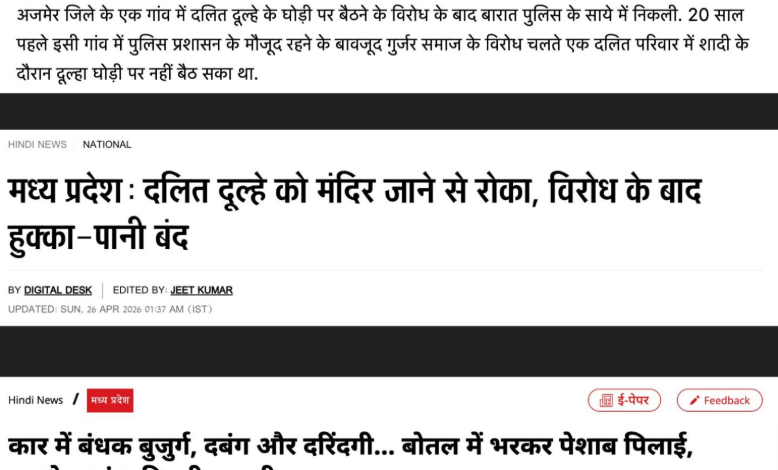
Headline 1: An elderly man held hostage in a vehicle – brutality and atrocity; forced to consume urine from a bottle: The complete account of the Raisen incident
Headline 2: Dalit groom prohibited from entering the temple; social boycott enforced after protest
Headline 3: Opposition to Dalit groom riding a horse during the wedding procession in Ajmer; baraat moves forward under strict police protection
You likely encounter such news regularly. Whether in Hindi or English media, these stories are everywhere. What immediate image forms in your mind? You assume the accused belong to the so-called “upper castes.”
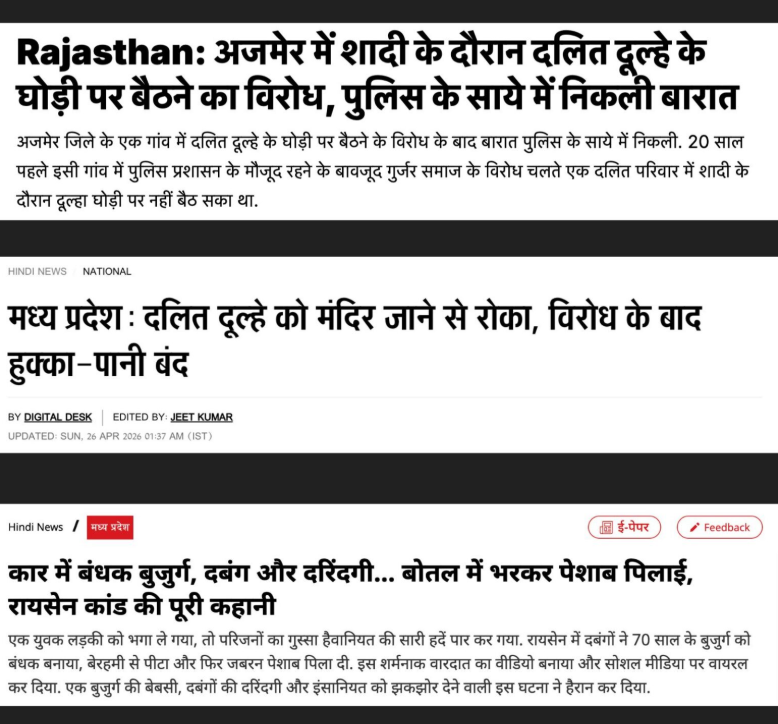
It is essential to briefly investigate the veracity of these three headlines prior to moving forward.
The reality of Headline 1
This event transpired in Raisen of Madhya Pradesh. It happened following the elopement of a young man with a minor girl from the village. Both are members of the Scheduled Tribes (ST) community.
The reality of Headline 2
The individuals that the Dalit couple accused of obstructing their entry into the temple are categorised as Other Backwards Class (OBC). The group that convened the Panchayat (village council) and imposed a social boycott on the pair also included members from Dalit families. This Panchayat was called after the Dalit groom used abusive language. According to the villagers, the temple doors were closed at the time of their arrival, and hence they were refused entry.
The reality of Headline 3
Lavera, situated in Ajmer, is the village where this incident took place and is primarily inhabited by Gujjars, who are categorised as OBC. No person from the upper castes of the area objected to the Dalit groom riding a mare during the procession nor did the Gujjars. This entire occurrence had no relation to caste whatsoever. Police were deployed as a preventive measure because of an incident that happened in the village 20 years ago.
For many years, the Indian media has systematically portrayed every such incident, whether it involves Scheduled Castes (SC) against SC, ST against ST, or Dalit against OBC, in a certain way. Their aim is to solidify leftist propaganda that whenever individuals from the SC, ST or OBC groups are perceived as victims, it should be presumed that the alleged offenders are from the so-called “upper castes.”
The animosity currently directed at the general category, along with phrases like “Down with Brahminism,” are direct outcomes of this agenda that the Indian media has been advocating for decades. This is exactly similar to how, if a Maulana, an Alim, or a Christian father engages in criminal activity, terms such as “Pujari” or “Priest” are intentionally used in the headlines to influence your perception. The images featured in these pieces are also chosen to create the impression that the accused is indeed a Hindu priest or sage.
Even when the caste identity of the individuals is not distinctly evident in the news, the media presents the headlines in such a way that it leads the reader to instinctively presume that the accused are part of the so-called “upper castes.” This issue transcends mere linguistics and embodies a well-established modus operandi within the Indian media for shaping narratives.
When the factual elements of a story correspond with the intended narrative, caste identity is disclosed openly. However, when it does not align or needs to be obscured, then terms like “strongman,” “youth,” “miscreants,” “mob,” or “members of a specific community” are invoked instead.
It is likely that you must have observed that when the offenders are from the Brahmin, Thakur or any other upper-caste community, multiple media outlets readily include this information in their headlines:
- Thakurs attacked Dalit youth
- Brahmin family harasses Dalit woman
- Upper-caste people did not permit entry into temple
We are not implying that such occurrences should go unreported. Nor do we propose that facts should be hidden in these cases. However, it becomes problematic when this same criterion is not employed for other incidents of a similar nature.
Every day, we come across news articles where, if the perpetrator is from an OBC, SC/ST, or a politically sensitive group, the media avoids mentioning their caste identity in the headlines. This is applicable whether the incidents pertain to honour killings, electoral violence or unrest provoked by religious factions.
Efforts are made to associate these incidents with upper castes by using terms like “Dabang” (strongman), or alternatively, the identities of these elements are concealed through vague descriptors such as “mob,” “specific community,” “friends,” or “locals.” On the contrary, the media promptly points out religious identity if the accused is a Hindu, even in matters of trivial disputes.
In any event, “Dabang” does not function as a designation for any particular group. Moreover, it is not a legal term utilised to define or classify a crime. It is, in fact, a term that often arises from bias rather than from actuality. An effort is made to evoke a specific social image in the reader’s perception via these descriptions.
The reader is misled to believe that the accused is probably a prominent individual from the neighbourhood, from the upper caste who enjoys political clout. Nevertheless, the truth is quite different, as the previously mentioned examples have already illustrated.
Now, the question is: What motivates the Indian media to partake in such practices? The main reason for this is the tight grip that the “Left-Liberal” cabal has over the mainstream media. They function within established ideological frameworks, through which every occurrence is filtered and portrayed as a fixed narrative of “oppressor versus victim,” a form of propaganda that is applied to every instance.
They intentionally avoid explicitly identifying certain communities. Moreover, journalists operating from air-conditioned newsrooms in urban areas often lack a true comprehension of the intricate social realities that exist on the ground. In addition, clickbait journalism plays a role in sustaining this narrative, as sensational language tends to attract greater engagement.
Consequently, readers are left with insufficient information about events. This leads to an increase in social mistrust. Issues at the grassroots level are neither properly recognised nor adequately addressed. Furthermore, the integrity of journalism is compromised. It is crucial that the caste or community identity of individuals is revealed only when it is pertinent to the event’s context.
For example, in a disagreement between two neighbours regarding a water pipe, it is inappropriate to refer to the victim as a “Dalit-Muslim” and the accused as a “Dominant-Caste Hindu” since the dispute did not arise from caste or religious issues. Therefore, the media should implement a policy that ensures that it clearly states the caste and religion of the accused in every instance, rather than selective revelations.
Ultimately, the fundamental role of journalism is to convey facts, not to construct social narratives or participate in appeasement. The nation is already filled with political parties that consider themselves the self-designated guardians of these agendas. Thus, journalism should not permit itself to be reduced to a mere tool in its hands.
Read the original report in Hindi here.