There was a time when sports sponsorships in India were largely about logo visibility. A brand appeared on a jersey, secured television airtime during matches and considered the job done. But that playbook is changing.
As the Indian Premier League increasingly evolves into a convergence point for sport, internet culture, creators, memes, communities and commerce, brands are no longer chasing visibility alone. They are trying to build participation. For sportswear brands especially, the equation is even more layered because credibility in sport matters as much as consumer attention.
The scale of the opportunity continues to grow. According to reports, IPL 2025 crossed one billion viewers across television and digital platforms, while digital consumption surpassed television viewership for the first time in the tournament’s history.
For Puma India, however, the IPL is not simply a seasonal visibility exercise. The brand has been associated with Royal Challengers Bengaluru (RCB) since 2021, when it became the franchise’s official kit partner. While Puma’s logo appears on the right sleeve of the RCB jersey, not necessarily the most high-visibility placement in a sponsorship-heavy IPL ecosystem, the partnership has evolved far beyond on-jersey branding and match-day visibility into a larger attempt at building a year-round cricket culture around the franchise.
According to Shreya Sachdev, Head of Marketing at Puma India, sponsorship today is less about logo placement and more about the ecosystem the brand builds around the franchise. “At Puma, sponsorship has never really been about logo visibility alone,” she says. “What matters far more is the access sponsorship gives us and how we activate that access.”
Building cricket culture, not seasonal campaigns
Sachdev says Puma’s long-term vision for RCB came from observing how global football clubs operate. The fandom around football clubs extends beyond match days and continues throughout the year through merchandise, community rituals, creator culture and fan-led engagement.
“That was the vision we had for cricket in India as well,” she explains. “RCB was the right partner because they’ve always built culture first, too, not just focused on performance on the field.”
That philosophy has steadily shaped Puma’s IPL marketing approach over the years. Instead of limiting campaigns to player-led communication or broadcast-heavy visibility, the brand has increasingly focused on community participation, fan-led storytelling and experiential engagement.
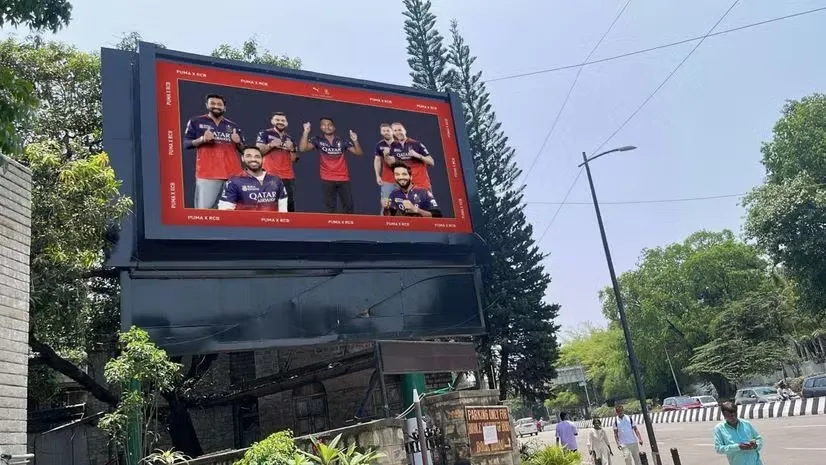
Last year, Puma launched ‘Fan on a Billboard’, a campaign that allowed consumers to click pictures at Puma stores and appear alongside RCB players on outdoor billboards. The campaign shifted the spotlight from players to fans, turning supporters themselves into the face of the brand’s IPL communication.
/socialsamosa/media/post_attachments/82fbccd1-717.png)
This year, the company built further on that idea with ‘RCB Everywhere’. The campaign stems from the observation that RCB fans were already carrying the jersey everywhere. From viral moments at the Kumbh Mela to internet-famous images of fans spotted wearing RCB jerseys in unexpected corners of the world, the jersey had already become an identifiable marker of internet fandom culture.
“The jersey was already everywhere, we simply wanted to become the brand that recognised and rewarded that behaviour,” Sachdev says.
The campaign invited fans to upload pictures and videos of themselves wearing RCB jerseys across locations globally, effectively turning existing fan behaviour into participative brand storytelling. According to Sachdev, the campaign has already seen fans take the jersey to over 25 countries.
But for Puma, the larger focus this season has been less about reach and more about participation-led engagement. To build that ecosystem, the brand launched an RCB broadcast channel on Instagram, which has already crossed 60,000 members. Voting and campaign participation happen directly through the channel, creating what Sachdev describes as “circularity” in engagement.
Consumers participating in the campaign also began creating their own reels, asking followers to vote for them, unintentionally expanding the campaign through peer-to-peer distribution.
“That creates far deeper engagement because audiences are not just consuming content, they’re actively participating in it,” she says.
The IPL media mix
For Puma, campaigns like RCB Everywhere are not designed around a single high-visibility platform. Instead, the brand approaches the IPL with a diversified, 360-degree media mix, as Sachdev explains.
“Going heavy on just one channel means you’re speaking to the same consumer in the same way repeatedly,” she says. “When you diversify the media mix, you reach different consumer groups and also engage the same consumer through multiple touchpoints and formats. That builds recall instead of irritation.”
As a result, ‘RCB Everywhere’ extends across multiple consumer touchpoints simultaneously. The campaign lives across Puma’s owned social media handles, RCB’s platforms, Instagram broadcast channels, marketing and meme pages, the Puma website and offline retail activations.
Sachdev says the idea is to make consumers encounter the campaign naturally across formats instead of forcing attention through repetition alone. “We believe recall is built when consumers encounter the same message across different formats and platforms,” she says.
Why Puma is shifting from influencers to consumers
While influencer-led IPL marketing continues to dominate social feeds during the tournament, Puma says it is consciously moving towards consumer-first storytelling instead of relying heavily on influencer-first communication.
For the brand, the shift reflects a larger change in internet culture itself. Sachdev believes the line between creators and consumers has increasingly blurred. “Today, everyone has a social media account and sees themselves as a creator in some way,” she says.
That thinking is visible in how Puma is approaching launches and fan activations. As part of the #RCBEverywhere campaign, the brand has been spotlighting contest participants on its own social channels every week, turning consumers into the face of the campaign rather than limiting visibility to established creators.
While Puma continues to seed products to influencers and public figures, a growing part of its strategy now revolves around rewarding consumers directly through access-led experiences, social features, match tickets and participation opportunities. While Puma continues to seed products to influencers and public figures, a growing part of its strategy now revolves around rewarding consumers directly through access-led experiences, social features, match tickets and participation opportunities.
According to Sachdev, consumers increasingly want access to the same ecosystem that was once largely reserved for influencers. “There’s a growing sentiment that influencers get all the rewards — free products, event access and exclusive experiences. Consumers want to be part of that ecosystem too,” she explains.
The strategy also taps into broader fandom-driven behaviour online. Puma observed fans organically visiting stores during merchandise drops and independently creating reels around the launches, several of which went on to generate millions of views.
For the brand, that organic participation signals a larger shift in how audiences now engage with campaigns. “We believe user-generated content is the next frontier. Consumers themselves are becoming brand ambassadors,” says Sachdev.
According to her, consumer-first content often travels further because audiences actively share it within their own communities and encourage others to participate. “This is something we want to double down on not just in cricket, but across categories, including lifestyle and running as well,” she adds.
Beyond social media, experiential marketing has also become a central part of Puma’s brand-building playbook. For the recent Superkicks x Palermo Jamun launch, the brand recreated the feeling of a ‘summer at nani’s house’, tying the product back to childhood nostalgia, jamun season and the carefree energy associated with Indian summers.
Similarly, earlier this year, Puma partnered with Myntra for a large-scale run club in Bengaluru to spotlight Myntra’s growing focus on sportswear. The early morning event drew close to 2,500 runners, turning the activation into both a fitness and community-led experience.
Sachdev says experiential marketing has steadily become integral to Puma’s overall strategy, with the IPL naturally amplifying those efforts because live cricket itself is inherently experiential.
“The excitement of watching a match live in the stadium already creates that ecosystem. During the IPL, our role is to build around that excitement and ensure we stay top of mind. That includes leveraging match tickets, meet-and-greets and access-led experiences,” she says.
Outside the tournament season, however, experiential becomes even more critical as Puma looks to keep cricket culture active throughout the year. The larger ambition, according to Sachdev, is to help build a year-round cricket fandom ecosystem in India, similar to the culture surrounding football globally.
Looking beyond the IPL
For Puma India, the IPL may be one of the brand’s biggest annual marketing properties, but the larger ambition is to build a year-round cricket culture around fandom and community.
“As a sports brand, you cannot claim to be authentic without investing in sport. That’s the backbone of who we are,” says Shreya Sachdev.
While the IPL remains central to Puma’s sports marketing strategy, Sachdev says the brand does not look at sport through an either-or lens. “A credible sports brand cannot invest in just one sport or one athlete,” she says, adding that diversification across sports and athletes remains equally important.