
The threat of a massive explosion from a ruptured tank in Garden Grove was eliminated Monday, but Orange County Fire Authority officials stopped short of allowing thousands of evacuated residents to return home due to lingering fears of a toxic chemical release.
As of Monday afternoon, an estimated 50,000 residents remained under an evacuation order as the crisis at the facility, GKN Aerospace, spilled into its fourth day.
“They have no idea when we’re gonna go home,” Jessica Doughty, 31, said Monday, three days after she and her partner were ordered to leave their Stanton home.
“We’re sitting here in the unknown … I just want to go home. I miss my bed,” said Doughty, who was staying at a Red Cross shelter in Anaheim.
Orange County officials said they were evaluating whether it was safe to reduce the evacuation zone to allow some of the displaced residents to go home.
Concerns remained that an explosion at the aerospace plant in Garden Grove was still possible, fire officials said.
Earlier in the day, there was good news for the crews who have been working around the clock to contain the situation. Orange County Fire Authority officials announced they were no longer worried about a worst-case scenario of a catastrophic explosion resulting from a breach of the tank, releasing toxic chemicals over a wide area.
TJ McGovern, interim chief of the Fire Authority, said firefighters had gained confidence the pressurized tank would not experience a “boiling liquid expanding vapor explosion,” or BLEVE.
“The threat of a BLEVE has been eliminated,” McGovern said, but added: “We still have threats that we are mitigating.”
Separately, President Trump authorized federal disaster assistance to help cover the costs of coordinating the response effort.
“We are grateful for the federal government approving our request and helping strengthen the resources already on the ground to help this community recover safely,” Gov. Gavin Newsom said in a statement.
More than 785 first responders and other emergency personnel, including firefighters, hazardous materials experts, public health officials and environmental scientists, have been mobilized since Friday, Newsom’s office said.
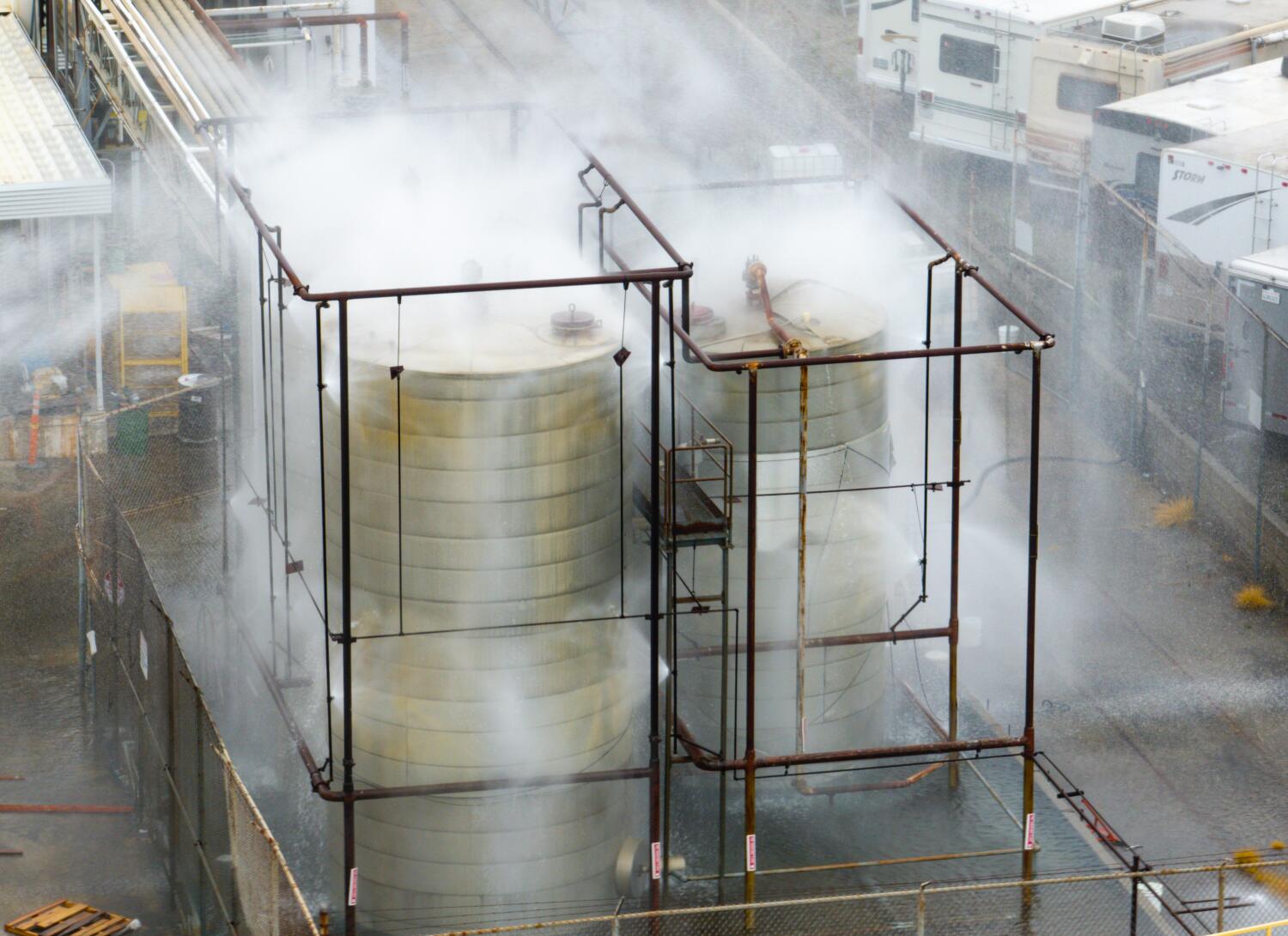
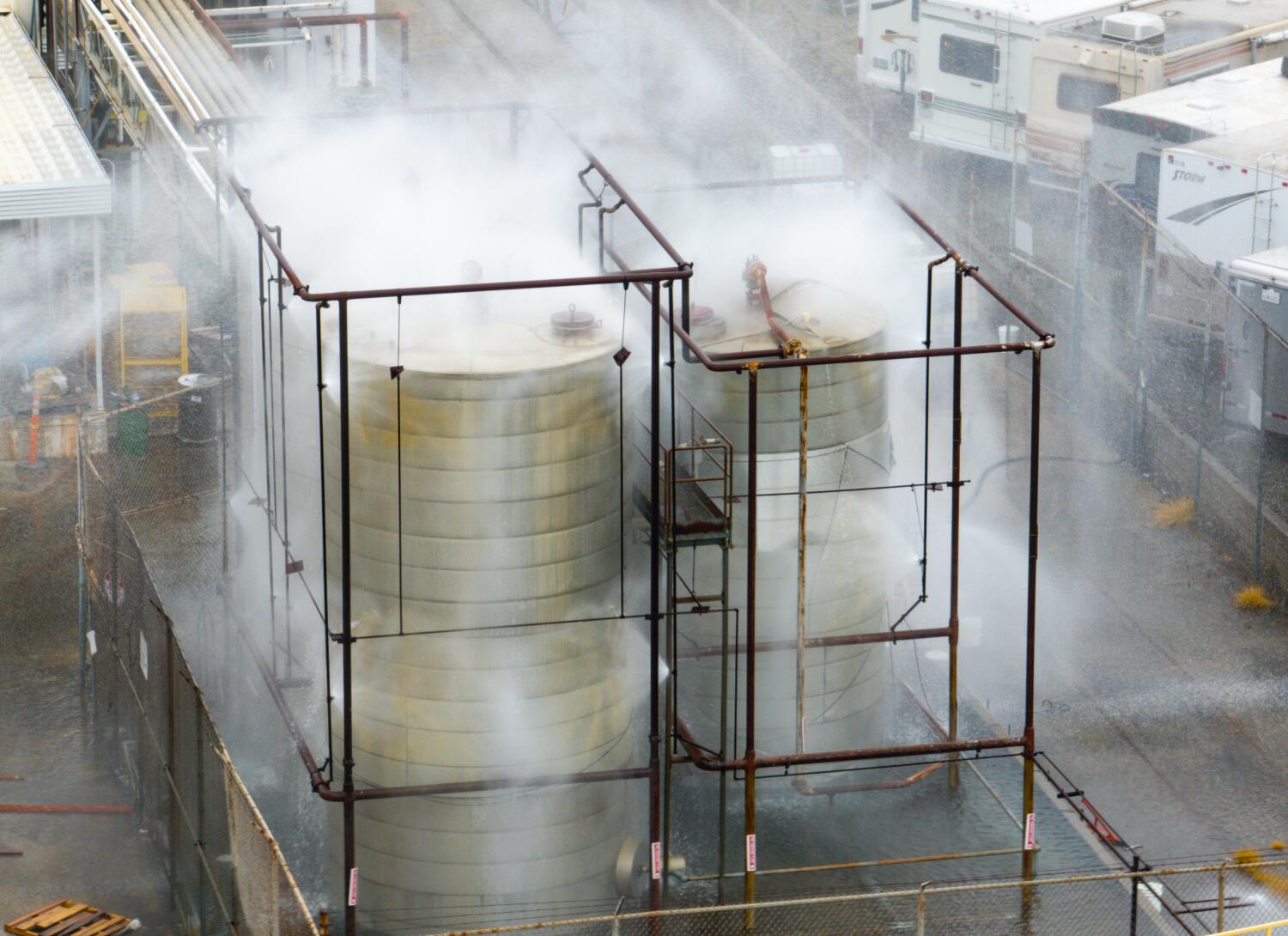
Firefighters were able to get a better handle on the situation after two overnight reconnaissance missions into the 15-acre manufacturing complex on the 12000 block of Western Avenue in Garden Grove.
Firefighters and the hazardous materials experts worked in collaboration with technicians from GKN Aerospace.
Late Saturday, the crews entered the facility to make a visual examination of the cracked container, which officials believed was holding 7,000 liquid gallons of methyl methacrylate, a chemical that is routinely used to make plastic.
The goal was to assess the integrity of the tank, McGovern said.
Hazardous materials technicians were able to confirm a single crack that night. The compromised container was one of three large tanks at the site containing the chemical.
While the crews were on the grounds, an alarm sounded, forcing a retreat, McGovern said during Monday’s briefing.
Nonetheless, “we got good intel” that allowed planning for the second night’s mission, McGovern said.
Late Sunday, the crews returned and were able to remove some of the tank’s insulation to get a more accurate reading of the temperature inside.
“The team safely and successfully removed external insulation material from the tank in order to help advance efforts to cool its contents,” GKN said in a statement. “This operation followed several days of careful monitoring and work to stabilize the tank.”
With the new information, the group was able to determine that temperatures had dropped and pressure was no longer building inside, McGovern said.
In a statement, state Sen. Tom Umberg (D-Orange) attributed “the courageous work of firefighters who were able to get on top of the tank and remove the shroud,” which allowed the emergency crews to better cool the contents.
Drones deployed earlier had been unable to read gauges showing the internal temperatures.
“There’s an internal temperature sensor, and the only way to read it is in person,” Orange County Fire Authority Capt. Wayhowe Huang told The Times outside of a command center at the Los Alamitos Race Course on Monday, near the perimeter of the evacuation zone.
“Of course it was a risky operation because of the possibility of explosion,” Huang said.
Temperature readings had been rising steadily over the weekend, reaching 100 degrees. Huang said the breakthrough came when firefighters were able strip the outer casing of the tank to allow for better cooling.
By late Monday, firefighters were still concerned the heat released by the chemical could still lead to a “less forceful explosion,” Huang said.
The chemical, known as MMA, is a flammable liquid widely used in the production of plastics, according the U.S. Environmental Protection Agency. If inhaled at high levels, fumes can aggravate a person’s lungs, causing coughing, wheezing and chest tightness. It can also cause nausea, dizziness and skin irritation.
“There’s still the worry of a thermal eruption of the tank,” Huang said. “Now the footprint of that would be smaller. … That threat is why we’re still holding those evacuation orders in place.”
Automated sprinklers at the facility have been running since the problem was detected on Thursday, and an additional unmanned hose has also been spraying down the tank.
GKN Aerospace, which is based in Britain, makes landing gears, jet engines and other materials for commercial and military aircraft at the Garden Grove facility.
“We are continuing to work around the clock with the OCFA, the EPA and all relevant federal, state and local agencies to mitigate the ongoing risk of a leak,” GKN said.
“We apologize for the ongoing disruption this incident is causing and our priority remains its safe resolution, so that residents can return to their homes as quickly as possible,” the company said, adding that it was “extremely grateful” for the efforts of the county, state and federal officials.
Orange County Dist. Atty. Todd Spitzer has opened a criminal investigation into the potential disaster. Legal “hold” letters have been sent to representatives of GKN Aerospace, demanding the company retain its records that could be relevant to the investigation, said Kimberly Edds, director of public affairs for Spitzer’s office.
The crisis began Thursday, when one of the tanks began to experience an increase in temperature, which triggered temporary evacuations.
At one point, the tank began to bulge, prompting fears among emergency workers of a potential BLEVE.
The company’s Garden Grove facility has undergone four inspections by the Occupational Safety and Health Administration since 2018, resulting in 10 violations, public records show.
The Red Cross has opened seven emergency shelters for people affected by the mandatory evacuations. The organization said thousands of meals and snacks have been provided. These operations have been supported by more than 100 Red Cross disaster workers.
“They’ve been doing a really good job — the Red Cross really came through,” said Edward Cho, 37, a cook who has been living with his 72-year-old mother, a cancer patient.
The pair were camped out in the basketball gymnasium at Savanna High School in Anaheim.
“People are taking care of each other,” Cho said. “It’s like poison gas is bringing people together. That’s a good story, right?”
Deputy managing editor Shelby Grad and staff writers Lisa Boone and Hailey Branson-Potts contributed to this report.